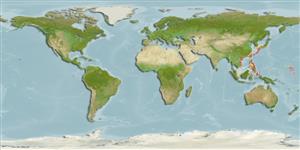
Environment: milieu / climate zone / depth range / distribution range
Ecology
Marine; reef-associated; depth range 0 - 15 m (Ref. 90102). Subtropical
Western Pacific: Ryukyu Islands, Japan and the northern Philippines, but not in Taiwan; to the south and east, it is replaced by Diancistrus atollorum.
Size / Weight / Age
Maturity: Lm ? range ? - ? cm
Max length : 7.0 cm SL male/unsexed; (Ref. 559)
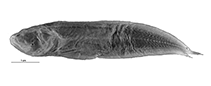
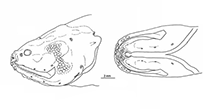
Dorsal spines (total): 0; Dorsal soft rays (total): 70 - 76; Anal spines: 0; Anal soft rays: 55 - 61; Vertebrae: 39 - 41. Diagnosis: This species is characterized by the following: vertebrae 11+28-30=39-41, dorsal fin rays 70-76, anal fin rays 55-61; eyes very small (<2.0% SL); outer pseudoclasper ear-lobe shaped, the half-moon shaped ear-lobe extension inwardly directed; inner pseudoclasper firmly joined to outer pseudoclasper anteriorly, with supporter, reduced small hook-like, often with a fleshy flap at its base; 5-7 rows of small scales on the upper cheek, no scales on operculum; head profile is slender; otolith length to height ratio <2.0 (Ref. 57884).
Body shape (shape guide): elongated; Cross section: compressed.
Rare species (Ref. 34024). Solitary inhabitant of coral reef crevices to at least 15m depth, cryptic (Ref 90102).
Life cycle and mating behavior
Maturity | Reproduction | Spawning | Eggs | Fecundity | Larvae
Nielsen, J.G., D.M. Cohen, D.F. Markle and C.R. Robins, 1999. Ophidiiform fishes of the world (Order Ophidiiformes). An annotated and illustrated catalogue of pearlfishes, cusk-eels, brotulas and other ophidiiform fishes known to date. FAO Fish. Synop. 125(18):178p. Rome: FAO. (Ref. 34024)
IUCN Red List Status (Ref. 130435: Version 2025-2)
Threat to humans
Harmless
Human uses
Fisheries: of no interest
Tools
Special reports
Download XML
Internet sources