Teleostei (teleosts) >
Siluriformes (Catfishes) >
Clariidae (Airbreathing catfishes)
Etymology: Heterobranchus: Greek, heteros = other + Greek, brangchia = gill (Ref. 45335).
Eponymy: George Albert Boulenger (1858–1937) was a Belgian-British zoologist at the British Museum, London. [...] (Ref. 128868), visit book page.
More on author: Pellegrin.
Environment: milieu / climate zone / depth range / distribution range
Ecology
Freshwater; demersal. Tropical
Africa: Lake Mweru system below Johnston Falls, including Mweru Wantipa (Ref. 78218), in Democratic Republic of the Congo and Zambia.
Size / Weight / Age
Maturity: Lm ? range ? - ? cm
Max length : 64.0 cm TL male/unsexed; (Ref. 270)
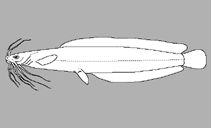
Dorsal spines (total): 0; Dorsal soft rays (total): 31 - 39; Anal soft rays: 46 - 50. Barbels short. Head spatulate in dorsal outline; snout rectangular and lower jaw extending beyond upper. Gill arches extended anteriorly. Suprabranchial organ well developed. Pectoral spine serrated on base of outer side. Openings of secondary sensory canals display a regular geometric pattern.
Body shape (shape guide): elongated; Cross section: circular.
Facultative air-breathing (Ref. 126274); Diet of adults consists of fishes. Juveniles feed on insect larvae and other invertebrates (Ref. 78218).
Life cycle and mating behavior
Maturity | Reproduction | Spawning | Eggs | Fecundity | Larvae
Teugels, G.G., B. Denayer and M. Legendre, 1990. A systematic revision of the African catfish genus Heterobranchus Geoffroy-Saint-Hilaire, 1809 (Pisces: Clariidae). Zool. J. Linn. Soc. 98:237-257. (Ref. 270)
IUCN Red List Status (Ref. 130435: Version 2025-2)
Threat to humans
Harmless
Human uses
Tools
Special reports
Download XML
Internet sources