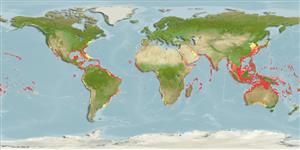
Environment: milieu / climate zone / Mức độ sâu / distribution range
Sinh thái học
Biển Cùng sống ở rạn san hô; Ở đại duơng, biển (Ref. 51243); Mức độ sâu 0 - 1000 m (Ref. 106604). Subtropical; 42°N - 38°S, 180°W - 180°E (Ref. 55255)
Circumglobal, tropical to temperate: in the Northern Hemisphere, as far north as southern California and Rhode Island on the United States west and east coasts, Mutsu Bay, Aomori, Japan, the Sinai Peninsula, Egypt and the Azores Islands; in the Southern Hemisphere, as far south as Peru, Uruguay, South Africa and New Zealand. In
some locations, including Mozambique, it is sympatric with Manta alfredi.
Length at first maturity / Bộ gần gũi / Khối lượng (Trọng lượng) / Age
Chín muồi sinh dục: Lm 422.0, range 380 - 460 cm
Max length : 910 cm WD con đực/không giới tính; (Ref. 58048); common length : 450 cm WD con đực/không giới tính; (Ref. 3176); Khối lượng cực đại được công bố: 3.0 t (Ref. 5377); Tuổi cực đại được báo cáo: 20 các năm (Ref. 31742)
A giant ray having an extremely broad head with long head fins, and a terminal mouth; upper surface of disc covered with denticles, and tail usually without a spine (Ref. 5578). Blackish above, sometimes with white shoulder patches; white below, with grey edging on disc (Ref. 5578). Tail whiplike but short (Ref. 7251).
Body shape (shape guide): other; Cross section: flattened.
Mainly in near-shore waters, near coral and rocky reefs; sometimes found over deep water (Ref. 12951). Reported along productive coastlines with regular upwelling, oceanic island groups and offshore pinnacles and seamounts (Ref. 82755). Penetrates shallow muddy bays and the intertidal and occurs off river mouths (Ref. 9911). Pelagic (Ref. 58302). Occurs singly or in loose aggregations (Ref. 12951). Mainly plankton feeders, but may feed on small and moderate-sized fishes as well (Ref. 9911). Leaps out the water mainly in spring and autumn, possibly as part of mating behavior (Ref. 31742). Easily approached (Ref. 9911). Ovoviviparous (Ref. 6902). Commonly caught by tuna gillnet and harpoon fisheries. Utilized for its gill filter plates (very high value), meat, cartilage and skin (Ref.58048). Liver yields oil and skin used as abrasive (Ref. 6902). World's largest ray (Ref. 37816).
Exhibit ovoviparity (aplacental viviparity), with embryos feeding initially on yolk, then receiving additional nourishment from the mother by indirect absorption of uterine fluid enriched with mucus, fat or protein through specialised structures (Ref. 50449). Bears up to 2 young (Ref. 5578); born at 122-127 cm WD (Ref.58048). A female of 550 cm width and weighing 1050 kg was collected in the Galapagos in June and was carrying a well-developed embryo of 12.7 kg (Ref. 28023). Size at partuition might be from 1.1 to 1.3 m and from 9.1 to 1.14 kg (Ref. 31742).
Yano et al (1999) (Ref. 35892) describe the mating behavior of manta rays based on observations off Ogasawara Islands, Japan, in the following sequence:
1) 'chasing', the male rapidly follows behind the tail of the female and attacks her several times;
2) 'nipping', the male nips the tip of the pectoral fin of the female and then moves to the ventral surface of the female;
3) 'copulating', the male inserts a clasper into the cloacaof the female and copulates abdomen-to-abdomen, up to 123 seconds;
4) 'post-copulating';
5) 'separating'. (Ref. 49562).
Last, P.R. and J.D. Stevens, 1994. Sharks and rays of Australia. CSIRO, Australia. 513 p. (Ref. 6871)
IUCN Red List Status (Ref. 130435: Version 2025-1)
Human uses
Các nghề cá: buôn bán nhỏ
Các công cụ
Special reports
Download XML
Các nguồn internet
Estimates based on models
Preferred temperature (Tài liệu tham khảo
123201): 22.8 - 29, mean 27.6 °C (based on 3220 cells).
Phylogenetic diversity index (Tài liệu tham khảo
82804): PD
50 = 0.5039 [Uniqueness, from 0.5 = low to 2.0 = high].
Bayesian length-weight: a=0.01000 (0.00244 - 0.04107), b=3.04 (2.81 - 3.27), in cm total length, based on all LWR estimates for this body shape (Ref.
93245).
Mức dinh dưỡng (Tài liệu tham khảo
69278): 3.5 ±0.50 se; based on food items.
Generation time: 7.3 ( na - na) years. Estimated as median ln(3)/K based on 2
growth studies.
Thích nghi nhanh (Tài liệu tham khảo
120179): Rất thấp, thời gian nhân đôi của chủng quần tối thiểu là hơn 14 năm (tm=6; tmax>20; Fec=1).
Fishing Vulnerability (Ref.
59153): High vulnerability (63 of 100).
🛈
Nutrients (Ref.
124155): Calcium = 2.4 [0.4, 10.8] mg/100g; Iron = 0.339 [0.080, 0.946] mg/100g; Protein = 23 [18, 28] %; Omega3 = 0.1 [0.0, 0.4] g/100g; Selenium = 26.2 [7.4, 97.2] μg/100g; VitaminA = 10.6 [3.1, 37.8] μg/100g; Zinc = 0.305 [0.144, 0.613] mg/100g (wet weight);