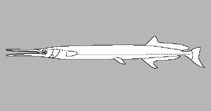
Teleostei (teleosts) >
Beloniformes (Needle fishes) >
Belonidae (Needlefishes)
Etymology: Potamorrhaphis: Greek, potamos = river + Greek, rhaphis = needle (Ref. 45335).
Eponymy: Dr James Arthur Peters (1922–1972) was a zoologist who specialised in Ecuadorean herpetofauna. [...] (Ref. 128868), visit book page.
Environment: milieu / climate zone / depth range / distribution range
Ecology
Freshwater; pelagic; depth range 0 - ? m. Tropical
South America: upper Orinoco and Negro River basins.
Size / Weight / Age
Maturity: Lm ? range ? - ? cm
Max length : 24.6 cm SL male/unsexed; (Ref. 40653)
Dorsal spines (total): 0; Dorsal soft rays (total): 37 - 43; Anal spines: 0; Anal soft rays: 32 - 39; Vertebrae: 77 - 85. Most similar to P. guianensis from which it differs most markedly in higher numbers of dorsal and anal fin rays, vertebrae, and predorsal scales. Predorsal scales 109-143, mean 130.5.
Oviparous (Ref. 205). Eggs may be found attached to objects in the water by tendrils on the egg's surface (Ref. 205).
Life cycle and mating behavior
Maturity | Reproduction | Spawning | Eggs | Fecundity | Larvae
Collette, B.B., 1982. South American freshwater needlefishes of the genus Potamorrhaphis (Beloniformes: Belonidae). Proc. Biol. Soc. Wash. 95(4):714-747. (Ref. 10994)
IUCN Red List Status (Ref. 130435: Version 2025-2)
Threat to humans
Harmless
Human uses
Tools
Special reports
Download XML
Internet sources