Teleostei (teleosts) >
Ophidiiformes (Cusk eels) >
Ophidiidae (Cusk-eels) > Neobythitinae
Etymology: Porogadus: Greek, poros = porous + Latin, gadus = a fish, cod? (Ref. 45335).
More on authors: Goode & Bean.
Environment: milieu / climate zone / depth range / distribution range
Ecology
Marine; bathydemersal; depth range 1000 - 5055 m (Ref. 34024). Deep-water
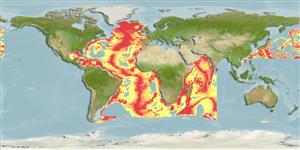
Cosmopolitan.
Size / Weight / Age
Maturity: Lm ? range ? - ? cm
Max length : 38.7 cm SL male/unsexed; (Ref. 125143)
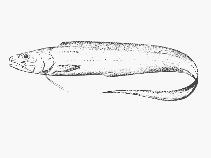
This species is distinguished by the following characters: precaudal vertebrae 17-19; first gill arch with long gill rakers 14-18; HL:HD 1.81-2.03; all head spines are strong, present on ethmoidal, lacrimal, prefrontal, interorbital, supraorbital, sphenotic, 5th infraorbital, supratemporal, inner and outer posttemporal, inner and outer preopercular rims; opercular spine is sharp, strong, extruding; maxilla with scales; small opercular flap with ridges; lower lateral line pores extend until beginning of anal fin 23-26; broad dentition patch on vomer (3-5 rows of teeth) and palatines (4-9 rows of teeth); otolith with separate ostial and caudal colliculi; OL:OH = 1.55-1.9; OL:TCL = 1.7-1.9 (Ref. 125143).
Cross section: compressed.
A benthopelagic species at bathyal and abyssal depth (Ref. 56809). Common species (Ref. 34024). Oviparous, with oval pelagic eggs floating in a gelatinous mass (Ref. 205).
Life cycle and mating behavior
Maturity | Reproduction | Spawning | Eggs | Fecundity | Larvae
Schwarzhans, W.W. and P.R. Møller, 2021. Revision of the ‘dragon-head’ cusk eels of the genus Porogadus (Teleostei: Ophidiidae), with description of eight new species and one new genus. Zootaxa 5029(1):001-096. (Ref. 125143)
IUCN Red List Status (Ref. 130435: Version 2025-2)
Threat to humans
Harmless
Human uses
Fisheries: of no interest
Tools
Special reports
Download XML
Internet sources