Teleostei (teleosts) >
Perciformes/Serranoidei (Groupers) >
Anthiadidae (Fairy basslets or Streamer basses)
Etymology: Hypoplectrodes: Greek, hypo = under + Greek, plektron = sting, spur + Greek, oides = similar (Ref. 45335).
Eponymy: Dr Barry Robert Wilson (1935–2017) was an Australian malacologist. [...] (Ref. 128868), visit book page.
Environment: milieu / climate zone / depth range / distribution range
Ecology
Marine; reef-associated; depth range 5 - 22 m (Ref. 33839). Temperate
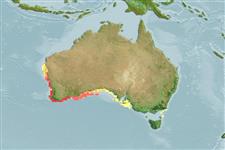
Eastern Indian Ocean: western Australia.
Size / Weight / Age
Maturity: Lm ? range ? - ? cm
Max length : 20.0 cm TL male/unsexed; (Ref. 33839)
Short description
Identification keys | Morphology | Morphometrics
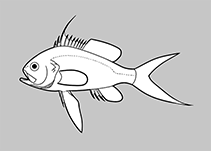
Dorsal spines (total): 10 - 11; Dorsal soft rays (total): 17 - 18; Anal spines: 3; Anal soft rays: 8. Pinkish brown to brownish orange, with six faint brown bands extending across body and several diffuse brown diagonal bands behind and in front of eyes on head; faint spotting also present in some individuals; fins pale (Ref. 33839).
Body shape (shape guide): fusiform / normal.
Occurs inshore (Ref. 7300), in caves and beneath ledges (Ref. 33839). Probably also at depths greater than 22 m (Ref. 33839). Secretive (Ref. 33839). Feeds on small fishes (Ref. 33839).
Life cycle and mating behavior
Maturity | Reproduction | Spawning | Eggs | Fecundity | Larvae
Gomon, M.F., C.J.M. Glover and R.H. Kuiter (eds.), 1994. The fishes of Australia's south coast. State Print, Adelaide. 992 p. (Ref. 33839)
IUCN Red List Status (Ref. 130435: Version 2025-2)
Threat to humans
Harmless
Human uses
Tools
Special reports
Download XML
Internet sources