Teleostei (teleosts) >
Beloniformes (Needle fishes) >
Belonidae (Needlefishes)
Etymology: Strongylura: Greek, strongylos = round + Greek, oura = tail (Ref. 45335).
Eponymy: Jules Sébastien César Dumont d’Urville (1790–1842) was a French naval officer who was also an explorer, botanist and cartographer. [...] (Ref. 128868), visit book page.
More on author: Valenciennes.
Environment: milieu / climate zone / depth range / distribution range
Ecology
Marine; brackish; pelagic-neritic; depth range 0 - 5 m (Ref. 86942). Tropical
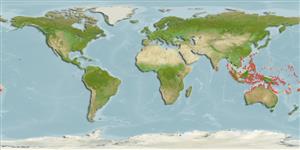
Western Pacific: waters of the East Indies, Philippines, and New Guinea east to the Solomon and Santa Cruz Islands. Reported from New Caledonia (Ref. 11889).
Size / Weight / Age
Maturity: Lm ? range ? - ? cm
Max length : 26.3 cm OT male/unsexed; (Ref. 9682); common length : 35.0 cm SL male/unsexed; (Ref. 9682)
Short description
Identification keys | Morphology | Morphometrics
Coastal species, sometimes entering brackish water (Ref. 9682). Feeds mainly on benthic invertebrates >2 mm (Ref. 11889). Oviparous (Ref. 205). Eggs may be found attached to objects in the water by tendrils on the egg's surface (Ref. 205).
Life cycle and mating behavior
Maturity | Reproduction | Spawning | Eggs | Fecundity | Larvae
Collette, B.B., 1999. Belonidae. Needlefishes. p. 2151-2161. In K.E. Carpenter and V.H. Niem (eds.) FAO species identification guide for fishery purposes. The living marine resources of the Western Central Pacific. Volume 4. Bony fishes part 2 (Mugilidae to Carangidae). FAO, Rome. (Ref. 9682)
IUCN Red List Status (Ref. 130435: Version 2025-2)
Threat to humans
Harmless
Human uses
Tools
Special reports
Download XML
Internet sources