Teleostei (teleosts) >
Perciformes/Serranoidei (Groupers) >
Serranidae (Sea basses: groupers and fairy basslets)
Etymology: Hypoplectrus: Greek, hypo = under + Greek, plektron = sting, spur (Ref. 45335).
More on author: Cuvier.
Environment: milieu / climate zone / depth range / distribution range
Ecology
Marine; reef-associated; depth range 3 - 23 m (Ref. 9710). Tropical
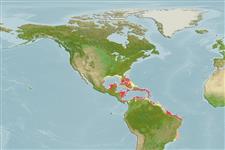
Western Central Atlantic: rare along the most of the continental western Caribbean, becoming occasional in the vicinity of Panama; Bahamas, Virgin Islands, Lesser Antilles, and islands off Venezuela. Absent from Florida, Marquesas Keys and the Dry Tortugas (USA); records from Texas, USA are almost certainly misidentified juveniles of Epinephelus sp.
Size / Weight / Age
Maturity: Lm ? range ? - ? cm
Max length : 15.0 cm TL male/unsexed; (Ref. 131872); max. published weight: 51.50 g (Ref. 131872)
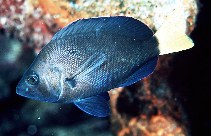
Body blackish in color (intensity of the black can vary from bluish to brownish). All fins pigmented. Pectoral fins rarely yellow. Caudal fin bright yellow.
Body shape (shape guide): short and / or deep.
A solitary species (Ref. 26340) found near the bottom of coral rich areas (Ref. 9710). Feeds on crustaceans and fishes (Ref. 26180).
Life cycle and mating behavior
Maturity | Reproduction | Spawning | Eggs | Fecundity | Larvae
Domeier, M.L., 1994. Speciation in the serranid fish Hypoplectrus. Bull. Mar. Sci. 54(1):103-141. (Ref. 26407)
IUCN Red List Status (Ref. 130435: Version 2025-2)
Threat to humans
Harmless
Human uses
Fisheries: commercial
Tools
Special reports
Download XML
Internet sources