>
Gobiiformes (Gobies) >
Gobiidae (Gobies) > Gobiinae
Etymology: Cryptocentrus: Greek, kryptos = hidden + Greek, kentron = sting (Ref. 45335).
Environment: milieu / climate zone / kisaran kedalaman / distribution range
Ekologi
laut berasosiasi dengan karang; kisaran kedalaman 5 - 20 m (Ref. 11441), usually 5 - 15 m (Ref. 9710). Tropical
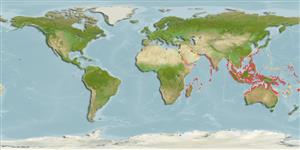
Indo-West Pacific: East Africa to Melanesia and the Great Barrier Reef.
Size / Weight / umur
Kematangan: Lm ? range ? - ? cm
Max length : 14.0 cm TL jantan/; (Ref. 9710)
deskripsi pendek
Kunci identifiaksi (pengenalan) | Morfologi | Morfometrik
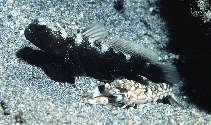
Duri punggung (Keseluruhan (total)) : 6 - 7; duri punggung lunak (Keseluruhan (total)) : 10; Duri dubur: 1; Sirip dubur lunak: 9. Mostly black with fine pale spotting or white saddles over top of head and back; sometimes yellow (Ref. 30404); further characterized by variable coloration ranging from yellow, entirely blackish, or barred or mottled; dorsal fins unmarked; barred variety with four brown saddles, head with white or bluish streaks, plain dorsal fins, pelvic fins with blue spots, blue stripe on anal fin; saddled variety dark brown color with whitish saddles on top of head and along back; head with small white or blue spots or streaks, pelvic fins with blue spots, blue stripes on anal fins; mottled variety with four diffuse brown bars on side; lower operculum with large brown blotch, head with white to bluish spots, strong mottling on back, anal fin with blue stripes; united pelvic fins, presence of frenum; longitudinal scale series 77-92; absence of scales on head except a few scales dorsally on opercle; greatest depth of body 5.5-5.8 in SL; rounded caudal fin, 3.2-3.8 in SL (Ref. 90102).
Body shape (shape guide): elongated; Cross section: circular.
Found on sand near patch reefs, usually in 5 m but to at least 15 m (Ref. 9710). Found in burrows with alpheid shrimps (Ref. 2334). Two individuals sometimes share a burrow, and these may be one of each color (Ref. 9360). Occurs in clear coastal and inner reef sand slopes, in small colonies in depth of 6-20 meters (Ref. 48637).
Life cycle and mating behavior
Kematangan | Reproduksi, perkembang biakan | Pemijahan | telur-telur | Fecundity | Larva
Randall, J.E., G.R. Allen and R.C. Steene, 1990. Fishes of the Great Barrier Reef and Coral Sea. University of Hawaii Press, Honolulu, Hawaii. 506 p. (Ref. 2334)
Status IUCN Red List (Ref. 130435: Version 2025-1)
ancaman kepada manusia
Harmless
penggunaan manusia
Perikanan: komersial; Akuarium: Komersial
Alat, peralatan
laporan khas
muat turun XML
Sumber internet
Estimates based on models
Preferred temperature (Acuan
123201): 25.4 - 29.3, mean 28.5 °C (based on 2738 cells).
Phylogenetic diversity index (Acuan
82804): PD
50 = 0.5000 [Uniqueness, from 0.5 = low to 2.0 = high].
Bayesian length-weight: a=0.00724 (0.00339 - 0.01546), b=3.10 (2.92 - 3.28), in cm total length, based on LWR estimates for this (Sub)family-body shape (Ref.
93245).
Trophic level (Acuan
69278): 3.4 ±0.4 se; based on size and trophs of closest relatives
Daya lenting (Acuan
120179): Tinggi, Waktu penggandaan populasi minimum kurang dari 15 bulan (Preliminary K or Fecundity.).
Fishing Vulnerability (Ref.
59153): Low vulnerability (10 of 100).
🛈
Nutrients (Ref.
124155): Calcium = 112 [52, 208] mg/100g; Iron = 0.692 [0.364, 1.320] mg/100g; Protein = 18 [16, 20] %; Omega3 = 0.0853 [, ] g/100g; Selenium = 24.1 [12.0, 51.6] μg/100g; VitaminA = 113 [30, 380] μg/100g; Zinc = 1.81 [1.19, 2.67] mg/100g (wet weight);