Environment: milieu / climate zone / depth range / distribution range
Ecology
Marine; brackish; demersal; depth range ? - 98 m (Ref. 89891). Subtropical; 43°N - 26°N, 98°W - 70°W
Western Atlantic: Massachusetts to Texas in the USA, except for southern Florida. Including Gulf of Mexico (Ref. 26938).
Size / Weight / Age
Maturity: Lm ? range ? - ? cm
Max length : 25.0 cm TL male/unsexed; (Ref. 7251); common length : 16.0 cm TL male/unsexed; (Ref. 3702)
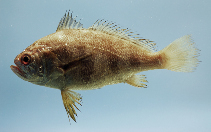
Dorsal spines (total): 11; Dorsal soft rays (total): 24 - 27; Anal spines: 2; Anal soft rays: 6 - 7. Colour greyish olive above, silvery white below. Back with 7 to 9 rather conspicuous dark vertical bars. Inside of opercle dark. Lower parts of pelvic fins, anal and caudal fins yellowish. A moderately small fish, body short and robust. Mouth large, strongly oblique, lower jaw projecting. Teeth very small and pointed, set in 1 or 2 rows along edges of jaws. Chin without barbels, but with 4 minute pores. Snout with 5 marginal pores and no rostral pores. Gas bladder simple, carrot-shaped, without anterior appendages. Sagitta (Large earstone) short but very thick (Ref 51721).
Body shape (shape guide): fusiform / normal.
Occurs usually over mud and sandy mud bottoms in coastal waters to about 60 m depth, more rarely in estuaries. Feeds mainly on small shrimps.
Life cycle and mating behavior
Maturity | Reproduction | Spawning | Eggs | Fecundity | Larvae
Robins, C.R. and G.C. Ray, 1986. A field guide to Atlantic coast fishes of North America. Houghton Mifflin Company, Boston, U.S.A. 354 p. (Ref. 7251)
IUCN Red List Status (Ref. 130435: Version 2025-2)
Threat to humans
Harmless
Human uses
Fisheries: of no interest; bait: usually
Tools
Special reports
Download XML
Internet sources