Environment: milieu / climate zone / depth range / distribution range
Ecology
Marine; demersal; depth range ? - 35 m (Ref. 26912). Subtropical; 28°N - 4°N, 98°W - 51°W
Western Atlantic: eastern Florida (USA), throughout the Antilles and along the Caribbean coast from the Bay of Campeche (Mexico) to Guianas.
Size / Weight / Age
Maturity: Lm ? range ? - ? cm
Max length : 26.0 cm TL male/unsexed; (Ref. 3702); common length : 22.0 cm TL male/unsexed; (Ref. 3702)
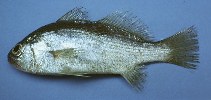
Dorsal spines (total): 11; Dorsal soft rays (total): 21 - 24; Anal spines: 2; Anal soft rays: 7 - 8. Colour grey or greyish blue on back, silvery below. Sides with faint streaks, oblique above and longitudinal below lateral line. Fins pale, yellowish, dusted with dark spots. A faint dark spot at pectoral-fin origin. Mouth moderate in size, slightly oblique, terminal. Preopercular margin thin, nearly smooth. Anal fin second spine moderately strong, less than 2/3 the length of first soft ray. Gas bladder with 2 chambers; anterior one yoke-shaped, without appendages on posterior margin, posterior one carrot-shaped. Lapillus (small earstone) enlarged, more than half the size of sagitta (Ref 51721).
Body shape (shape guide): fusiform / normal.
Common over muddy and sandy bottoms in inshore waters. Juveniles are also found in rocky areas. Feeds mainly on shrimps. Seldom marketed as a food fish; mostly used as bait (Ref. 3702).
Life cycle and mating behavior
Maturity | Reproduction | Spawning | Eggs | Fecundity | Larvae
Robins, C.R. and G.C. Ray, 1986. A field guide to Atlantic coast fishes of North America. Houghton Mifflin Company, Boston, U.S.A. 354 p. (Ref. 7251)
IUCN Red List Status (Ref. 130435: Version 2025-2)
Threat to humans
Harmless
Human uses
Fisheries: minor commercial; bait: usually
Tools
Special reports
Download XML
Internet sources