Teleostei (teleosts) >
Osteoglossiformes (Bony tongues) >
Mormyridae (Elephantfishes)
Etymology: Petrocephalus: Latin, petra = stone + Greek, kephale = head (Ref. 45335).
More on authors: Whitehead & Greenwood.
Environment: milieu / climate zone / depth range / distribution range
Ecology
Freshwater; demersal. Tropical
Size / Weight / Age
Maturity: Lm ? range ? - ? cm
Max length : 15.2 cm TL male/unsexed; (Ref. 52331)
Short description
Identification keys | Morphology | Morphometrics
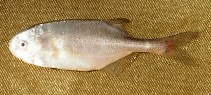
Dorsal spines (total): 0; Dorsal soft rays (total): 22 - 27; Anal spines: 0; Anal soft rays: 26 - 29. Diagnosis: Body depth 25.7-35.6% of standard length; predorsal length 57.4-64.5% of standard length; dorsal fin length 16.7-22.2% of standard length; anal fin length 21.4-25.7% of standard length; distance dorsal fin to end of caudal peduncle 42.7-47.2% of standard length; depth of caudal peduncle 29.1-43.9% of its length; 22-27 dorsal fin rays (Ref. 91771).
Body shape (shape guide): fusiform / normal.
Life cycle and mating behavior
Maturity | Reproduction | Spawning | Eggs | Fecundity | Larvae
Kramer, B., R. Bills, P. Skelton and M. Wink, 2012. A critical revision of the churchill snoutfish, genus Petrocephalus Marcusen, 1854 (Actinopterygii: Teleostei: Mormyridae), from southern and eastern Africa, with the recognition of Petrocephalus tanensis, and the description of five new species. Journal of Natural History 46(35-36):2179-2258. (Ref. 91771)
IUCN Red List Status (Ref. 130435: Version 2025-2)
Threat to humans
Harmless
Human uses
Tools
Special reports
Download XML
Internet sources