>
Siluriformes (Catfishes) >
Mochokidae (Squeakers or upside-down catfishes) > Mochokinae
Etymology: Synodontis: Greek, syn, symphysis = grown together + Greek, odous = teeth (Ref. 45335).
More on authors: Bloch & Schneider.
Environment: milieu / Zona climática / intervalo de profundidade / distribution range
Ecologia
; Água doce bentopelágico; pH range: 6.0 - 8.0; dH range: ? - 30; potamódromo (Ref. 51243). Tropical; 22°C - 28°C (Ref. 2060)
Africa: found practically in all basins of West Africa, except for the coastal basins of Guinea, Sierra Leone and Liberia (Ref. 57223), but including Senegal, Gambia, Volta, Niger and Chad basins (Ref. 3202), and Cross River in Nigeria (Ref. 81251). Also Nile basin downstream of Murchison Falls, including Lake Albert (Ref. 28714, 78218); Lake Turkana (Ref. 52331, 78218); and Ethiopian lakes Abaya and Chew Bahir [= Stephanie] (Ref. 78218). Also reported from Uebi Guiba (Uebi Shebeli) (Ref. 3202). Reports from Athi and Tana rivers are misidentifications probably refering to Synodontis zanzibaricus (Ref. 52331).
Comprimento de primeira maturação / Tamanho / Peso / Idade
Maturidade: Lm 19.7, range 12 - 17 cm
Max length : 40.0 cm TL macho/indeterminado; (Ref. 126422); peso máx. publicado: 584.00 g (Ref. 126422); idade máx. registrada: 12 anos (Ref. 72479)
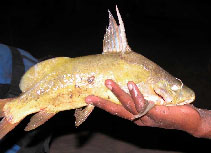
Espinhos dorsais (total) : 1; Raios dorsais (total) : 6 - 7; Espinhos anais: 0. Diagnosis: gill slits not extending ventrally beyond pectoral-fin insertions (Ref. 28714, 57223). Body long, its depth 20-29% of SL (Ref. 28714). Post-orbital length at least 60% of snout length (Ref. 57223, 81251). Eye contained 1.75-2.25 times in interorbital width (Ref. 4903). Maxillary barbels longer than head (Ref. 57223, 81251) but not reaching to pelvic fins (Ref. 57223), unbranched and without tubercles (Ref. 57223, 81251) or distinct basal membrane (Ref. 28714, 57223, 81251). Outer mandibular barbels with few, rather short and simple ramifications (Ref. 57223, 81251). Branches of inner mandibular barbels few, short, simple and tuberculate (Ref. 57223, 81251), at least the anterior ones (Ref. 57223). Mandibular teeth moderately developed (Ref. 57223), movable (Ref. 81251), numbering 24-39 (Ref. 57223, 81251). Entire margin of opercle smooth (Ref. 81251). Dorsal- and pectoral-fin spines straight (Ref. 57223). Pectoral spines strongly serrated with twice the number of serrations along anterior edge than posterior edge (Ref. 81251), denticulations weaker on outer than on inner margin (Ref. 4903, 57223). Dorsal spine prolonged by a short filament (Ref. 81251), smooth anteriorly (Ref. 57223, 81251) except for a few apical denticles (Ref. 57223), and few serrations along posterior edge (Ref. 81251). However, large individuals may also have a weak denticulation on lower half of spine (Ref. 57223). Humeral process pointed and granulose, slightly keeled ventrally (Ref. 57223, 81251), its depth contained 1.8-2 times in its length (Ref. 4903), its posterior tip not or just reaching a point beneath the dorsal fin spine (Ref. 28714). Adipose fin well developed (Ref. 57223, 81251), high, rather close to rayed dorsal fin (Ref. 57223), not rayed (Ref. 28714). Body uniformly coloured or spotted body brownish dorsally, whitish ventrally (juveniles with white markings and black spots); caudal fin without single dark patch at base of each fin lobe (Ref. 81251). Maxillary barbels white or beige; outer margins of caudal-fin lobes more or less dark (Ref. 57223).
Body shape (shape guide): fusiform / normal.
Maximum TL was recorded at 47.0 cm (Ref. 57223). Omnivore, feeds on insect larvae (Ref. 13868) (especially chironomids, Ref. 28714), nymphs, eggs and detritus (Ref. 13868). Also feeds on molluscs (predominantly, Ref. 4903), fish, bivalves in the Sudd and snails in Gezira irrigation canals (Ref. 28714). Oviparous (Ref. 205). Breeding occurs during the flood season (Ref. 28714). Utilized for human consumption.
Oviparous (Ref. 205). Distinct pairing during breeding (Ref. 205).
Paugy, D. and T.R. Roberts, 2003. Mochokidae. p. 195-268 In C. Lévêque, D. Paugy and G.G. Teugels (eds.) Faune des poissons d'eaux douce et saumâtres de l'Afrique de l'Ouest, Tome 2. Coll. Faune et Flore tropicales 40. Musée Royal de l'Afrique Centrale, Tervuren, Belgique, Museum National d'Histoire Naturalle, Paris, France and Institut de Recherche pour le Développement, Paris, France. 815 p. (Ref. 57223)
Status na Lista Vermelha da UICN (Ref. 130435: Version 2025-1)
Ameaça para os humanos
Harmless
Uso pelos humanos
Pescarias: espécies comerciais; peixe esportivo: sim
Ferramentas
Relatórios especiais
Baixar XML
Fontes da internet
Estimates based on models
Índice de diversidade filogenética (Ref.
82804): PD
50 = 0.5000 [Uniqueness, from 0.5 = low to 2.0 = high].
Bayesian length-weight: a=0.01585 (0.01274 - 0.01972), b=2.89 (2.84 - 2.94), in cm total length, based on LWR estimates for this species (Ref.
93245).
Nível Trófico (Ref.
69278): 2.9 ±0.37 se; based on food items.
Resiliência (Ref.
120179): médio(a), tempo mínimo de duplicação da população 1,4 - 4,4 anos (K=0.10-0.54; tmax=3; Fec=64,273).
Fishing Vulnerability (Ref.
59153): Low vulnerability (20 of 100).
🛈
Nutrients (Ref.
124155): Calcium = 115 [56, 220] mg/100g; Iron = 1.53 [0.87, 2.66] mg/100g; Protein = 16.5 [15.3, 17.7] %; Omega3 = 0.519 [0.186, 1.468] g/100g; Selenium = 122 [48, 309] μg/100g; VitaminA = 28.5 [10.1, 77.5] μg/100g; Zinc = 1.85 [1.22, 2.69] mg/100g (wet weight);