



Beobachtung melden im Fish Watcher
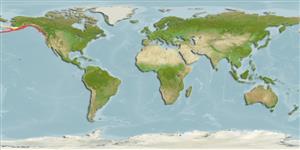
| Native range | All suitable habitat | Point map | Year 2050 |
|
| This map was computer-generated and has not yet been reviewed. |
| Sebastes proriger AquaMaps Data sources: GBIF OBIS |
Hochladen Photos und videos
Bilder | Google Bild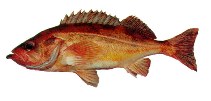 Sebastes proriger
Photo von Archipelago Marine Research Ltd.
Bilder | Google Bild
Photo von Archipelago Marine Research Ltd.
Klassifizierung / Names Namen | Synonyme | Catalog of Fishes(Gattung, Arten) | ITIS | CoL | WoRMS | Cloffa
> Perciformes/Scorpaenoidei (Scorpionfishes) > Sebastidae (Rockfishes, rockcods and thornyheads) > Sebastinae
Etymology: Sebastes: Greek, sebastes = august, venerable (Ref. 45335); proriger: From the Latin prora and gero, meaning 'bow' and 'to bear' (Ref. 27436).
More on authors: Jordan & Gilbert.
Etymology: Sebastes: Greek, sebastes = august, venerable (Ref. 45335); proriger: From the Latin prora and gero, meaning 'bow' and 'to bear' (Ref. 27436).
More on authors: Jordan & Gilbert.
Umwelt: Milieu / Klimazone / Tiefenbereich / Verbreitungsgebiet Ökologie
seewasser bathydemersal; tiefenbereich 12 - 425 m (Ref. 6793), usually 183 - 274 m (Ref. 27437). Deep-water; 66°N - 32°N, 177°E - 116°W
Verbreitung Territorien | FAO Gebiete | Ökosysteme | Vorkommen | Punkt Karte | Einführungen | Faunafri
North Pacific: Pribilof Canyon in the Bering Sea and Amchitka Island in the Aleutian chain to San Diego, California, USA.
Größe / Gewicht / Alter
Geschlechtsreife: Lm ? range ? - ? cm
Max length : 61.0 cm TL Männchen/unbestimmt; (Ref. 27437); max. veröff. Alter: 55 Jahre (Ref. 39247)
Max length : 61.0 cm TL Männchen/unbestimmt; (Ref. 27437); max. veröff. Alter: 55 Jahre (Ref. 39247)
Kurzbeschreibung Bestimmungsschlüssel | Morphologie | Morphometrie
Rückenflossenstacheln (insgesamt) : 13; Rückenflossenweichstrahlen (insgesamt) : 13 - 15; Afterflossenstacheln: 3; Afterflossenweichstrahlen: 6 - 7. Head spines weak - nasal, preocular, postocular, tympanic and parietal spines present, supraocular, coronal and nuchal spines absent (Ref. 27437). Notch on dorsal fin shallow; 2nd anal fin spine is of the same length or shorter than the 3rd (Ref. 27437). Caudal fin moderately indented (Ref. 6885). Light red and mottled with olive on back, lower sides flushed with yellow; light red stripe along lateral line; lips blackened; fins red with some light green or yellow (Ref. 27437).
Body shape (shape guide): fusiform / normal.
Body shape (shape guide): fusiform / normal.
Occur in areas where rocky reefs and steep silt-covered cliff faces meet gently sloping sand or mud bottoms (Ref. 27436). Found hovering just off the bottom or resting on a rocky perch (Ref. 27436). Viviparous (Ref. 34817). Sold as fresh or frozen fillets, together with other rockfish species (Ref. 27436). Not popular as a game fish (Ref. 27436).
Lebenszyklus und Paarungsverhalten Geschlechtsreife | Fortpflanzung | Ablaichen | Eier | Fruchtbarkeit | Larven
Hauptreferenz
Laden Sie Ihre Referenzen hoch | Referenzen | Koordinator | Partner
Eschmeyer, W.N., E.S. Herald and H. Hammann, 1983. A field guide to Pacific coast fishes of North America. Boston (MA, USA): Houghton Mifflin Company. xii+336 p. (Ref. 2850)
CITES
Not Evaluated
Bedrohung für Menschen
Harmless
Nutzung durch Menschen
Fischereien: kommerziell; Sportfisch: ja
FAO - Publication: search | FishSource |
Mehr Information
Trophische Ökologie
Lebensmittel (Beutetiere)
Nahrungszusammensetzung
Nahrungsaufnahme
Lebensmittelrationen
Räuber
Lebensmittel (Beutetiere)
Nahrungszusammensetzung
Nahrungsaufnahme
Lebensmittelrationen
Räuber
Populationsdynamik
Wachstumsparameter
Max. Alter/Größen
Länge-Gewicht-Rel.
Länge-Länge-Verhältnis.
Längenhäufigkeiten
Massenkonvertierung
Rekrutierung
Dichte
Wachstumsparameter
Max. Alter/Größen
Länge-Gewicht-Rel.
Länge-Länge-Verhältnis.
Längenhäufigkeiten
Massenkonvertierung
Rekrutierung
Dichte
Anatomie
Kiemenoberfläche
Gehirn
Otolith
Kiemenoberfläche
Gehirn
Otolith
Physiologie
Körperliche Zusammensetzung
Nährstoffe
Sauerstoffverbrauch
Schwimmart
Schwimmgeschwindigkeit
Visuelle Pigmente
Fischgeräusche
Krankheiten und Parasiten
Toxizität (LC50s)
Körperliche Zusammensetzung
Nährstoffe
Sauerstoffverbrauch
Schwimmart
Schwimmgeschwindigkeit
Visuelle Pigmente
Fischgeräusche
Krankheiten und Parasiten
Toxizität (LC50s)
Genetik
Genom
Genetik
Heterozygotie
Vererbbarkeit
Genetische Vielfalt
Genom
Genetik
Heterozygotie
Vererbbarkeit
Genetische Vielfalt
Menschenbezogen
Aquakultur-Systeme
Aquakultur Profile
Zuchtlinien
Ciguatera-Fälle
Briefmarken, Münzen, Verschiedenes.
Aquakultur-Systeme
Aquakultur Profile
Zuchtlinien
Ciguatera-Fälle
Briefmarken, Münzen, Verschiedenes.
Tools
Zusatzinformationen
Download XML
Zusammenfassung | Punktdaten | Namen | Photos
Internet Quellen
AFORO (otoliths) | Aquatic Commons | BHL | Cloffa | Websites from users | FishWatcher Einträge suchen | CISTI | Catalog of Fishes: Gattung, Arten | DiscoverLife | ECOTOX | FAO - Publication: search | Faunafri | Fishipedia | Fishtrace | GloBI | Google Books | Google Scholar | Google | IGFA World Record | OceanAdapt | OneZoom | Open Tree of Life | Otolith Atlas of Taiwan Fishes | PubMed | Reef Life Survey | RFE Bestimmung | Socotra Atlas | TreeBase | Tree of Life | Wikipedia: Gehe zu, Suchen | World Records Freshwater Fishing | Zoologischer Rekord
Schätzungen auf der Grundlage von Modellen
Bevorzugte Temperatur (Ref. 123201): 3.7 - 6.6, mean 5.4 °C (based on 51 cells).
Phylogenetischer Diversitätsindex (Ref. 82804): PD50 = 0.5000 [Uniqueness, from 0.5 = low to 2.0 = high].
Bayesian length-weight: a=0.01000 (0.00490 - 0.02040), b=3.09 (2.92 - 3.26), in cm total length, based on LWR estimates for this Genus-body shape (Ref. 93245).
Trophische Ebene (Ref. 69278): 3.8 ±0.5 se; based on size and trophs of closest relatives
Generation time: 7.4 ( na - na) years. Estimated as median ln(3)/K based on 2 growth studies.
Widerstandsfähigkeit (Ref. 120179): niedrig, Verdopplung der Population dauert 4,5 - 14 Jahre. (K=0.15-0.18; tmax=55).