Klassifizierung / Names
Namen | Synonyme | Catalog of Fishes(Gattung, Arten) | ITIS | CoL | WoRMS | Cloffa
>
Gobiiformes (Gobies) >
Gobiidae (Gobies) > Gobionellinae
Etymology: Redigobius: Latin,. Redere = to come back + Latin, gobius = gudgeon.
More on author: Larson.
Environment: milieu / climate zone / Tiefenbereich / distribution range
Ökologie
; süßwasser; brackwasser demersal. Tropical
Oceania: Northern Australia and New Guinea.
Size / Gewicht / Alter
Geschlechtsreife: Lm ? range ? - ? cm
Max length : 2.2 cm SL Männchen/unbestimmt; (Ref. 84480)
Kurzbeschreibung
Bestimmungsschlüssel | Morphologie | Morphometrie
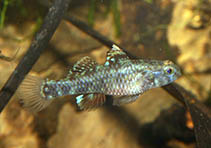
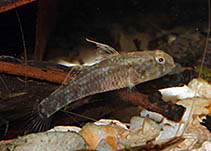
Rückenflossenweichstrahlen (insgesamt) : 7; Afterflossenstacheln: 1; Afterflossenweichstrahlen: 6. Distinguished by the following characteristics: small, less than 3 cm SL when adult; indistinct lateral dark speckling and dorsal saddles; scale margins narrowly outlined with dark brown; bright pale blue flecks and spots over brown markings on head, body and fins; first dorsal fin pointed, first spine elongate and pale-coloured in males; first or second spine longest in females but never elongate; second dorsal rays I,7; anal rays I,6; pectoral rays 16-17; longitudinal scales 20-25; TRB 7-10; predorsal scales 6-10; circumpeduncular scales 12 (Ref. 84480).
Found in mangroves, among rock and mangroves or in muddy of sandy-muddy estuarine habitats (Ref. 84480).
Life cycle and mating behavior
Geschlechtsreife | Fortpflanzung | Ablaichen | Eier | Fecundity | Larven
Larson, H.K., 2010. A review of the gobiid fish genus Redigobius (Teleostei: Gobionellina), with descriptions of two new species. Ichthyol. Explor. Freshwat. 21(2):123-191. (Ref. 84480)
IUCN Rote Liste Status (Ref. 130435: Version 2025-1)
Bedrohung für Menschen
Harmless
Nutzung durch Menschen
Tools
Zusatzinformationen
Download XML
Internet Quellen
Estimates based on models
Phylogenetic diversity index (Ref.
82804): PD
50 = 0.5000 [Uniqueness, from 0.5 = low to 2.0 = high].
Bayesian length-weight: a=0.00724 (0.00338 - 0.01553), b=3.05 (2.87 - 3.23), in cm total length, based on LWR estimates for this (Sub)family-body shape (Ref.
93245).
Trophic level (Ref.
69278): 3.1 ±0.4 se; based on size and trophs of closest relatives
Widerstandsfähigkeit (Ref.
120179): hoch, Verdopplung der Population dauert weniger als 15 Monate. (Preliminary K or Fecundity.).
Fishing Vulnerability (Ref.
59153): Low vulnerability (10 of 100).
🛈