This website uses cookies to enhance your browsing experience and ensure the functionality of our site. For more detailed information about the types of cookies we use and how we protect your privacy, please visit our Privacy Information page.
×
Cookie Settings
This website uses different types of cookies to enhance your experience. Please select your preferences below:
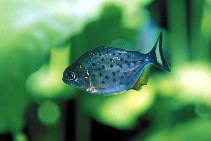
Pygocentrus nattereri, Red piranha : fisheries, gamefish, aquarium
> Characiformes (Characins) > Serrasalmidae (Piranhas and pacus) > Serrasalminae
Etymology: Pygocentrus:Greek, pyge = rump + Greek, kentron = sting (Ref. 45335). Eponymy: Dr Johann Natterer (1787–1843) was an Austrian naturalist and collector. [...] (Ref. 128868), visit book page. More on author: Kner.
Taxonomic Remarks Recent observation reveal NMW 16167 dry specimen as possible syntype. See Fink & Zelditch (1997:179) for taxonomic status. See Zbinden (1973) and Sazima and Machado (1990) for details on behaviour.
Entorno: milieu / zona climática / rango de profundidad / gama de distribución Ecología
South America: Amazon River basin, Paraguay-Paraná River basin, northeastern Brazilian coastal rivers and Essequibo River basin (Ref. 39031). Reported from the Uruguay River, Brazil (Ref. 79585).
Longitud en la primera madurez / Tamaño / Peso / Edad
Madurez: Lm? range ? - 15 cm Max length : 50.0 cm SL macho / no sexado; (Ref. 81048); peso máximo publicado: 3.9 kg (Ref. 40637)
Espinas dorsales (total) : 0; Radios blandos dorsales (total) : 16 - 18; Espinas anales: 0; Radios blandos anales: 27 - 30. Body shape (shape guide): short and / or deep; Cross section: compressed.
Common in creeks and interconnected ponds in Matto Grosso, Brazil, where it influences distribution and feeding of other fish (Ref. 9080) and in areas of high primary production in Rio Machado and Rio Negro (Ref.9096). Adults feed mainly at dusk and dawn on insects, worms and fish (Ref. 7020). Medium-sized to large individuals (15-24 cm length) forage mainly at dawn, late afternoon and night up to about 2200H, whereas smaller fish (8-11 cm) are active mainly during the day (Ref. 9080). Teeth replacement on alternating sides of jaw allows continuous feeding. Its powerful dentition can inflict serious bites. Has a highly evolved auditory capacity and a 'lurking', then 'dashing' behavior during daytime. Shows hierarchies within small schools (Ref. 9077). Available information on body composition of 'piranha caju' flesh is 8.2% fat, 15.0% protein and 4.4% ash (Ref. 9251).
Males and females appear externally alike (Refs. 2279 & 9245). In 'Serrasalmus sp. aff. nattereri', reported to occur in the Orinoco basin (Venezuela, Guyana), the males have more 'bull-like' heads, but are more slender than females (Ref. 1672). Eggs are laid on tree roots trailing in the water and are guarded; the reproductive success may vary strongly from year to year depending on how the savanna was flooded (Ref. 9078). The eggs are large, adhere to plants and are not attacked by the parents. They hatch in 9 to10 days (Ref. 7020).
Fisiología Composición corporal Nutrientes Consumo del oxígeno Tipo de natación Velocidad de natación Pigmentos visuales Sonido de peces Enfermedades y parásitos Toxicidad (CL50)
Índice de diversidad filogenética (Referencia 82804): PD50 = 0.5625 [Uniqueness, from 0.5 = low to 2.0 = high].
Bayesian length-weight: a=0.02089 (0.01377 - 0.03170), b=3.16 (3.04 - 3.28), in cm total length, based on LWR estimates for this species & (Sub)family-body (Ref. 93245).
Nivel trófico (Referencia 69278): 3.7 ±0.61 se; based on food items.
Generation time: 1.7 ( na - na) years. Estimated as median ln(3)/K based on 1 growth studies.
Resiliencia (Referencia 120179): Medio, población duplicada en un tiempo mínimo de 1.4-4.4 años (K=0.89; tm=1; Fec=4,000-5,000).
Vulnerabilidad pesquera (Ref. 59153): Moderate vulnerability (44 of 100). 🛈