Elasmobranchii (tubarões e raias) (sharks and rays) >
Squaliformes (Sleeper and dogfish sharks) >
Oxynotidae (Rough sharks)
Etymology: Oxynotus: oxys (Gr.), sharp; notos (Gr.), back, referring to its keeled back (“dorso carenato”) (See ETYFish); centrina: From “Centrina,” name for this shark dating to at least Giovio’s De romanis piscibus (1524), presumably derived from centrum (L.), prickle or sharp point, referring to spines on both dorsal fins (See ETYFish).
More on author: Linnaeus.
Environment: milieu / climate zone / intervalo de profundidade / distribution range
Ecologia
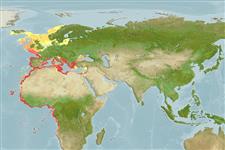
marinhas batidemersal; intervalo de profundidade 60 - 1309 m (Ref. 128029). Deep-water; 70°N - 17°S, 25°W - 36°E (Ref. 54693)
Eastern Atlantic: Bay of Biscay and Mediterranean Sea to Senegal, north to Cornwall, England (apparently as a stray). Compagno et al. (Ref. 5578) reports this species as ranging south to Cape Point, South Africa but Springer 1990 (Ref. 10718) notes Bass et al. 1976 as considering specimens from Walvis Bay distinct from Oxynotus centrina calling attention to the considerably greater distance between dorsal fins in Mediterranean specimens than in specimens taken south of the equator.
Length at first maturity / Tamanho / Peso / Idade
Maturidade: Lm ?, range 50 - ? cm
Max length : 150 cm TL macho/indeterminado; (Ref. 247); common length : 55.0 cm TL macho/indeterminado; (Ref. 26999)
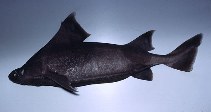
Espinhos dorsais (total) : 2; Espinhos anais: 0. A small bizarre-looking shark with an unmistakable high body and bristly textured skin (Ref. 5578). Uniformly grey to grey-brown (Ref. 5578).
Body shape (shape guide): elongated.
Found on the outer continental shelf and upper slope (Ref. 5578). Depth range from 60-660 m (Ref. 247) and from 549-777 m in the eastern Ionian Sea (Ref. 56504), and 818-1309 m NW Africa (Ref. 128029). Feeds on polychaetes (Ref. 247) and sipunculids (apparenly a suction feeder which mainly feeds on worm-like prey), which are rapidly digested, and the rapid gastric evacuation could partially explain the vacuity of several guts; teleosts, crustaceans and echinoderms are considered as accessory prey items, thus recorded predation on egg cases of the smallspotted catshark Scyliorhinus canicula remains an occasional phenomenon (Ref. 81816). Ovoviviparous (Ref. 205). Utilized for fishmeal, oil, and smoked and dried salted for human consumption (Ref. 247).
Ovoviviparous, without a placenta, with about 7 or 8 young in a litter (Ref. 247). Distinct pairing with embrace (Ref. 205).
Compagno, L.J.V., 1984. FAO Species Catalogue. Vol. 4. Sharks of the world. An annotated and illustrated catalogue of shark species known to date. Part 1 - Hexanchiformes to Lamniformes. FAO Fish. Synop. 125(4/1):1-249. Rome, FAO. (Ref. 247)
Categoria na Lista Vermelha da IUCN (Ref. 130435: Version 2025-1)
Ameaça para o homem
Harmless
Utilização humana
Pescarias: pouco comercial
Ferramentas
Relatórios especiais
Descarregue XML
Fontes da internet
Estimates based on models
Preferred temperature (Ref.
123201): 9.5 - 15.3, mean 13.3 °C (based on 283 cells).
Phylogenetic diversity index (Ref.
82804): PD
50 = 0.5625 [Uniqueness, from 0.5 = low to 2.0 = high].
Bayesian length-weight: a=0.00372 (0.00163 - 0.00849), b=3.15 (2.94 - 3.36), in cm total length, based on LWR estimates for this (Sub)family-body shape (Ref.
93245).
Nível Trófico (Ref.
69278): 3.1 ±0.3 se; based on diet studies.
Resiliência (Ref.
120179): Muito baixo, tempo mínimo de duplicação da população maior que 14 anos (Fec=7).
Fishing Vulnerability (Ref.
59153): Very high vulnerability (90 of 100).
🛈
Climate Vulnerability (Ref.
125649): Moderate vulnerability (38 of 100).
🛈
Nutrients (Ref.
124155): Calcium = 5.91 [1.03, 31.36] mg/100g; Iron = 0.271 [0.065, 0.929] mg/100g; Protein = 18.7 [16.8, 20.5] %; Omega3 = 0.229 [0.074, 0.746] g/100g; Selenium = 18.8 [5.3, 65.9] μg/100g; VitaminA = 5.9 [1.1, 30.1] μg/100g; Zinc = 0.392 [0.185, 0.747] mg/100g (wet weight);