Classification / Names
Nomi Comuni | Sinonimi | Catalog of Fishes(Genere, Specie) | ITIS | CoL | WoRMS | Cloffa
>
Siluriformes (Catfishes) >
Amphiliidae (Loach catfishes) > Doumeinae
Etymology: inga: Named for the Inga Rapids, on the lower Congo
River; a noun in apposition (Ref. 88958).
More on authors: Ferraris, Vari & Skelton.
Environment: milieu / climate zone / distribuzione batimetrica / distribution range
Ecologia
; acqua dolce demersale. Tropical; 5°S - 6°S, 13°E - 14°E
Africa: known only from the vicinity of the Inga Dam, Lower Congo River basin, in the Democratic Republic of the Congo (Ref. 88958, 92838).
Size / Peso / Age
Maturità: Lm ? range ? - ? cm
Max length : 11.1 cm SL maschio/sesso non determinato; (Ref. 88958)
Short description
Chiavi di identificazione | Morfologia | Morfometria
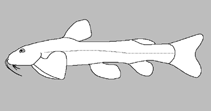
Spine dorsali (totale) : 0; Raggi dorsali molli (totale) : 7 - 8; Spine anali: 0; Raggi anali molli: 10 - 11; Vertebre: 35 - 37. Diagnosis: Congoglanis inga differs from C. sagitta in having a longer maxillary barbel, reaching well past vertical through anterior margin of orbit vs. not reaching to orbit; a deeper caudal peduncle, 7-8% of standard length vs. 6%; and less slender caudal peduncle, its depth 2.1-2.9 times in its length vs. 3.1-4.0; a longer pelvic fin, 22-25% of standard length vs. 19-21%; a more posteriorly placed anal fin, anal-fin origin approximately at tip of adpressed pelvic fin vs. origin well in advance of tip of adpressed pelvic fin; longer anal-fin rays, posterior rays of adpressed anal fin extend well past vertical through posterior limit of adipose fin vs. posterior rays extend to, rarely slightly beyond, vertical through posterior limit of adipose fin; and fewer vertebrae, 35-37 vs. 39-41 (Ref. 88958). It differs from C. alula in having a longer maxillary barbel, reaching well past vertical through anterior margin of orbit vs. not reaching to orbit; a shorter pelvic fin, 19-21% of standard length vs. 24-28%; a longer postorbital length, 32-35% of head length vs. 27-31%; a relatively wide interorbital width, 2 times eye-diameter vs. 1.5 times; and longer anal-fin rays, posterior rays of adpressed anal fin extend well past vertical through posterior limit of adipose fin vs. posterior rays extend to, rarely slightly beyond, vertical through posterior limit of adipose fin (Ref. 88958).
Body shape (shape guide): elongated.
This species has been collected from "a long channel with moderate current, numerous pools and a predominantly rocky bottom" (Ref. 42510, 88958).
Life cycle and mating behavior
Maturità | Riproduzione | Deposizione | Uova | Fecundity | Larve
Ferraris, C.J. Jr., R.P. Vari and P.H. Skelton, 2011. A new genus of African loach catfish (Siluriformes: Amphiliidae) from the Congo River basin, the sister-group to all other genera of the Doumeinae, with the description of two new species. Copeia 2011(4):477-489. (Ref. 88958)
IUCN Red List Status (Ref. 130435: Version 2025-1)
Threat to humans
Harmless
Human uses
Strumenti
Special reports
Download XML
Fonti Internet
Estimates based on models
Phylogenetic diversity index (Fonte Biblio.
82804): PD
50 = 0.5625 [Uniqueness, from 0.5 = low to 2.0 = high].
Bayesian length-weight: a=0.00389 (0.00180 - 0.00842), b=3.12 (2.94 - 3.30), in cm total length, based on all LWR estimates for this body shape (Ref.
93245).
Trophic level (Fonte Biblio.
69278): 3.1 ±0.4 se; based on size and trophs of closest relatives
Resilienza (Fonte Biblio.
120179): Medio, tempo minimo di raddoppiamento della popolazione 1.4 - 4.4 anni (Preliminary K or Fecundity.).
Fishing Vulnerability (Ref.
59153): Low vulnerability (10 of 100).
🛈