>
Kurtiformes (Nurseryfishes, cardinalfishes.) >
Apogonidae (Cardinalfishes) > Apogoninae
Etymology: Cheilodipterus: Greek, cheilos = lip + Greek, di = two + Greek, pteryx = fin (Ref. 45335).
More on authors: Smith & Radcliffe.
Issue
Type locality: Sacol Island, east of Zamboanga, Philippines.
Environment: milieu / climate zone / profondeur / distribution range
Écologie
marin récifal; profondeur 2 - 25 m (Ref. 90102). Tropical
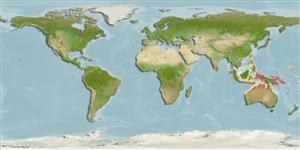
Indo-Pacific: Philippines and Indonesia south to Australia and east to Solomon Islands.
Taille / Poids / Âge
Maturité: Lm ? range ? - ? cm
Max length : 10.0 cm TL mâle / non sexé; (Ref. 48635)
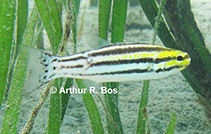
Épines dorsales (Total) : 7; Rayons mous dorsaux (Total) : 9; Épines anales: 2; Rayons mous anaux: 8. Body with 4 black stripes; uppermost extending from nape along dorsal-fin base to caudal-fin base; stripes broken to dots posteriorly on caudal peduncle and caudal-fin base; the head between stripes yellowish; fins pale. Developed gill rakers on hypobranchial 1-2; on ceratobranchial 8. Preopercular edge usually smooth, sometimes with several weak serrae at angle (Ref. 8525). Mimics Malacanthus species; only close examination reveals the different mouth shape and the apogonid has two separate dorsal fins, whilst the blenny has a long continuous single fin (Ref. 48635).
Body shape (shape guide): elongated; Cross section: oval.
This species is apparently a Batesian mimic of the saber-toothed blenny Meiacanthus grammistes. Observed to swim in open water in a similar fashion as this blenny by using its tail to swim rather than the pectoral fins; but if approached, it quickly swims to the cover of reefs (Ref. 48635). Sexually mature between 6 to 6.5 cm. Solitary or in pairs (Ref 90102).
Life cycle and mating behavior
Maturité | Reproduction | Frai | Œufs | Fécondité | Larves
Mouthbrooders (Ref. 240). Distinct pairing during courtship and spawning (Ref. 205).
Gon, O., 1993. Revision of the cardinalfish genus Cheilodipterus (Perciformes: Apogonidae), with description of five new species. Indo-Pac. Fish. (22):59 p. (Ref. 8525)
Statut dans la liste rouge de l'IUCN (Ref. 130435: Version 2025-1)
Menace pour l'homme
Harmless
Utilisations par l'homme
Outils
Articles particuliers
Télécharger en XML
Sources Internet
Estimates based on models
Preferred temperature (Réf.
123201): 27.9 - 29.3, mean 28.7 °C (based on 1059 cells).
Phylogenetic diversity index (Réf.
82804): PD
50 = 0.5000 [Uniqueness, from 0.5 = low to 2.0 = high].
Bayesian length-weight: a=0.00550 (0.00223 - 0.01355), b=3.27 (3.06 - 3.48), in cm total length, based on LWR estimates for this (Sub)family-body shape (Ref.
93245).
Niveau trophique (Réf.
69278): 3.8 ±0.6 se; based on size and trophs of closest relatives
Résilience (Réf.
120179): Haut, temps minimum de doublement de population inférieur à 15 mois (Preliminary K or Fecundity.).
Fishing Vulnerability (Ref.
59153): Low vulnerability (10 of 100).
🛈
Nutrients (Ref.
124155): Calcium = 165 [86, 291] mg/100g; Iron = 0.957 [0.517, 1.625] mg/100g; Protein = 18.7 [17.6, 19.8] %; Omega3 = 0.109 [0.059, 0.203] g/100g; Selenium = 31.5 [13.8, 68.9] μg/100g; VitaminA = 90.7 [28.6, 276.5] μg/100g; Zinc = 1.93 [1.23, 2.92] mg/100g (wet weight);