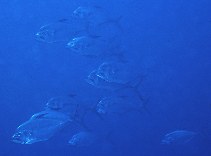
Klassifizierung / Names
Namen | Synonyme | Catalog of Fishes(Gattung, Arten) | ITIS | CoL | WoRMS | Cloffa
>
Carangiformes (Jacks) >
Carangidae (Jacks and pompanos) > Caranginae
Etymology: Atropus: The name of the Parcae, fates of Roman mythology (Ref. 45335).
Eponymy: In Greek mythology, Atropos -known as the ‘inflexible’ or ‘inevitable’ -was the oldest of the Three Fates. (Ref. 128868), visit book page.
More on author: Cuvier.
Environment: milieu / climate zone / Tiefenbereich / distribution range
Ökologie
seewasser riff-verbunden. Tropical
Indo-West Pacific: East Africa (Ref. 3287) and Madagascar eastward to Taiwan and Australia.
Size / Gewicht / Alter
Geschlechtsreife: Lm ? range ? - ? cm
Max length : 100.0 cm TL Männchen/unbestimmt; (Ref. 3287); common length : 60.0 cm TL Männchen/unbestimmt; (Ref. 3287)
Rückenflossenstacheln (insgesamt) : 9; Rückenflossenweichstrahlen (insgesamt) : 21 - 22; Afterflossenstacheln: 3; Afterflossenweichstrahlen: 17 - 18.
Body shape (shape guide): short and / or deep.
Adults are found in shallow coastal waters near reefs (Ref. 30573, 90102). Juveniles feed on benthic crustaceans (Ref. 37816) while adults feed on crustaceans and fish (Ref. 5213, 37816).
Life cycle and mating behavior
Geschlechtsreife | Fortpflanzung | Ablaichen | Eier | Fecundity | Larven
Paxton, J.R., D.F. Hoese, G.R. Allen and J.E. Hanley, 1989. Pisces. Petromyzontidae to Carangidae. Zoological Catalogue of Australia, Vol. 7. Australian Government Publishing Service, Canberra, 665 p. (Ref. 7300)
IUCN Rote Liste Status (Ref. 130435: Version 2025-1)
Bedrohung für Menschen
Harmless
Nutzung durch Menschen
Fischereien: kommerziell; Sportfisch: ja
Tools
Zusatzinformationen
Download XML
Internet Quellen
Estimates based on models
Preferred temperature (Ref.
123201): 24.6 - 29.2, mean 28.2 °C (based on 1412 cells).
Phylogenetic diversity index (Ref.
82804): PD
50 = 0.5312 [Uniqueness, from 0.5 = low to 2.0 = high].
Bayesian length-weight: a=0.03090 (0.01719 - 0.05556), b=2.88 (2.73 - 3.03), in cm total length, based on LWR estimates for this species & (Sub)family-body (Ref.
93245).
Trophic level (Ref.
69278): 3.7 ±0.51 se; based on food items.
Widerstandsfähigkeit (Ref.
120179): mittel, Verdopplung der Population dauert 1,4 - 4,4 Jahre. (Preliminary K or Fecundity.).
Fishing Vulnerability (Ref.
59153): High vulnerability (60 of 100).
🛈
Nutrients (Ref.
124155): Calcium = 30.6 [14.2, 62.4] mg/100g; Iron = 0.671 [0.378, 1.336] mg/100g; Protein = 19.2 [18.0, 20.3] %; Omega3 = 0.108 [0.064, 0.194] g/100g; Selenium = 54 [27, 109] μg/100g; VitaminA = 41.3 [11.6, 145.9] μg/100g; Zinc = 0.68 [0.45, 0.99] mg/100g (wet weight);