



Adicionar as suas observações no Fish Watcher
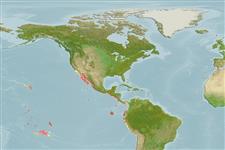
| Native range | All suitable habitat | Point map | Year 2050 |
|
| This map was computer-generated and has not yet been reviewed. |
| Dasyatis brevis AquaMaps Data sources: GBIF OBIS |
Adicionar o seu Fotografias e vídeos
Fotografias | vídeos | Imagem do Google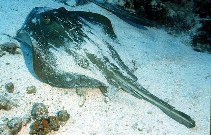 Dasyatis brevis
Fotografia de Ziegler, P.E.
Fotografias | vídeos | Imagem do Google
Fotografia de Ziegler, P.E.
Classificação / Nomes Nomes comuns | Sinónimos | Catalog of Fishes(Género, Espécies) | ITIS | CoL | WoRMS | Cloffa
Elasmobranchii (tubarões e raias) (sharks and rays) > Myliobatiformes (Stingrays) > Dasyatidae (Stingrays) > Dasyatinae
Etymology: Dasyatis: Greek, dasys = rough, dense (Ref. 45335).
More on author: Garman.
Etymology: Dasyatis: Greek, dasys = rough, dense (Ref. 45335).
More on author: Garman.
Taxonomic Remarks
This species is synonym of Dasyatis dipterura Jordan & Gilbert, 1880. See nomenclatural details in Eschmeyer (CofF ver. Oct. 2012: Ref. 92135). The species page will be removed.
Ambiente: milieu / zona climática / intervalo de profundidade / gama de distribuição Ecologia
marinhas demersal; intervalo de profundidade 1 - 70 m (Ref. 37955), usually 1 - 17 m (Ref. 9254). Subtropical; 42°N - 19°S, 161°W - 70°W
Distribuição Territórios | Áreas FAO | Ecossistemas | Ocorrências | Mapa dos pontos | Introduções | Faunafri
Eastern Pacific: Hawaii and from California, USA to Peru.
Tamanho / Peso / Idade
Maturidade: Lm ? range ? - ? cm
Max length : 187 cm TL macho/indeterminado; (Ref. 40637); common length : 120 cm TL macho/indeterminado; (Ref. 9254); peso máx. Publicado: 46.3 kg (Ref. 40637)
Max length : 187 cm TL macho/indeterminado; (Ref. 40637); common length : 120 cm TL macho/indeterminado; (Ref. 9254); peso máx. Publicado: 46.3 kg (Ref. 40637)
Found in bays, in sea grass beds, kelp beds, and near reefs on sand and mud bottoms (Ref. 12951). Digs in the sand to feed (Ref. 5227). Feeds on small fishes, crabs, clams, and other benthic invertebrates (Ref. 37955). Ovoviviparous (Ref. 50449). Venomous spine on tail.
Ciclo de vida e comportamento de acasalamento Maturidade | Reprodução | Desova | Ovos | Fecundidade | Larvas
Exhibit ovoviparity (aplacental viviparity), with embryos feeding initially on yolk, then receiving additional nourishment from the mother by indirect absorption of uterine fluid enriched with mucus, fat or protein through specialised structures (Ref. 50449). Distinct pairing with embrace (Ref. 205).
Referência principal
Carregar as suas referências | Referências | Coordenador : McEachran, John | Colaboradores
Nishida, K. and K. Nakaya, 1990. Taxonomy of the genus Dasyatis (Elasmobranchia, Dasyatidae) from the North Pacific. In: Pratt Jr., H. L., S. H. Gruber and T. Taniuchi (eds.): Elasmobranchs as living resources: advances in the biology, ecology, systematics, and the status of the fisheries. NOAA (National Oceanic and Atmospheric Administration) Tech. Rept. NMFS 90:327-346. (Ref. 7445)
CITES
Not Evaluated
Ameaça para o homem
Venomous
Utilização humana
Pescarias: pouco comercial; Aquário: Aquários públicos
FAO - Publication: search | FishSource |
Mais informação
Ecologia Trófica
Produtos alimentares (presas)
Composição da dieta
Consumo alimentar
Rações alimentares
Predadores
Produtos alimentares (presas)
Composição da dieta
Consumo alimentar
Rações alimentares
Predadores
Dinâmica das populações
Parâmetros de crescimento
Idades / tamanhos máximos
Comprimento-peso rel.
Comprimento-comprimento rel.
Frequência de comprimento
Conversão de massa
Recrutamento
Abundância
Parâmetros de crescimento
Idades / tamanhos máximos
Comprimento-peso rel.
Comprimento-comprimento rel.
Frequência de comprimento
Conversão de massa
Recrutamento
Abundância
Ciclo de vida
Reprodução
Maturidade
Maturidade/Rel. das guelras
Fecundidade
Desova
Agregações de desova
Ovos
Desenvolvimento dos ovos
Larvas
Dinâmica larvar
Reprodução
Maturidade
Maturidade/Rel. das guelras
Fecundidade
Desova
Agregações de desova
Ovos
Desenvolvimento dos ovos
Larvas
Dinâmica larvar
Anatomia
Área branquial
Cérebro
Otólitos
Área branquial
Cérebro
Otólitos
Fisiologia
Composição corporal
Nutrientes
Consumo de oxigénio
Tipo de natação
Velocidade de natação
Pigmentos visuais
Som de peixe
Doenças e Parasitas
Toxicidade (LC50s)
Composição corporal
Nutrientes
Consumo de oxigénio
Tipo de natação
Velocidade de natação
Pigmentos visuais
Som de peixe
Doenças e Parasitas
Toxicidade (LC50s)
Genética
genoma
Genética
Heterozigotia
Hereditariedade
Diversidade genética
genoma
Genética
Heterozigotia
Hereditariedade
Diversidade genética
Relacionado com o ser humano
Sistemas de aquacultura
Perfis para aquacultura
Estirpes
Casos de Ciguatera
Selos, moedas, diversos.
Sistemas de aquacultura
Perfis para aquacultura
Estirpes
Casos de Ciguatera
Selos, moedas, diversos.
Ferramentas
Questionário orgânico | E-book | Guia de campo | Ferramenta auxiliar de frequências de comprimento | Ferramenta sobre a história de vida | Mapa dos pontos |
Captura-MSY |
Relatórios especiais
Descarregue XML
Fontes da internet
AFORO (otoliths) | Aquatic Commons | BHL | Cloffa | Websites from users | Consultar FishWatcher | CISTI | Catalog of Fishes: Género, Espécies | DiscoverLife | ECOTOX | FAO - Publication: search | Faunafri | Fishipedia | Fishtrace | GloBI | Google Books | Google Scholar | Google | IGFA World Record | OneZoom | Open Tree of Life | Otolith Atlas of Taiwan Fishes | Aquários públicos | PubMed | Reef Life Survey | Socotra Atlas | TreeBase | Árvore da vida | Wikipedia: ir para, procurar | World Records Freshwater Fishing | Registo zoológico
Estimativas baseadas em modelos
Temperatura preferida (Ref. 123201): 19.1 - 28.9, mean 24.2 °C (based on 317 cells).
Índice de diversidade filogenética (Ref. 82804): PD50 = 0.5020 [Uniqueness, from 0.5 = low to 2.0 = high].
Bayesian length-weight: a=0.00447 (0.00189 - 0.01058), b=3.12 (2.92 - 3.32), in cm total length, based on LWR estimates for this (Sub)family-body shape (Ref. 93245).
Nível Trófico (Ref. 69278): 3.8 ±0.60 se; based on food items.
Resiliência (Ref. 120179): Baixo, tempo mínimo de duplicação da população 4,5 - 14 anos (Assuming fecundity<100).
Nutrientes (Ref. 124155): Calcium = 8.57 [1.15, 169.73] mg/100g; Iron = 0.64 [0.06, 7.72] mg/100g; Protein = 21.3 [18.9, 23.9] %; Omega3 = 0.179 [0.059, 0.499] g/100g; Selenium = 25.8 [5.2, 131.9] μg/100g; VitaminA = 3.34 [0.29, 35.44] μg/100g; Zinc = 0.41 [0.03, 5.00] mg/100g (wet weight);