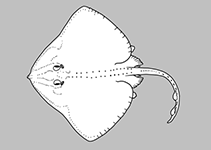
Elasmobranchii (sharks and rays) >
Rajiformes (Skates and rays) >
Arhynchobatidae (Softnose skates)
Etymology: Bathyraja: Greek, bathys = deep + Latin, raja, -ae = a ray (Raja sp) (Ref. 45335).
Eponymy: Dr María Cristina Oddone Franco, a post-doctoral researcher at the Instituto de Ciências Biológicas, Universidade Federal do Rio Grande, Brazil, was nicknamed ‘Tuna’. [...] (Ref. 128868), visit book page.
Environment: milieu / climate zone / depth range / distribution range
Ecology
Marine; bathydemersal; depth range 1700 - 2240 m (Ref. 75588). Deep-water
Western Indian Ocean: Mozambique Channel.
Size / Weight / Age
Maturity: Lm ? range ? - ? cm
Max length : 100.0 cm TL (female)
Short description
Identification keys | Morphology | Morphometrics
This species is characterized by the following: moderately extended snout and mouth; wide interorbital space; broad space between the first gill slits; tail length shorter than body length; almost completely prickly upper but smooth lower surfaces, no thorns on disc, but only a median row of 19 thorns along tail to D1; nearly confluent dorsal fins without thorn between them; > 30 upper tooth rows; 40-44 trunk vertebrae; dorsal edge of scapulocoracoid strongly sloping to metacondyle; high number of postventral foramina, markedly short and broadly drop-shaped anterior cranial fontanelle (Ref. 75588).
Body shape (shape guide): other.
Life cycle and mating behavior
Maturity | Reproduction | Spawning | Eggs | Fecundity | Larvae
Stehmann, M.F.W., 2005. Bathyraja tunae n. sp., a new deep-water skate from the western Indian Ocean (Chondrichthyes, Rajiformes, Rajidae). J. Ichthyol. 45(suppl.1):23-38. (Ref. 75588)
IUCN Red List Status (Ref. 130435: Version 2025-2)
Threat to humans
Harmless
Human uses
Fisheries: of no interest
Tools
Special reports
Download XML
Internet sources