Elasmobranchii (sharks and rays) >
Rajiformes (Skates and rays) >
Arhynchobatidae (Softnose skates)
Etymology: Bathyraja: Greek, bathys = deep + Latin, raja, -ae = a ray (Raja sp) (Ref. 45335).
Eponymy: Anatoly Yakovlevich Taranetz (1910–1941) was a Russian marine biologist and ichthyologist who was an eminent expert on Far Eastern fishes. [...] (Ref. 128868), visit book page.
Environment: milieu / climate zone / depth range / distribution range
Ecology
Marine; brackish; bathydemersal; depth range 58 - 1054 m (Ref. 80796). Deep-water
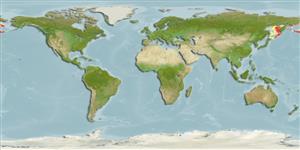
Northwest Pacific: Bering Sea and Aleutian Islands (unconfirmed report from the Gulf of Alaska); to Pacific coast of Kamchatka and northern Kuril Is.
Size / Weight / Age
Maturity: Lm ? range ? - ? cm
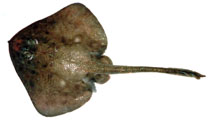
Max length : 70.0 cm TL male/unsexed; (Ref. 555); 62.3 cm TL (female)
Holotype taken from a depth between 405-420 m (Ref. 26282). Oviparous. Distinct pairing with embrace. Young may tend to follow large objects, such as their mother (Ref. 205). Eggs are oblong capsules with stiff pointed horns at the corners deposited in sandy or muddy flats (Ref. 205). Egg capsules are 6.7 cm long and 4.7 cm wide (Ref. 41249).
Life cycle and mating behavior
Maturity | Reproduction | Spawning | Eggs | Fecundity | Larvae
Oviparous, paired eggs are laid. Embryos feed solely on yolk (Ref. 50449). Distinct pairing with embrace. Young may tend to follow large objects, such as their mother (Ref. 205).
McEachran, J.D. and K.A. Dunn, 1998. Phylogenetic analysis of skates, a morphologically conservative clade of elasmobranchs (Chondrichthyes: Rajidae). Copeia 1998(2):271-290. (Ref. 27314)
IUCN Red List Status (Ref. 130435: Version 2025-2)
Threat to humans
Harmless
Human uses
Tools
Special reports
Download XML
Internet sources