Elasmobranchii (sharks and rays) >
Rajiformes (Skates and rays) >
Arhynchobatidae (Softnose skates)
Etymology: Bathyraja: Greek, bathys = deep + Latin, raja, -ae = a ray (Raja sp) (Ref. 45335).
Environment: milieu / climate zone / depth range / distribution range
Ecology
Marine; bathydemersal; depth range 243 - 1207 m (Ref. 127873). Deep-water; 6°S - 7°S
Southeast Pacific: Ecuador and Peru to southern Chile.
Size / Weight / Age
Maturity: Lm ? range ? - ? cm
Max length : 110 cm TL male/unsexed; (Ref. 127873)
Short description
Identification keys | Morphology | Morphometrics
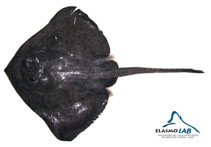
This species is distinguished by the following characters: the pectoral fin apices narrowly or abruptly rounded; the preorbital length times orbital length 2.41-3.40; preorbital length times interorbital length 1.02-1.17; interorbital space times orbit length 1.02-1.26; orbital length times spiracle length 1.16-1.78; pre-oral length times internarial length 1.24-1.34 (> 97.0 cm TL); tail thorns evenly spaced; dorsal disc surface and tail with finely textured denticles; teeth arranged in quincunx; predorsal tail vertebrae 64-71; pectoral-fin radial count 77-82 (Ref. 127873).
Cross section: flattened.
Holotype taken from a depth of 980 m (Ref. 26282). Oviparous (Ref. 50449). Eggs have horn-like projections on the shell (Ref. 205).
Life cycle and mating behavior
Maturity | Reproduction | Spawning | Eggs | Fecundity | Larvae
Oviparous, paired eggs are laid. Embryos feed solely on yolk (Ref. 50449). Eggs have horn-like projections on the shell (Ref. 205).
McEachran, J.D. and K.A. Dunn, 1998. Phylogenetic analysis of skates, a morphologically conservative clade of elasmobranchs (Chondrichthyes: Rajidae). Copeia 1998(2):271-290. (Ref. 27314)
IUCN Red List Status (Ref. 130435: Version 2025-2)
Threat to humans
Harmless
Human uses
Tools
Special reports
Download XML
Internet sources