Environment: milieu / climate zone / rango de profundidad / distribution range
Ecología
; agua dulce bentopelágico. Tropical
South America: Tocantins River basin, Brazil.
Tamaño / Peso / Age
Madurez: Lm ? range ? - ? cm
Max length : 23.8 cm SL macho / no sexado; (Ref. 36914)
Short description
Claves de identificación | Morfología | Morfometría
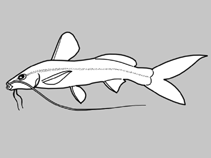
Espinas dorsales (total) : 1; Radios blandos dorsales (total) : 6. Rhamdia itacaiunas is diagnosed from all congeners by the pectoral fin spine with serrations on both sides; caudal fin upper lobe pointed and longer than lower lobe; mouth deeply cleft to near the vertical at the anterior margin of the eye; eyes in advanced position, distinctly closer to the snout than to the operculum hind margin; adipose fin 23.3-28.4% of SL or 96.2-127% of HL; maxillary barbel 41.2-53.8% of SL or 190-231% of HL; broad tooth plates.
Body shape (shape guide): elongated; Cross section: oval.
Life cycle and mating behavior
Madurez | Reproducción | Puesta | Huevos | Fecundidad | Larva
Silfvergrip, A.M.C., 1996. A systematic revision of the Neotropical catfish genus Rhamdia (Teleostei, Pimelodidae). Stockholm University and Swedish Museum of Natural History. 156 pp. + 8 pls. (Ref. 50029)
IUCN Red List Status (Ref. 130435: Version 2025-1)
Threat to humans
Harmless
Human uses
Herramientas
Special reports
Download XML
Fuentes de Internet
Estimates based on models
Phylogenetic diversity index (Referencia
82804): PD
50 = 0.5000 [Uniqueness, from 0.5 = low to 2.0 = high].
Bayesian length-weight: a=0.00794 (0.00374 - 0.01688), b=2.97 (2.79 - 3.15), in cm total length, based on LWR estimates for this (Sub)family-body shape (Ref.
93245).
Nivel trófico (Referencia
69278): 3.6 ±0.4 se; based on size and trophs of closest relatives
Resiliencia (Referencia
120179): Muy bajo, población duplicada en un tiempo mínimo superior a 14 años (Preliminary K or Fecundity.).
Fishing Vulnerability (Ref.
59153): Low vulnerability (19 of 100).
🛈