>
Siluriformes (Catfishes) >
Clariidae (Airbreathing catfishes)
Etymology: Clarias: Greek, chlaros = lively, in reference to the ability of the fish to live for a long time out of water.
More on author: Boulenger.
Environment: milieu / climate zone / rango de profundidad / distribution range
Ecología
; agua dulce demersal. Tropical; 6°N - 7°S
Africa: from the coastal rivers of south Cameroon (up to the Sanaga river) southwards to the Ogooué system in Gabon and the middle Congo basin in the Democratic Republic of the Congo (Ref. 78218). Outside this area also reported from the Lualaba/upper Congo (Ref. 106245), the Kouilou-Niari in Republic of Congo (Ref. 92841), the Niger Delta (Ref. 57129) and Cross River in Nigeria (Ref. 31256, 57129), and from the Chad (Ref. 13331). A report from the Oueme River in Benin needs confirmation (Ref. 57129, 81644).
Tamaño / Peso / Age
Madurez: Lm ? range ? - ? cm
Max length : 35.6 cm TL macho / no sexado; (Ref. 57129)
Espinas dorsales (total) : 0; Radios blandos dorsales (total) : 81 - 95; Espinas anales: 0; Radios blandos anales: 63 - 76; Vértebra: 65 - 67. Diagnosis: head length 19.6-24.6% SL (Ref. 81644). Head pointed in dorsal outline; snout short; tooth plates small; eyes dorsally located; "dermosphenotic" and supraorbital bones joined in specimens over 80 mm SL (Ref. 248). Frontal fontanella long and narrow ("knife-shaped")(Ref. 248, 57129, 81644). Occipital process long and oval-shaped (Ref. 248). Distance between occipital process and dorsal-fin base 4.3-10.5% SL (m = 8.1) (Ref. 81644). Gill rakers long, slender and distantly set (Ref. 248), 11-19 on 1st gill arch (Ref. 81644). Suprabranchial organ well developed (Ref. 248). Pectoral spine serrated on both sides (Ref. 57129), strongly on posterior face, weakly on anterior face (Ref. 81644). 65-67 vertebrae (Ref. 57129).
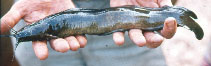
Coloration: no information on colour in life (Ref. 57129). Preserved specimens uniformly dark brown on back and sides, and yellowish-brown on belly (Ref. 57129, 81644). Vertical series of small white spots on flanks (Ref. 57129).
Body shape (shape guide): elongated; Cross section: circular.
Facultative air-breathing (Ref. 126274); Nothing is known on the biology and reproduction of this species (Ref. 78218).
Life cycle and mating behavior
Madurez | Reproducción | Puesta | Huevos | Fecundidad | Larva
Teugels, G.G., 1986. A systematic revision of the African species of the genus Clarias (Pisces; Clariidae). Ann. Mus. R. Afr. Centr., Sci. Zool., 247:199 p. (Ref. 248)
IUCN Red List Status (Ref. 130435: Version 2025-1)
Threat to humans
Harmless
Human uses
Herramientas
Special reports
Download XML
Fuentes de Internet
Estimates based on models
Phylogenetic diversity index (Referencia
82804): PD
50 = 0.5000 [Uniqueness, from 0.5 = low to 2.0 = high].
Bayesian length-weight: a=0.00794 (0.00357 - 0.01766), b=2.96 (2.78 - 3.14), in cm total length, based on LWR estimates for this Genus-body shape (Ref.
93245).
Nivel trófico (Referencia
69278): 3.4 ±0.5 se; based on size and trophs of closest relatives
Resiliencia (Referencia
120179): Alto, población duplicada en un tiempo mínimo inferior a 15 meses (Preliminary K or Fecundity.).
Fishing Vulnerability (Ref.
59153): Low to moderate vulnerability (26 of 100).
🛈