



Branchiostegus saitoi Dooley & Iwatsuki, 2012
Upload your photos and videos
Pictures | Google image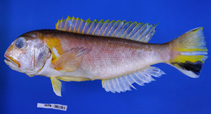 Branchiostegus saitoi
Picture by Iwatsuki, Y.
Pictures | Google image
Picture by Iwatsuki, Y.
Classification / Names Common names | Synonyms | Catalog of Fishes(genus, species) | ITIS | CoL | WoRMS | Cloffa
Teleostei (teleosts) > Eupercaria/misc (Various families in series Eupercaria) > Latilidae (Deepwater tilefishes)
Etymology: Branchiostegus: Greek, brangchia = gills + Greek, stego = roof, to cover (Ref. 45335); saitoi: A new species of Branchiostegus was first caught off Batangas Laiya, Philippines in 2009, photographed and eaten. Two years passed before two more specimens were caught by J. Saito, an amateur angler from Japan in April, 2011. Without J. Saito’s considerable efforts and interest, this species would have remained unknown. The new species is herein named in his honor (Ref. 89848).
Eponymy: Jiro Saito is a Japanese amateur angler who caught specimens of this fish in the Philippines (2009 & 2011) and sent frozen examples to the junior author, Yukio Iwatsuki. [...] (Ref. 128868), visit book page.
Etymology: Branchiostegus: Greek, brangchia = gills + Greek, stego = roof, to cover (Ref. 45335); saitoi: A new species of Branchiostegus was first caught off Batangas Laiya, Philippines in 2009, photographed and eaten. Two years passed before two more specimens were caught by J. Saito, an amateur angler from Japan in April, 2011. Without J. Saito’s considerable efforts and interest, this species would have remained unknown. The new species is herein named in his honor (Ref. 89848).
Eponymy: Jiro Saito is a Japanese amateur angler who caught specimens of this fish in the Philippines (2009 & 2011) and sent frozen examples to the junior author, Yukio Iwatsuki. [...] (Ref. 128868), visit book page.
Environment: milieu / climate zone / depth range / distribution range Ecology
Marine; benthopelagic; depth range 210 - 220 m (Ref. 89848). Tropical; 14°N - 13°N, 121°E - 122°E
Distribution Territories | FAO areas | Ecosystems | Occurrences | Point map | Introductions | Faunafri
Pacific Ocean: possible endemic to the Philippines.
Size / Weight / Age
Short description Identification keys | Morphology | Morphometrics
Dorsal spines (total): 7; Dorsal soft rays (total): 15; Anal spines: 2; Anal soft rays: 12; Vertebrae: 24. This species is distinguished from its congeners by the following set of characters: great body depth (28-29% SL; vs. the usual 27% SL); longer head length 30-31% SL (vs. usual 28%),: head profile oblique, about 130 degree angle (vs. usual 95-130 degrees); head depth 26-27% SL (vs. usual 26% SL); eyes high on head, interorbital width 31-34% HL; small orbital diameter 24–25% HL, only B. sawakinensis and B. albus with small orbital diameters, 23-24% HL) long predorsal length 35% SL (vs. usual 30-32% SL, rarely 33-34% SL), deep body 28-29% SL (vs. usual 24-27%, rarely, only in B. japonicus and B. semifasciatus, 28-29% SL); wide body 14-15% SL (vs. usual 11-13% SL); number of first arch gill rakers low 18 + 1 rudimentary (vs. most other species 18-24, modally 19-22) (Ref. 89848).
Body shape (shape guide): elongated; Cross section: compressed.
Body shape (shape guide): elongated; Cross section: compressed.
This species inhabits burrows as do other tilefishes (Ref. 89848).
Life cycle and mating behavior Maturity | Reproduction | Spawning | Eggs | Fecundity | Larvae
Main reference
Upload your references | References | Coordinator | Collaborators
Dooley, J.K. and Y. Iwatsuki, 2012. A new species of deepwater tilefish (Percoidea: Branchiostegidae) from the Philippines, with a brief discussion of the status of tilefish systematics. Zootaxa 3249:31-38. (Ref. 89848)
IUCN Red List Status (Ref. 130435: Version 2025-2 (Global))
Least Concern (LC) ; Date assessed: 13 May 2024
CITES
Not Evaluated
Threat to humans
Harmless
Human uses
Fisheries: of no interest
FAO - Publication: search | FishSource |
More information
Trophic ecology
Food items (preys)
Diet composition
Food consumption
Food rations
Predators
Food items (preys)
Diet composition
Food consumption
Food rations
Predators
Ecology
Ecology
Ecology
Population dynamics
Growth parameters
Max. ages / sizes
Length-weight rel.
Length-length rel.
Length-frequencies
Mass conversion
Recruitment
Abundance
Growth parameters
Max. ages / sizes
Length-weight rel.
Length-length rel.
Length-frequencies
Mass conversion
Recruitment
Abundance
Life cycle
Reproduction
Maturity
Maturity/Gills rel.
Fecundity
Spawning
Spawning aggregations
Eggs
Egg development
Larvae
Larval dynamics
Reproduction
Maturity
Maturity/Gills rel.
Fecundity
Spawning
Spawning aggregations
Eggs
Egg development
Larvae
Larval dynamics
Anatomy
Gill area
Brain
Otolith
Gill area
Brain
Otolith
Physiology
Body composition
Nutrients
Oxygen consumption
Swimming type
Swimming speed
Visual pigments
Fish sound
Diseases & Parasites
Toxicity (LC50s)
Body composition
Nutrients
Oxygen consumption
Swimming type
Swimming speed
Visual pigments
Fish sound
Diseases & Parasites
Toxicity (LC50s)
Genetics
Genome
Genetics
Heterozygosity
Heritability
Genetic Diversity
Genome
Genetics
Heterozygosity
Heritability
Genetic Diversity
Human related
Aquaculture systems
Aquaculture profiles
Strains
Ciguatera cases
Stamps, coins, misc.
Aquaculture systems
Aquaculture profiles
Strains
Ciguatera cases
Stamps, coins, misc.
Tools
Special reports
Download XML
Internet sources
AFORO (otoliths) | Aquatic Commons | BHL | Cloffa | Websites from users | Check FishWatcher | CISTI | Catalog of Fishes: genus, species | DiscoverLife | ECOTOX | FAO - Publication: search | Faunafri | Fishipedia | Fishtrace | GloBI | Google Books | Google Scholar | Google | IGFA World Record | OneZoom | Open Tree of Life | Otolith Atlas of Taiwan Fishes | PubMed | Reef Life Survey | Socotra Atlas | TreeBase | Tree of Life | Wikipedia: Go, Search | | Zoobank | Zoological Record
Estimates based on models
|
Phylogenetic diversity index (Ref. 82804) |
PD50 = 0.5000 [Uniqueness, from 0.5 = low to 2.0 = high]. |
| Bayesian length-weight | a=0.00708 (0.00298 - 0.01684), b=3.07 (2.86 - 3.28), in cm total length, based on LWR estimates for this (Sub)family-body shape (Ref. 93245). |
|
Trophic level (Ref. 69278) |
3.6 ±0.5 se; based on size and trophs of closest relatives |
|
Resilience (Ref. 120179) |
Medium, minimum population doubling time 1.4 - 4.4 years (Preliminary K or Fecundity.). |
|
Fishing Vulnerability (Ref. 59153) |
Moderate vulnerability (43 of 100). 🛈 |