



Aetomylaeus bovinus (Geoffroy Saint-Hilaire, 1817)
Bull ray
Add your observation in Fish Watcher
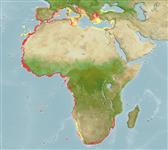
| Native range | All suitable habitat | Point map | Year 2050 |
|
| This map was computer-generated and has not yet been reviewed. |
| Aetomylaeus bovinus AquaMaps Data sources: GBIF OBIS |
Classification / Names Common names | Synonyms | Catalog of Fishes(genus, species) | ITIS | CoL | WoRMS | Cloffa
Elasmobranchii (sharks and rays) > Myliobatiformes (Stingrays) > Myliobatidae (Eagle and manta rays)
Etymology: Aetomylaeus: Greek, aetos = eagle + Greek, mylio = mill, grinder (Ref. 45335).
Etymology: Aetomylaeus: Greek, aetos = eagle + Greek, mylio = mill, grinder (Ref. 45335).
Environment: milieu / climate zone / depth range / distribution range Ecology
Marine; brackish; benthopelagic; depth range 10 - 150 m (Ref. 6808). Subtropical; 44°N - 35°S, 19°W - 36°E
Distribution Territories | FAO areas | Ecosystems | Occurrences | Point map | Introductions | Faunafri
Eastern Atlantic: Portugal and Morocco to Angola, including the Mediterranean, Madeira and the Canary Islands; then from Saldanha Bay to Natal (South Africa) and southern Mozambique (Ref. 5578).
Length at first maturity / Size / Weight / Age
Maturity: Lm 90.0, range 35 - 148 cm
Max length : 222.0 cm WD (female); common length : 150 cm WD male/unsexed; (Ref. 57025); max. published weight: 116.0 kg (Ref. 85836)
Max length : 222.0 cm WD (female); common length : 150 cm WD male/unsexed; (Ref. 57025); max. published weight: 116.0 kg (Ref. 85836)
Short description Identification keys | Morphology | Morphometrics
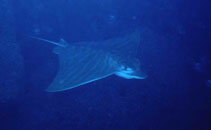
Long, flat, rounded snout like a duck's bill; head thick and pectoral disc with sharply curved, angular corners; upper or lower jaw; usually with 7 rows of flat teeth (Ref. 5578). Light brown with several pale blue-grey stripes (may be absent) dorsally, white ventrally (Ref. 5578).
Body shape (shape guide): other.
Body shape (shape guide): other.
Found in coastal tropical and warm temperate waters, occasionally offshore. Sometimes found in small groups (Ref. 5578). Feed on bottom-living crustaceans and mollusks. Ovoviviparous (Ref. 50449), aplacental (Ref. 57025). Prized angling fish, often released (Ref. 5578). Flesh highly esteemed (Ref. 3965).
Life cycle and mating behavior Maturity | Reproduction | Spawning | Eggs | Fecundity | Larvae
Exhibit ovoviparity (aplacental viviparity), with embryos feeding initially on yolk, then receiving additional nourishment from the mother by indirect absorption of uterine fluid enriched with mucus, fat or protein through specialised structures (Ref. 50449). Gestation about 6 months; 3-7 young produced (Ref. 5578). Size at birth 45 cm WD (Ref. 6677).
Main reference
Upload your references | References | Coordinator : McEachran, John | Collaborators
White, W.T., 2014. A revised generic arrangement for the eagle ray family Myliobatidae, with definitions for the valid genera. Zootaxa 3860(2):149-166. (Ref. 97392)
IUCN Red List Status (Ref. 130435: Version 2025-2 (Global))
Critically Endangered (CR) (A2d); Date assessed: 04 August 2020
CITES
Not Evaluated
Threat to humans
Harmless
Human uses
Fisheries: commercial; gamefish: yes
FAO - Publication: search | FishSource |
More information
Population dynamics
Growth parameters
Max. ages / sizes
Length-weight rel.
Length-length rel.
Length-frequencies
Mass conversion
Recruitment
Abundance
Growth parameters
Max. ages / sizes
Length-weight rel.
Length-length rel.
Length-frequencies
Mass conversion
Recruitment
Abundance
Life cycle
Reproduction
Maturity
Maturity/Gills rel.
Fecundity
Spawning
Spawning aggregations
Eggs
Egg development
Larvae
Larval dynamics
Reproduction
Maturity
Maturity/Gills rel.
Fecundity
Spawning
Spawning aggregations
Eggs
Egg development
Larvae
Larval dynamics
Anatomy
Gill area
Brain
Otolith
Gill area
Brain
Otolith
Physiology
Body composition
Nutrients
Oxygen consumption
Swimming type
Swimming speed
Visual pigments
Fish sound
Diseases & Parasites
Toxicity (LC50s)
Body composition
Nutrients
Oxygen consumption
Swimming type
Swimming speed
Visual pigments
Fish sound
Diseases & Parasites
Toxicity (LC50s)
Human related
Aquaculture systems
Aquaculture profiles
Strains
Ciguatera cases
Stamps, coins, misc.
Aquaculture systems
Aquaculture profiles
Strains
Ciguatera cases
Stamps, coins, misc.
Tools
Bio-Quiz | E-book | Field guide | Length-frequency wizard | Life-history tool | Point map |
Catch-MSY |
Special reports
Download XML
Internet sources
AFORO (otoliths) | Aquatic Commons | BHL | Cloffa | Websites from users | Check FishWatcher | CISTI | Catalog of Fishes: genus, species | DiscoverLife | ECOTOX | FAO - Publication: search | Faunafri | Fishipedia | Fishtrace | GloBI | Google Books | Google Scholar | Google | IGFA World Record | National databases | OneZoom | Open Tree of Life | Otolith Atlas of Taiwan Fishes | Public aquariums | PubMed | Reef Life Survey | Socotra Atlas | TreeBase | Tree of Life | Wikipedia: Go, Search | | Zoological Record
Estimates based on models
|
Phylogenetic diversity index (Ref. 82804) |
PD50 = 0.5039 [Uniqueness, from 0.5 = low to 2.0 = high]. |
| Bayesian length-weight | a=0.00389 (0.00123 - 0.01230), b=3.09 (2.84 - 3.34), in cm total length, based on LWR estimates for this (Sub)family-body shape (Ref. 93245). |
|
Trophic level (Ref. 69278) |
3.8 ±0.57 se; based on food items. |
|
Resilience (Ref. 120179) |
Very Low, minimum population doubling time more than 14 years (Fec=3). |
|
Fishing Vulnerability (Ref. 59153) |
High vulnerability (60 of 100). 🛈 |
|
Price category (Ref. 80766) |
Medium. |
|
Nutrients (Ref. 124155) |
Calcium = 6.08 [0.77, 110.95] mg/100g; Iron = 0.496 [0.044, 5.834] mg/100g; Protein = 20.6 [15.3, 25.8] %; Omega3 = 0.146 [0.059, 0.340] g/100g; Selenium = 32.5 [6.1, 179.7] μg/100g; VitaminA = 3.64 [0.33, 39.75] μg/100g; Zinc = 0.455 [0.027, 5.132] mg/100g (wet weight); based on nutrient studies. |