



Bathyclupea hoskynii Alcock, 1891
Indian deepsea herring
Add your observation in Fish Watcher
| Native range | All suitable habitat | Point map | Year 2050 |

|
| This map was computer-generated and has not yet been reviewed. |
| Bathyclupea hoskynii AquaMaps Data sources: GBIF OBIS |
Upload your photos and videos
Pictures | Google image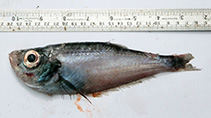 Bathyclupea hoskynii
Picture by Mullasseri, S.
Pictures | Google image
Picture by Mullasseri, S.
Classification / Names Common names | Synonyms | Catalog of Fishes(genus, species) | ITIS | CoL | WoRMS | Cloffa
Teleostei (teleosts) > Acropomatiformes (Oceanic basses) > Bathyclupeidae (Deepsea herring)
Etymology: Bathyclupea: Greek, bathys = deep + Latin, clupea = sardine. See under "clupea" (Ref. 45335).
Eponymy: Commander Richard Frazer Hoskyn (1848–1892) was a British naval officer who was Commander of ‘HMS Investigator’ from which the holotypes were collected. [...] (Ref. 128868), visit book page.
More on author: Alcock.
Etymology: Bathyclupea: Greek, bathys = deep + Latin, clupea = sardine. See under "clupea" (Ref. 45335).
Eponymy: Commander Richard Frazer Hoskyn (1848–1892) was a British naval officer who was Commander of ‘HMS Investigator’ from which the holotypes were collected. [...] (Ref. 128868), visit book page.
More on author: Alcock.
Environment: milieu / climate zone / depth range / distribution range Ecology
Marine; pelagic-oceanic; depth range 330 - 550 m (Ref. 122568). Deep-water
Distribution Territories | FAO areas | Ecosystems | Occurrences | Point map | Introductions | Faunafri
Indian Ocean: Arabian-Bengal province..
Size / Weight / Age
Maturity: Lm ? range ? - ? cm
Max length : 19.0 cm TL male/unsexed; (Ref. 126025); max. published weight: 76.00 g (Ref. 126025)
Max length : 19.0 cm TL male/unsexed; (Ref. 126025); max. published weight: 76.00 g (Ref. 126025)
Short description Identification keys | Morphology | Morphometrics
This species is distinguished by the following characters: head length (2.8) 2.9-3.1 times in SL; maximum body height 27.8-33.3% SL, usually more than 29%; preanal length 39.8-48.0% SL (usuially less than 45%); anal fin with 30-33 (usually 32-33) rays; developed gill rakers on first arch 27-30, the longest gill rakers 11.9-15.1% of head length; denticles on ventral branches of praeoperculum somewhat weaker than in two other species; 5 (very rarely 4) axonosts of anal fin before first hemapophysis; edges of pectoral fins distinctly blackish (Ref. 122568).
Cross section: compressed.
Cross section: compressed.
Needs better reference. Andaman Sea, 11°31'40"N, 92°46'40"E, Investigator station 115, 188-220 fathoms.
Life cycle and mating behavior Maturity | Reproduction | Spawning | Eggs | Fecundity | Larvae
Main reference
Upload your references | References | Coordinator | Collaborators
Prokofiev, A.M., 2014. Taxonomy and distribution of deepsea herring (Bathyclupeidae) in oceans. J. Ichthyol. 54(8):493-500. (Ref. 122568)
CITES
Not Evaluated
Threat to humans
Harmless
Human uses
FAO - Publication: search | FishSource |
More information
Trophic ecology
Food items (preys)
Diet composition
Food consumption
Food rations
Predators
Food items (preys)
Diet composition
Food consumption
Food rations
Predators
Ecology
Ecology
Ecology
Population dynamics
Growth parameters
Max. ages / sizes
Length-weight rel.
Length-length rel.
Length-frequencies
Mass conversion
Recruitment
Abundance
Growth parameters
Max. ages / sizes
Length-weight rel.
Length-length rel.
Length-frequencies
Mass conversion
Recruitment
Abundance
Life cycle
Reproduction
Maturity
Maturity/Gills rel.
Fecundity
Spawning
Spawning aggregations
Eggs
Egg development
Larvae
Larval dynamics
Reproduction
Maturity
Maturity/Gills rel.
Fecundity
Spawning
Spawning aggregations
Eggs
Egg development
Larvae
Larval dynamics
Anatomy
Gill area
Brain
Otolith
Gill area
Brain
Otolith
Physiology
Body composition
Nutrients
Oxygen consumption
Swimming type
Swimming speed
Visual pigments
Fish sound
Diseases & Parasites
Toxicity (LC50s)
Body composition
Nutrients
Oxygen consumption
Swimming type
Swimming speed
Visual pigments
Fish sound
Diseases & Parasites
Toxicity (LC50s)
Genetics
Genome
Genetics
Heterozygosity
Heritability
Genetic Diversity
Genome
Genetics
Heterozygosity
Heritability
Genetic Diversity
Human related
Aquaculture systems
Aquaculture profiles
Strains
Ciguatera cases
Stamps, coins, misc.
Aquaculture systems
Aquaculture profiles
Strains
Ciguatera cases
Stamps, coins, misc.
Tools
Special reports
Download XML
Internet sources
AFORO (otoliths) | Aquatic Commons | BHL | Cloffa | Websites from users | Check FishWatcher | CISTI | Catalog of Fishes: genus, species | DiscoverLife | ECOTOX | FAO - Publication: search | Faunafri | Fishipedia | Fishtrace | GloBI | Google Books | Google Scholar | Google | IGFA World Record | OneZoom | Open Tree of Life | Otolith Atlas of Taiwan Fishes | PubMed | Reef Life Survey | Socotra Atlas | TreeBase | Tree of Life | Wikipedia: Go, Search | World Records Freshwater Fishing | Zoobank | Zoological Record
Estimates based on models
Preferred temperature (Ref. 123201): 10.6 - 12.8, mean 10.7 °C (based on 5 cells).
Phylogenetic diversity index (Ref. 82804): PD50 = 0.6260 [Uniqueness, from 0.5 = low to 2.0 = high].
Bayesian length-weight: a=0.00501 (0.00195 - 0.01287), b=3.08 (2.86 - 3.30), in cm total length, based on LWR estimates for this (Sub)family-body shape (Ref. 93245).
Trophic level (Ref. 69278): 3.5 ±0.5 se; based on size and trophs of closest relatives