Common names from other countries
>
Clupeiformes (Herrings) >
Engraulidae (Anchovies) > Engraulinae
Etymology: Encrasicholina: Greek, egkrasicholos, -os, -on = mixed with spleen.
More on author: Fowler.
Ambiente: milieu / zona climática / intervalo de profundidade / gama de distribuição
Ecologia
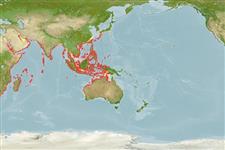
marinhas associadas(os) a recifes; oceanódromo (Ref. 51243); intervalo de profundidade 5 - 35 m (Ref. 86942). Tropical; 42°N - 35°S, 30°E - 140°E (Ref. 189)
Indo-Pacific: Red Sea and Persian Gulf south to perhaps Durban in South Africa, Pakistan, India, Sri Lanka, and probably Burma. Also from southern Japan to China, Philippines, Thailand, Indonesia south to Brisbane, Australia, Japan eastward to Hawaii, the Solomon Islands, Fiji, Samoa and Tahiti.
Comprimento na primeira maturidade / Tamanho / Peso / Idade
Maturidade: Lm ?, range 7 - ? cm
Max length : 13.0 cm TL macho/indeterminado; (Ref. 189)
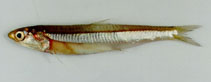
Espinhos dorsais (total) : 0; Raios dorsais moles (total) : 12 - 15; Espinhos anais: 0; Raios anais moles: 14 - 17. Belly rounded with 3 to 6 sharp needle-like pre-pelvic scutes. Maxilla tip blunt, scarcely projecting beyond second supra-maxilla, not reaching to front border of pre-operculum. Isthmus short, preceded by small fleshy plate on urohyal between branchial membranes. Anal fin short, its origin behind base of last dorsal fin ray.
Body shape (shape guide): fusiform / normal; Cross section: circular.
Epipelagic (Ref. 58302). A schooling species found inshore and in oceanic waters, hundreds of miles from land. Sometimes entering large atoll lagoons or deep, clear bays. Ranks among the most important food (bait) for tuna and other large pelagic fishes (Ref. 1602). Processed into nuoc-mam, a kind of fish pickle, in Indo-China (Ref. 4929).
Spawn in school (Ref. 205).
Whitehead, P.J.P., G.J. Nelson and T. Wongratana, 1988. FAO Species Catalogue. Vol. 7. Clupeoid fishes of the world (Suborder Clupeoidei). An annotated and illustrated catalogue of the herrings, sardines, pilchards, sprats, shads, anchovies and wolf-herrings. FAO Fish. Synop. 125(7/2):305-579. Rome: FAO. (Ref. 189)
Categoria na Lista Vermelha da IUCN (Ref. 130435: Version 2025-2 (Global))
Ameaça para o homem
Harmless
Utilização humana
Pescarias: pouco comercial; isco: usually
Ferramentas
Relatórios especiais
Descarregue XML
Fontes da internet
Estimativas baseadas em modelos
Temperatura preferida (Ref.
123201): 24.7 - 29.2, mean 28.3 °C (based on 928 cells).
Índice de diversidade filogenética (Ref.
82804): PD
50 = 0.5005 [Uniqueness, from 0.5 = low to 2.0 = high].
Bayesian length-weight: a=0.00479 (0.00305 - 0.00750), b=3.26 (3.13 - 3.39), in cm total length, based on LWR estimates for this species & (Sub)family-body (Ref.
93245).
Nível Trófico (Ref.
69278): 3.4 ±0.45 se; based on food items.
Resiliência (Ref.
120179): Elevada, tempo mínimo de duplicação da população menor que 15 meses (K=1.1-2.0).
Vulnerabilidade da pesca (Ref.
59153): Low vulnerability (12 of 100).
🛈
Nutrientes (Ref.
124155): Calcium = 124 [38, 413] mg/100g; Iron = 1.16 [0.41, 3.17] mg/100g; Protein = 20 [17, 22] %; Omega3 = 0.323 [0.144, 0.762] g/100g; Selenium = 37.7 [12.9, 120.3] μg/100g; VitaminA = 49.4 [9.8, 236.8] μg/100g; Zinc = 1.28 [0.70, 3.00] mg/100g (wet weight);