Galeorhinus galeus, Tope shark : fisheries, gamefish, aquarium

You can sponsor this page

Galeorhinus galeus (Linnaeus, 1758)

Tope shark
Adicionar as suas observações no Fish Watcher
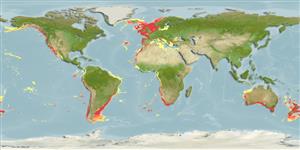
Native range | All suitable habitat | Point map | Year 2050
This map was computer-generated and has not yet been reviewed.
Galeorhinus galeus   AquaMaps   Data sources: GBIF OBIS
Adicionar o seu Fotografias e vídeos
Fotografias | vídeos | Imagem do Google
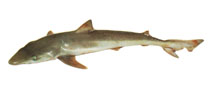
Image of Galeorhinus galeus (Tope shark)
Galeorhinus galeus
Fotografia de SeaFIC


South Africa territory information

Common names: Sopvinhaai, Soupfin shark, Vaalhaai
Occurrence: native
Salinity: marine
Abundance: | Ref:
Importance: minor commercial | Ref: van der Elst, R.P. and F. Adkin (eds.), 1991
Aquaculture: | Ref:
Regulations: no regulations | Ref: van der Elst, R., 1993
Uses: gamefish: yes;
Comments: Ranges from the west coast to East London. Common along the Cape coast. Status of stock indeterminate; most abundant in the southwest coast; an important component of Gansbaai commercial shark fishery; taken by recreational anglers (Ref. 4332). Made into fish biltong or jerky (Ref. 12484). Angling record 32.5 kg (Ref. 12484). Also Ref. 244, 5485.
National Checklist:
Territory Information: https://www.cia.gov/library/publications/resources/the-world-factbook/geos/sf.html
National Fisheries Authority:
Occurrences: Occurrences Point map
Main Ref: Compagno, L.J.V., D.A. Ebert and M.J. Smale, 1989
National Database:

Common names from other countries

Classificação / Nomes Nomes comuns | Sinónimos | Catalog of Fishes(Género, Espécies) | ITIS | CoL | WoRMS | Cloffa

Elasmobranchii (tubarões e raias) (sharks and rays) > Carcharhiniformes (Ground sharks) > Triakidae (Houndsharks) > Galeorhininae
Etymology: Galeorhinus: galeo, probably based on G. galeus (see below); rhinus, an ancient name for sharks, from rhine (Gr.), rasp, alluding to their rasp-like skin (See ETYFish)galeus: From galeos, a small shark or dogfish per Aristotle (sometimes translated as weasel), possibly referring to the pointed snouts, swift movements and/or rapacious feeding behavior of smaller predatory sharks1 (See ETYFish).
More on author: Linnaeus.

Ambiente: milieu / zona climática / intervalo de profundidade / gama de distribuição Ecologia

marinhas bentopelágico; oceanódromo (Ref. 51243); intervalo de profundidade 0 - 1100 m (Ref. 26346), usually 2 - 471 m (Ref. 43939). Subtropical; 70°N - 58°S, 111°E - 37°E

Distribuição Territórios | Áreas FAO | Ecossistemas | Ocorrências | Mapa dos pontos | Introduções | Faunafri

World-wide in cold to warm temperate waters.

Comprimento na primeira maturidade / Tamanho / Peso / Idade

Maturidade: Lm 144.1, range 120 - 185 cm
Max length : 193 cm TL macho/indeterminado; (Ref. 40637); 195.0 cm TL (female); common length : 160 cm TL macho/indeterminado; (Ref. 9258); peso máx. Publicado: 44.7 kg (Ref. 40637); Idade máx. registada: 55 anos (Ref. 6871)

Descrição breve Chaves de identificação | Morfologia | Morfometria

Espinhos dorsais (total) : 0; Espinhos anais: 0. A large houndshark with a long, pointed snout, a large mouth, and small blade-like teeth; 2nd dorsal about as large as anal fin and terminal caudal lobe as long as rest of fin (Ref. 5578). Greyish above, white below; young with black markings on fins (Ref. 5578).
Body shape (shape guide): elongated.

Biologia     Glossário (ex. epibenthic)

Mainly demersal on continental and insular shelves, but also on the upper slopes, at depths from near shore to 550 m (Ref. 6871), but has been shown to be pelagic in the open ocean (frequently caught on floating tuna longlines over deep water, and many New Zealand-tagged specimens have been recaptured in Australia) (Ref. 26346). Occurs in small schools that are highly migratory in higher latitudes in their range (Ref. 244). There is pronounced partial segregation by size and sex in some areas (Ref. 244). Feeds on fishes (bottom as well as pelagic species, Ref. 26346), crustaceans, cephalopods, worms, and echinoderms (Ref. 244). Ovoviviparous (Ref. 50449). Targeted for human consumption, liver for squalene oil, fins for soup (Ref. 244); also utilized as fishmeal (Ref. 13563). Marketed fresh, dried-salted, and frozen (Ref. 9987). Adapts well in captivity if carefully captured and handled (Ref. 12951).

Ciclo de vida e comportamento de acasalamento Maturidade | Reprodução | Desova | Ovos | Fecundidade | Larvas

Ovoviviparous, without a yolk-sac placenta (Ref. 244). Embryos feed solely on yolk (Ref. 50449). 6 to 52 young in a litter (Ref. 26346). Litter size increases with the size of the mother. Embryos reach 30-36 cm TL at birth (Ref. 6080). In the southern waters of Australia, newly born and older juveniles (30-70 cm long) aggregate in 'nursery areas' found in shallow waters.They move to deeper coastal waters to over-winter. The following spring finds most of these young returning to their nursery areas. The older ones, aged 2 years and over move instead to eastern Bass Strait where most of the immature stock are found. The length of an average full-term embryo is 32 cm. Spawning frequency is once every year, ovulation occurring in early summer and parturition is completed by January of the following year. Gestation period lasts for about 12 months (Ref. 6390, 6871).

Referência principal Carregar as suas referências | Referências | Coordenador : Compagno, Leonard J.V. | Colaboradores

Compagno, L.J.V., 1984. FAO Species Catalogue. Vol. 4. Sharks of the world. An annotated and illustrated catalogue of shark species known to date. Part 2 - Carcharhiniformes. FAO Fish. Synop. 125(4/2):251-655. Rome: FAO. (Ref. 244)

Categoria na Lista Vermelha da IUCN (Ref. 130435: Version 2025-2 (Global))

  Criticamente ameaçada (CR) (A2bd); Date assessed: 14 February 2020

CITES

Not Evaluated

Ameaça para o homem

  Harmless (Ref. 13563)


Utilização humana

Pescarias: altamente comercial; peixe desportivo: sim; Aquário: Aquários públicos
FAO - pescarias: desembarques, perfil da espécie; Publication: search | FishSource | Sea Around Us

Mais informação

Ciclo de vida
Reprodução
Maturidade
Maturidade/Rel. das guelras
Fecundidade
Desova
Agregações de desova
Ovos
Desenvolvimento dos ovos
Larvas
Dinâmica larvar
Distribuição
Territórios
Áreas FAO
Ecossistemas
Ocorrências
Introduções
BRUVS - Vídeos
Anatomia
Área branquial
Cérebro
Otólitos
Fisiologia
Composição corporal
Nutrientes
Consumo de oxigénio
Tipo de natação
Velocidade de natação
Pigmentos visuais
Som de peixe
Doenças e Parasitas
Toxicidade (LC50s)
Genética
genoma
Genética
Heterozigotia
Hereditariedade
Relacionado com o ser humano
Sistemas de aquacultura
Perfis para aquacultura
Estirpes
Casos de Ciguatera
Selos, moedas, diversos.
Divulgação
Colaboradores
Referências
Referências

Ferramentas

Relatórios especiais

Descarregue XML

Fontes da internet

AFORO (otoliths) | Aquatic Commons | BHL | Cloffa | Websites from users | Consultar FishWatcher | CISTI | Catalog of Fishes: Género, Espécies | DiscoverLife | ECOTOX | FAO - pescarias: desembarques, perfil da espécie; Publication: search | Faunafri | Fishipedia | Fishtrace | GloBI | Google Books | Google Scholar | Google | IGFA World Record | Bases de dados nacionais | OceanAdapt | OneZoom | Open Tree of Life | Otolith Atlas of Taiwan Fishes | Aquários públicos | PubMed | Reef Life Survey | Socotra Atlas | TreeBase | Árvore da vida | Wikipedia: ir para, procurar | World Records Freshwater Fishing | Registo zoológico

Estimativas baseadas em modelos

Temperatura preferida (Ref. 123201): 6.7 - 23.2, mean 12.3 °C (based on 7314 cells).
Índice de diversidade filogenética (Ref. 82804):  PD50 = 1.0000   [Uniqueness, from 0.5 = low to 2.0 = high].
Bayesian length-weight: a=0.00479 (0.00363 - 0.00631), b=2.99 (2.91 - 3.07), in cm total length, based on LWR estimates for this species (Ref. 93245).
Nível Trófico (Ref. 69278):  4.3   ±0.1 se; based on diet studies.
Generation time: 11.9 (6.9 - 14.7) years. Estimated as median ln(3)/K based on 12 growth studies.
Resiliência (Ref. 120179):  Baixo, tempo mínimo de duplicação da população 4,5 - 14 anos (rm=0.033; tmax=55; Fec=6-52).
Prior r = 0.06, 95% CL = 0.04 - 0.09, Based on 2 full stock assessments.
Vulnerabilidade da pesca (Ref. 59153):  Very high vulnerability (76 of 100). 🛈
Vulnerabilidade climática (Ref. 125649):  High vulnerability (62 of 100). 🛈
Categoria de preço (Ref. 80766):   Medium.
Nutrientes (Ref. 124155):  Calcium = 8.56 [1.46, 48.15] mg/100g; Iron = 0.465 [0.128, 1.502] mg/100g; Protein = 20 [18, 22] %; Omega3 = 0.18 [0.11, 0.30] g/100g; Selenium = 44.2 [13.5, 139.5] μg/100g; VitaminA = 13.1 [4.2, 44.7] μg/100g; Zinc = 0.409 [0.194, 0.769] mg/100g (wet weight); based on nutrient studies.