Brosme brosme, Cusk : fisheries, gamefish

You can sponsor this page

Brosme brosme (Ascanius, 1772)

Cusk
Adicionar as suas observações no Fish Watcher
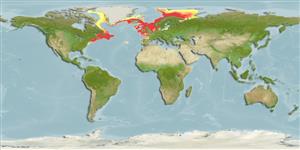
Native range | All suitable habitat | Point map | Year 2050
This map was computer-generated and has not yet been reviewed.
Brosme brosme   AquaMaps   Data sources: GBIF OBIS
Adicionar o seu Fotografias e vídeos
Fotografias | vídeos | Imagem do Google
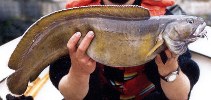
Image of Brosme brosme (Cusk)
Brosme brosme
Fotografia de Østergaard, T.


Russia / Russian Federation territory information

Common names: Menek, Menyok, менек
Occurrence: native
Salinity: marine
Abundance: occasional (usually not seen) | Ref: Cohen, D.M., T. Inada, T. Iwamoto and N. Scialabba, 1990
Importance: subsistence fisheries | Ref:
Aquaculture: | Ref:
Regulations: | Ref:
Uses: no uses
Comments:
National Checklist:
Territory Information: https://www.cia.gov/library/publications/resources/the-world-factbook/geos/rs.html
National Fisheries Authority:
Occurrences: Occurrences Point map
Main Ref: Cohen, D.M., T. Inada, T. Iwamoto and N. Scialabba, 1990
National Database:

Common names from other countries

Classificação / Nomes Nomes comuns | Sinónimos | Catalog of Fishes(Género, Espécies) | ITIS | CoL | WoRMS | Cloffa

> Gadiformes (Cods) > Lotidae (Hakes and burbots)
Etymology: Brosme: Greek, brosomai, bibrosko = to eat up, to devour (Ref. 45335).

Ambiente: milieu / zona climática / intervalo de profundidade / gama de distribuição Ecologia

marinhas demersal; oceanódromo (Ref. 51243); intervalo de profundidade 18 - 1000 m (Ref. 1371), usually 18 - 549 m (Ref. 1371). Temperate; 83°N - 37°N, 75°W - 57°E (Ref. 1371)

Distribuição Territórios | Áreas FAO | Ecossistemas | Ocorrências | Mapa dos pontos | Introduções | Faunafri

Northwest Atlantic: New Jersey to the Strait of Belle Isle and on the Grand Banks of Newfoundland. Rare at the southern tip of Greenland. Northeast Atlantic: off Iceland, in the northern North Sea, and along the coast of Scandinavia to the Murmansk Coast and at Spitzbergen.

Comprimento na primeira maturidade / Tamanho / Peso / Idade

Maturidade: Lm 53.3, range 50 - ? cm
Max length : 120 cm TL macho/indeterminado; (Ref. 9988); common length : 50.0 cm TL macho/indeterminado; (Ref. 1371); peso máx. Publicado: 30.0 kg (Ref. 9988); Idade máx. registada: 20 anos (Ref. 1371)

Descrição breve Chaves de identificação | Morfologia | Morfometria

Espinhos dorsais (total) : 0; Raios dorsais moles (total) : 93 - 103; Raios anais moles: 62 - 75; Vértebras: 64 - 67. Barbel on present on chin, none on snout, its length equal to eye diameter. Color is variable; dorsally dark red-brown or green brown to yellow shading into pale color on belly. Young specimens may have six transverse yellow bands on sides. Vertical fins with dark margin rimmed with white.
Body shape (shape guide): elongated; Cross section: oval.

Biologia     Glossário (ex. epibenthic)

Found in small shoals on rough, rock, gravel, or pebble bottoms. Generally keeps far from the shore, near the bottom, mostly between 150 and 450 m in the northeastern Atlantic, and between 18 and 550 m in the northwestern Atlantic. Occurs at a temperature range of 0°-10° C (Ref. 9988). Solitary or in small groups. Feeds on crustaceans and shellfishes, benthic fishes (flatfishes and gurnard) and even on starfishes. Preyed upon by seals (Ref. 9988). Sold fresh, frozen as fillets or dried salted. Eaten steamed, fried, broiled, boiled, microwaved and baked (Ref. 9988).

Ciclo de vida e comportamento de acasalamento Maturidade | Reprodução | Desova | Ovos | Fecundidade | Larvas

Spawns in shallower waters between 40-400 m, usually 100 to 200 m. Most important spawning grounds are located between Scotland and Iceland, from 200 to 500 m depth. In the Gulf of Maine, spawning grounds can be found in shallower waters (>50 m). Some individuals even spawn close inshore in Cape Cod, Provincetown Harbor and the Isles of Shoals (Ref. 1371).

Referência principal Carregar as suas referências | Referências | Coordenador | Colaboradores

Cohen, D.M., T. Inada, T. Iwamoto and N. Scialabba, 1990. FAO species catalogue. Vol. 10. Gadiform fishes of the world (Order Gadiformes). An annotated and illustrated catalogue of cods, hakes, grenadiers and other gadiform fishes known to date. FAO Fish. Synop. 125(10). Rome: FAO. 442 p. (Ref. 1371)

Categoria na Lista Vermelha da IUCN (Ref. 130435: Version 2025-2 (Global))


CITES

Not Evaluated

CMS (Ref. 116361)

Not Evaluated

Ameaça para o homem

  Harmless


Utilização humana

Pescarias: altamente comercial; peixe desportivo: sim
FAO - pescarias: desembarques, perfil da espécie; Publication: search | FIRMS - Stock assessments | FishSource | Sea Around Us

Mais informação

Ecologia Trófica
Produtos alimentares (presas)
Composição da dieta
Consumo alimentar
Rações alimentares
Predadores
Ecologia
Ecologia
Home ranges
Dinâmica das populações
Parâmetros de crescimento
Idades / tamanhos máximos
Comprimento-peso rel.
Comprimento-comprimento rel.
Frequência de comprimento
Conversão de massa
Recrutamento
Abundância
Ciclo de vida
Reprodução
Maturidade
Maturidade/Rel. das guelras
Fecundidade
Desova
Agregações de desova
Ovos
Desenvolvimento dos ovos
Larvas
Dinâmica larvar
Distribuição
Territórios
Áreas FAO
Ecossistemas
Ocorrências
Introduções
BRUVS - Vídeos
Anatomia
Área branquial
Cérebro
Otólitos
Fisiologia
Composição corporal
Nutrientes
Consumo de oxigénio
Tipo de natação
Velocidade de natação
Pigmentos visuais
Som de peixe
Doenças e Parasitas
Toxicidade (LC50s)
Genética
genoma
Genética
Heterozigotia
Hereditariedade
Relacionado com o ser humano
Sistemas de aquacultura
Perfis para aquacultura
Estirpes
Casos de Ciguatera
Selos, moedas, diversos.
Divulgação
Colaboradores
Referências
Referências

Ferramentas

Relatórios especiais

Descarregue XML

Fontes da internet

Estimativas baseadas em modelos

Temperatura preferida (Ref. 123201): 0.5 - 7.7, mean 3.6 °C (based on 726 cells).
Índice de diversidade filogenética (Ref. 82804):  PD50 = 1.0312   [Uniqueness, from 0.5 = low to 2.0 = high].
Bayesian length-weight: a=0.00525 (0.00386 - 0.00714), b=3.10 (3.01 - 3.19), in cm total length, based on LWR estimates for this species (Ref. 93245).
Nível Trófico (Ref. 69278):  3.9   ±0.3 se; based on diet studies.
Generation time: 8.1 (6.8 - 11.1) years. Estimated as median ln(3)/K based on 13 growth studies.
Resiliência (Ref. 120179):  Médio, tempo mínimo de duplicação da população 1,4 - 4,4 anos (K=0.08-0.16; tm=8-10; tmax=20; Fec=2 million).
Prior r = 0.45, 95% CL = 0.30 - 0.68, Based on 9 full stock assessments.
Vulnerabilidade da pesca (Ref. 59153):  High vulnerability (58 of 100). 🛈
Vulnerabilidade climática (Ref. 125649):  Moderate vulnerability (44 of 100). 🛈
Categoria de preço (Ref. 80766):   Low.
Nutrientes (Ref. 124155):  Calcium = 20.1 [10.6, 44.7] mg/100g; Iron = 0.308 [0.158, 0.657] mg/100g; Protein = 17.3 [15.5, 19.1] %; Omega3 = 0.376 [0.199, 0.688] g/100g; Selenium = 29.3 [14.7, 59.6] μg/100g; VitaminA = 11.1 [2.7, 41.5] μg/100g; Zinc = 0.364 [0.244, 0.562] mg/100g (wet weight);