Trachurus trachurus, Atlantic horse mackerel : fisheries, gamefish, bait

You can sponsor this page

Trachurus trachurus (Linnaeus, 1758)

Atlantic horse mackerel
Adicionar as suas observações no Fish Watcher
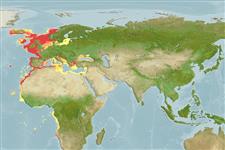
Native range | All suitable habitat | Point map | Year 2050
This map was computer-generated and has not yet been reviewed.
Trachurus trachurus   AquaMaps   Data sources: GBIF OBIS
Adicionar o seu Fotografias e vídeos
Fotografias | vídeos | Selos, moedas, diversos. | Imagem do Google
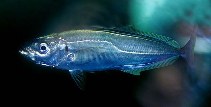
Image of Trachurus trachurus (Atlantic horse mackerel)
Trachurus trachurus
Fotografia de JJPhoto


Portugal territory information

Common names: Carapau, Chicharro
Occurrence: native
Salinity: brackish
Abundance: occasional (usually not seen) | Ref: Veiga, P., J. Ribeiro, J.M.S. Gonçalves and K. Erzini, 2010
Importance: commercial | Ref: FAO, 1994
Aquaculture: | Ref:
Regulations: | Ref:
Uses: no uses
Comments: Found in Tagus estuary (Ref. 51031). Recorded from the south and southwest coast (Ref. 85184).
National Checklist: Portugal
Territory Information: https://www.cia.gov/library/publications/resources/the-world-factbook/geos/po.html
National Fisheries Authority:
Occurrences: Occurrences Point map
Main Ref: Bauchot, M.-L., 1987
National Database: Portuguese Freshwater Fishes

Common names from other countries

Classificação / Nomes Nomes comuns | Sinónimos | Catalog of Fishes(Género, Espécies) | ITIS | CoL | WoRMS | Cloffa

> Carangiformes (Jacks) > Carangidae (Jacks and pompanos) > Caranginae
Etymology: Trachurus: Greek, trachys, -eia, -ys = rough + Greek, oura = tail (Ref. 45335).
More on author: Linnaeus.

Ambiente: milieu / zona climática / intervalo de profundidade / gama de distribuição Ecologia

marinhas pelagic-neritic; oceanódromo (Ref. 51243); intervalo de profundidade 0 - 1050 m (Ref. 54256), usually 100 - 200 m (Ref. 54256). Subtropical; 67°N - 38°S, 26°W - 42°E

Distribuição Territórios | Áreas FAO | Ecossistemas | Ocorrências | Mapa dos pontos | Introduções | Faunafri

Eastern Atlantic: Norway to Cape of Good Hope, South Africa to southwestern Indian Ocean (South Africa to southern Mozambique), and Baltic Sea, North Sea, Mediterranean Sea and Black Sea.

Comprimento na primeira maturidade / Tamanho / Peso / Idade

Maturidade: Lm 22.9, range 21 - 30 cm
Max length : 70.0 cm TL macho/indeterminado; (Ref. 3197); common length : 22.0 cm FL macho/indeterminado; (Ref. 3397); peso máx. Publicado: 2.0 kg (Ref. 27584)

Descrição breve Chaves de identificação | Morfologia | Morfometria

Espinhos dorsais (total) : 9; Raios dorsais moles (total) : 30 - 36; Espinhos anais: 3; Raios anais moles: 24 - 32. Bluish green, grey or black above, silvery white below; opercle with black spot (Ref. 3197). Lateral scales tall and keeled. Gill cover with a distinct black spot. First dorsal fin tall (Ref. 35388).
Body shape (shape guide): fusiform / normal.

Biologia     Glossário (ex. epibenthic)

Adults form large schools in coastal areas with sandy substrate. They feed on fish, crustaceans, and cephalopods. Are batch spawners (Ref. 51846). Females lay 140,000 eggs, which hatch into 5mm long larvae (Ref. 35388). Eggs are pelagic (Ref. 4233). Utilized fresh, smoked, canned and frozen; can be fried, broiled and baked (Ref. 9988). Divided into two stocks: West stock and North Sea stock. West stock spawns in a belt from the Biscay to Ireland in early spring, migrates north and eastwards to southern Norway and northern North Sea. North Sea stock spawns in the southern North Sea in summer, migrates to central North Sea, Skagerrak and Kattegat.

Ciclo de vida e comportamento de acasalamento Maturidade | Reprodução | Desova | Ovos | Fecundidade | Larvas

Referência principal Carregar as suas referências | Referências | Coordenador : Smith-Vaniz, William F. | Colaboradores

Smith-Vaniz, W.F., 1986. Carangidae. p. 815-844. In P.J.P. Whitehead, M.-L. Bauchot, J.-C. Hureau, J. Nielsen and E. Tortonese (eds.) Fishes of the north-eastern Atlantic and the Mediterranean. UNESCO, Paris. vol. 2. (Ref. 4233)

Categoria na Lista Vermelha da IUCN (Ref. 130435: Version 2025-2 (Global))

  Vulnerável (VU) (A2bd); Date assessed: 09 May 2013

CITES

Not Evaluated

CMS (Ref. 116361)

Not Evaluated

Ameaça para o homem

  Harmless


Utilização humana

Pescarias: altamente comercial; peixe desportivo: sim; isco: usually
FAO - pescarias: desembarques, perfil da espécie; Publication: search | FIRMS - Stock assessments | FishSource | Sea Around Us

Mais informação

Ciclo de vida
Reprodução
Maturidade
Maturidade/Rel. das guelras
Fecundidade
Desova
Agregações de desova
Ovos
Desenvolvimento dos ovos
Larvas
Dinâmica larvar
Anatomia
Área branquial
Cérebro
Otólitos
Fisiologia
Composição corporal
Nutrientes
Consumo de oxigénio
Tipo de natação
Velocidade de natação
Pigmentos visuais
Som de peixe
Doenças e Parasitas
Toxicidade (LC50s)
Genética
genoma
Genética
Heterozigotia
Hereditariedade
Relacionado com o ser humano
Sistemas de aquacultura
Perfis para aquacultura
Estirpes
Casos de Ciguatera
Selos, moedas, diversos.
Divulgação
Colaboradores
Referências
Referências

Ferramentas

Relatórios especiais

Descarregue XML

Fontes da internet

AFORO (otoliths) | Aquatic Commons | BHL | Cloffa | Websites from users | Consultar FishWatcher | CISTI | Catalog of Fishes: Género, Espécies | DiscoverLife | DORIS | ECOTOX | FAO - pescarias: desembarques, perfil da espécie; Publication: search | Faunafri | Fishipedia | Fishtrace | GloBI | Google Books | Google Scholar | Google | IGFA World Record | Bases de dados nacionais | OneZoom | Open Tree of Life | Otolith Atlas of Taiwan Fishes | Aquários públicos | PubMed | Reef Life Survey | Socotra Atlas | TreeBase | Árvore da vida | Wikipedia: ir para, procurar | World Records Freshwater Fishing | Registo zoológico

Estimativas baseadas em modelos

Temperatura preferida (Ref. 123201): 10.6 - 16.6, mean 13.3 °C (based on 165 cells).
Índice de diversidade filogenética (Ref. 82804):  PD50 = 0.5001   [Uniqueness, from 0.5 = low to 2.0 = high].
Bayesian length-weight: a=0.00813 (0.00745 - 0.00886), b=2.97 (2.95 - 2.99), in cm total length, based on LWR estimates for this species (Ref. 93245).
Nível Trófico (Ref. 69278):  3.7   ±0.0 se; based on diet studies.
Generation time: 6.5 (5.1 - 7.6) years. Estimated as median ln(3)/K based on 25 growth studies.
Resiliência (Ref. 120179):  Médio, tempo mínimo de duplicação da população 1,4 - 4,4 anos (K=0.18; tm=2-4; tmax=11).
Prior r = 0.39, 95% CL = 0.26 - 0.58, Based on 13 full stock assessments.
Vulnerabilidade da pesca (Ref. 59153):  High vulnerability (56 of 100). 🛈
Vulnerabilidade climática (Ref. 125649):  Low vulnerability (25 of 100). 🛈
Categoria de preço (Ref. 80766):   Medium.
Nutrientes (Ref. 124155):  Calcium = 184 [129, 263] mg/100g; Iron = 3.67 [2.45, 5.60] mg/100g; Protein = 19.4 [18.8, 20.0] %; Omega3 = 0.355 [0.260, 0.479] g/100g; Selenium = 33.4 [24.6, 45.6] μg/100g; VitaminA = 13.5 [4.0, 54.4] μg/100g; Zinc = 1.66 [1.34, 2.16] mg/100g (wet weight); based on nutrient studies.