Galeorhinus galeus, Tope shark : fisheries, gamefish, aquarium

You can sponsor this page

Galeorhinus galeus (Linnaeus, 1758)

Tope shark
Aggiungete la vostra osservazione in Fish Watcher
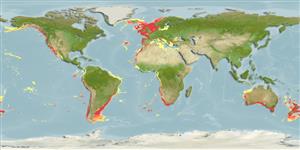
Native range | All suitable habitat | Point map | Year 2050
This map was computer-generated and has not yet been reviewed.
Galeorhinus galeus   AquaMaps   Data sources: GBIF OBIS
Carica il tuo foto e Video
Immagini | Video | Google image
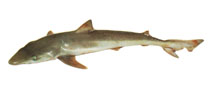
Image of Galeorhinus galeus (Tope shark)
Galeorhinus galeus
Immagine di SeaFIC


New Zealand territory information

Common names: Flake, Greyboy, Greyshark
Occurrence: native
Salinity: marine
Abundance: common (usually seen) | Ref: Cox, G. and M. Francis, 1997
Importance: commercial | Ref: Armitage, R.O., D.A. Payne, G.J. Lockley, H.M. Currie, R.L. Colban, B.G. Lamb and L.J. Paul (eds.), 1994
Aquaculture: | Ref:
Regulations: restricted | Ref: Cox, G. and M. Francis, 1997
Uses: gamefish: yes;
Comments: Recorded in trawl surveys in Chathams Island (Ref. 45493) and off the east coast of South Island (Ref. 58461). One of the most common sharks (reaching only about 170 cm TL) in New Zealand inshore waters. In the past, this species was one of the two main shark targets of the Maori; it was caught in large numbers in set nets duing the shark's annual inshore migration and was utilized as food and the liver oil was mixed with red ochre to make the distinctive red paint used by the Maori on their carvinges. A significant proportion of school sharks tagged in New Zealand have crossed the Tasman Sea to Australia. Commercially caught with longlines (Ref. 26346), trawls or set lines (Ref. 9258). Available throughout the year but landings peak during summer months (Ref. 9258). Taken as a non-target species by game fishers. Voucher specimen(s) held at the NMNZ (Ref. 5755). Also Ref. 244, 9987, 13563, 75154.
National Checklist:
Territory Information: https://www.cia.gov/library/publications/resources/the-world-factbook/geos/nz.html
National Fisheries Authority: http://www.fish.govt.nz/
Occurrences: Occurrences Point map
Main Ref: Cox, G. and M. Francis, 1997
National Database:

Common names from other countries

Classificazione / Nomi Nomi Comuni | Sinonimi | Catalog of Fishes(Genere, Specie) | ITIS | CoL | WoRMS | Cloffa

Elasmobranchi (squali e razze) (sharks and rays) > Carcharhiniformes (Ground sharks) > Triakidae (Houndsharks) > Galeorhininae
Etymology: Galeorhinus: galeo, probably based on G. galeus (see below); rhinus, an ancient name for sharks, from rhine (Gr.), rasp, alluding to their rasp-like skin (See ETYFish)galeus: From galeos, a small shark or dogfish per Aristotle (sometimes translated as weasel), possibly referring to the pointed snouts, swift movements and/or rapacious feeding behavior of smaller predatory sharks1 (See ETYFish).
More on author: Linnaeus.

Ambiente: milieu / zona climatica / distribuzione batimetrica / gamma di distribuzione Ecologia

marino benthopelagico; oceanodromo (Ref. 51243); distribuzione batimetrica 0 - 1100 m (Ref. 26346), usually 2 - 471 m (Ref. 43939). Subtropical; 70°N - 58°S, 111°E - 37°E

Distribuzione Territories | Aree FAO | Ecosistemi | Presenze | Mappa dei ritrovamenti | Introduzioni | Faunafri

World-wide in cold to warm temperate waters.

Lunghezza alla prima maturità / Dimensione / Peso / Età

Maturità: Lm 144.1, range 120 - 185 cm
Max length : 193 cm TL maschio/sesso non determinato; (Ref. 40637); 195.0 cm TL (female); common length : 160 cm TL maschio/sesso non determinato; (Ref. 9258); peso massimo pubblicato: 44.7 kg (Ref. 40637); Età massima riportata: 55 anni (Ref. 6871)

Breve descrizione Chiavi di identificazione | Morfologia | Morfometria

Spine dorsali (totale) : 0; Spine anali: 0. A large houndshark with a long, pointed snout, a large mouth, and small blade-like teeth; 2nd dorsal about as large as anal fin and terminal caudal lobe as long as rest of fin (Ref. 5578). Greyish above, white below; young with black markings on fins (Ref. 5578).
Body shape (shape guide): elongated.

Biologia     Glossario (es. epibenthic)

Mainly demersal on continental and insular shelves, but also on the upper slopes, at depths from near shore to 550 m (Ref. 6871), but has been shown to be pelagic in the open ocean (frequently caught on floating tuna longlines over deep water, and many New Zealand-tagged specimens have been recaptured in Australia) (Ref. 26346). Occurs in small schools that are highly migratory in higher latitudes in their range (Ref. 244). There is pronounced partial segregation by size and sex in some areas (Ref. 244). Feeds on fishes (bottom as well as pelagic species, Ref. 26346), crustaceans, cephalopods, worms, and echinoderms (Ref. 244). Ovoviviparous (Ref. 50449). Targeted for human consumption, liver for squalene oil, fins for soup (Ref. 244); also utilized as fishmeal (Ref. 13563). Marketed fresh, dried-salted, and frozen (Ref. 9987). Adapts well in captivity if carefully captured and handled (Ref. 12951).

Ciclo vitale e comportamento di accoppiamento Maturità | Riproduzione | Deposizione | Uova | Fecondità | Larve

Ovoviviparous, without a yolk-sac placenta (Ref. 244). Embryos feed solely on yolk (Ref. 50449). 6 to 52 young in a litter (Ref. 26346). Litter size increases with the size of the mother. Embryos reach 30-36 cm TL at birth (Ref. 6080). In the southern waters of Australia, newly born and older juveniles (30-70 cm long) aggregate in 'nursery areas' found in shallow waters.They move to deeper coastal waters to over-winter. The following spring finds most of these young returning to their nursery areas. The older ones, aged 2 years and over move instead to eastern Bass Strait where most of the immature stock are found. The length of an average full-term embryo is 32 cm. Spawning frequency is once every year, ovulation occurring in early summer and parturition is completed by January of the following year. Gestation period lasts for about 12 months (Ref. 6390, 6871).

Riferimento principale Caricare le referenze | Bibliografia | Coordinatore : Compagno, Leonard J.V. | Collaboratori

Compagno, L.J.V., 1984. FAO Species Catalogue. Vol. 4. Sharks of the world. An annotated and illustrated catalogue of shark species known to date. Part 2 - Carcharhiniformes. FAO Fish. Synop. 125(4/2):251-655. Rome: FAO. (Ref. 244)

Stato della Lista Rossa IUCN (Ref. 130435: Version 2025-2 (Global))

  Critically Endangered (CR) (A2bd); Date assessed: 14 February 2020

CITES

Not Evaluated

Minaccia per l'uomo

  Harmless (Ref. 13563)


Usi umani

Pesca: elevato interesse commerciale; Pesce da pesca sportiva: si; Acquario: Acquari pubblici
FAO - pesca: sbarchi, profilo della specie; Publication: search | FishSource | Sea Around Us

Informazioni ulteriori

Ciclo di vita
Riproduzione
Maturità
Maturità/Gli occhielli sono relativi.
Fecondità
Deposizione
Aggregazioni riproduttive
Uova
Sviluppo delle uova
Larve
Dinamica popolazioni larvali
Distribuzione
Territories
Aree FAO
Ecosistemi
Presenze
Introduzioni
BRUVS - Video
Anatomia
Area branchiale
Cervello
Otolite
Fisiologia
Composizione corporea
Nutrienti
Consumo di ossigeno
Tipo di nuoto
Velocità di nuoto
Pigmenti visivi
Suono del pesce
Malattie e parassiti
Tossicità (LC50)
Genetica
Genome
Genetica
Eterozigosi
Ereditarietà
Legato all'uomo
Sistemi di acquacoltura
Profili di acquacoltura
Varietà
Casi di Ciguatera
Francobolli, monete, materiale vario.
Raggiungimento
Collaboratori
Bibliografia
Bibliografia

Strumenti

Rapporti speciali

Scarica XML

Fonti Internet

AFORO (otoliths) | Aquatic Commons | BHL | Cloffa | Websites from users | Check FishWatcher | CISTI | Catalog of Fishes: Genere, Specie | DiscoverLife | ECOTOX | FAO - pesca: sbarchi, profilo della specie; Publication: search | Faunafri | Fishipedia | Fishtrace | GloBI | Google Books | Google Scholar | Google | IGFA World Record | Database Nazionali | OceanAdapt | OneZoom | Open Tree of Life | Otolith Atlas of Taiwan Fishes | Acquari pubblici | PubMed | Reef Life Survey | Socotra Atlas | TreeBase | Tree of Life | Wikipedia: Go, ricerca | World Records Freshwater Fishing | Record zoologico

Stime basate su modelli

Temperatura preferita (Fonte Biblio. 123201): 6.7 - 23.2, mean 12.3 °C (based on 7314 cells).
Indice di diversità filogenetica (Fonte Biblio. 82804):  PD50 = 1.0000   [Uniqueness, from 0.5 = low to 2.0 = high].
Bayesian length-weight: a=0.00479 (0.00363 - 0.00631), b=2.99 (2.91 - 3.07), in cm total length, based on LWR estimates for this species (Ref. 93245).
Livello trofico (Fonte Biblio. 69278):  4.3   ±0.1 se; based on diet studies.
Generation time: 11.9 (6.9 - 14.7) years. Estimated as median ln(3)/K based on 12 growth studies.
Resilienza (Fonte Biblio. 120179):  Basso, tempo minimo di raddoppiamento della popolazione 4.5 - 14 anni (rm=0.033; tmax=55; Fec=6-52).
Prior r = 0.06, 95% CL = 0.04 - 0.09, Based on 2 full stock assessments.
Vulnerabilità della pesca (Ref. 59153):  Very high vulnerability (76 of 100). 🛈
Vulnerabilità climatica (Ref. 125649):  High vulnerability (62 of 100). 🛈
Categoria di prezzo (Ref. 80766):   Medium.
Nutrienti (Ref. 124155):  Calcium = 8.56 [1.46, 48.15] mg/100g; Iron = 0.465 [0.128, 1.502] mg/100g; Protein = 20 [18, 22] %; Omega3 = 0.18 [0.11, 0.30] g/100g; Selenium = 44.2 [13.5, 139.5] μg/100g; VitaminA = 13.1 [4.2, 44.7] μg/100g; Zinc = 0.409 [0.194, 0.769] mg/100g (wet weight); based on nutrient studies.