Common names from other countries
Classification / Names
Nomi Comuni | Sinonimi | Catalog of Fishes(Genere, Specie) | ITIS | CoL | WoRMS | Cloffa
>
Cypriniformes (Carps) >
Nemacheilidae (Brook loaches)
Etymology: Barbatula: Diminutive of Latin barba,-ae = beard (Ref. 45335); selengensis: Name 'selengensis' from the type locality of the species, Selenga (Selenghe) river basin.
Environment: milieu / climate zone / distribuzione batimetrica / distribution range
Ecologia
; acqua dolce demersale. Temperate
Asia: Mongolia.
Size / Peso / Age
Maturità: Lm ? range ? - ? cm
Max length : 10.3 cm SL maschio/sesso non determinato; (Ref. 133452)
Short description
Chiavi di identificazione | Morfologia | Morfometria
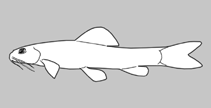
Raggi dorsali molli (totale) : 10; Raggi anali molli: 7; Vertebre: 40 - 44. This species is distinguished by the following set of characters: snout laterally compressed, with width positioned immediately before anterior nostril 1.7-2.0 times smaller than greatest width of head; anterior and posterior nostril widely separated; upper lip crenulate or weakly furrowed; lower lip with two deep furrows, conspicuous simple mental lobes and short lateral expansions; supratemporal commissure complete, with 3 pores; predorsal distance 53.4-57.1,
mean 54-55 % SL; branched dorsal fin rays 7, tips of paired fins formed by second to third branched rays; caudal fin with straight to very weakly emarginated distal margin; vertebrae 40-44, modally 38; body scaled; dark pattern on body consists of irregular blotches often confluent into short transverse bars or longitudinal band along lateral line, no distinct dorsal saddles; peritoneum brownish, becoming paler with mottles ventrally (Ref. 133452).
Cross section: compressed.
Life cycle and mating behavior
Maturità | Riproduzione | Deposizione | Uova | Fecundity | Larve
Prokofiev, A.M., 2024. A new species of Barbatula from the Selenga River Basin, Mongolia and a revised key to the species from Siberia and Mongolia (Teleostei: Cypriniformes: Nemacheilidae). Mun. Ent. Zool. 19(2):1121-1126. (Ref. 133452)
IUCN Red List Status (Ref. 130435: Version 2025-1)
Threat to humans
Harmless
Human uses
Pesca: di nessun interesse
Strumenti
Special reports
Download XML
Fonti Internet
Estimates based on models
Phylogenetic diversity index (Fonte Biblio.
82804): PD
50 = 0.5000 [Uniqueness, from 0.5 = low to 2.0 = high].
Trophic level (Fonte Biblio.
69278): 2.7 ±0.3 se; based on size and trophs of closest relatives
Resilienza (Fonte Biblio.
120179): Medio, tempo minimo di raddoppiamento della popolazione 1.4 - 4.4 anni (Preliminary K or Fecundity.).
Fishing Vulnerability (Ref.
59153): Low vulnerability (10 of 100).
🛈