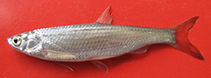
Hemiculter leucisculus, Sharpbelly : fisheries, gamefish

You can sponsor this page

Hemiculter leucisculus (Basilewsky, 1855)

Sharpbelly
Adicionar o seu Fotografias e vídeos
Fotografias | Imagem do Google
Image of Hemiculter leucisculus (Sharpbelly)
Hemiculter leucisculus
Fotografia de Abbasi, K.


Mongolia country information

Common names: Buyr sawbelly
Occurrence: native
Salinity: freshwater
Abundance: | Ref:
Importance: | Ref:
Aquaculture: | Ref:
Regulations: | Ref:
Uses: no uses
Comments: Known from Lakes Buir and Bayan (Ref. 57778).
National Checklist:
Country Information: https://www.cia.gov/library/publications/resources/the-world-factbook/geos/mg.html
National Fisheries Authority:
Occurrences: Occurrences Point map
Main Ref: Dulmaa, A., 1999
National Database:

Common names from other countries

Classificação / Names Nomes comuns | Sinónimos | Catalog of Fishes(Género, Espécies) | ITIS | CoL | WoRMS | Cloffa

> Cypriniformes (Carps) > Xenocyprididae (East Asian minnows)
Etymology: Hemiculter: Greek, hemis = the half + Latin, culter = knife (Ref. 45335).

Environment: milieu / climate zone / intervalo de profundidade / distribution range Ecologia

; Água doce; estuarina bentopelágico; pH range: 7.0 - ? ; dH range: 15 - ?; intervalo de profundidade 0 - 10 m (Ref. 6898). Tropical; 18°C - 22°C (Ref. 2059)

Distribuição Países | Áreas FAO | Ecossistemas | Ocorrências | Mapa dos pontos | Introduções | Faunafri

Asia: China, North and South Korea, Hong Kong, Japan and Amur River basin (Ref. 1441) to Red River drainages; Mongolia (Ref. 57778). Several countries report adverse ecological impact after introduction. Introduced in Iran (Ref. 39702).

Length at first maturity / Tamanho / Peso / Idade

Maturidade: Lm 10.3, range 9 - 13 cm
Max length : 29.0 cm TL macho/indeterminado; (Ref. 128900); common length : 16.9 cm SL macho/indeterminado; (Ref. 35840); peso máx. Publicado: 232.30 g (Ref. 128900)

Descrição breve Chaves de identificação | Morfologia | Morfometria

Espinhos dorsais (total) : 3; Raios dorsais moles (total) : 7; Espinhos anais: 3; Raios anais moles: 11 - 13. Completed lateral line, went downward suddenly at the pectoral fin, forming an angle, going upward along the anal fin, till the middle of the caudal fin. Green gray in the back, white in the stomach (Ref. 33303).
Body shape (shape guide): fusiform / normal.

Biologia     Glossário (ex. epibenthic)

The species is common in large streams and reservoirs in Hong Kong but not favored as a table fish because the flesh is unpalatable and very bony; abundant in China where it is canned. The main bulk of the diet includes zooplankton, insects, crustaceans, algae and detritus.

Life cycle and mating behavior Maturidade | Reprodução | Desova | Ovos | Fecundidade | Larvas

Referência principal Upload your references | Referências | Coordenador | Colaboradores

Berg, L.S., 1964. Freshwater fishes of the U.S.S.R. and adjacent countries. volume 2, 4th edition. Israel Program for Scientific Translations Ltd, Jerusalem. (Russian version published 1949). (Ref. 1441)

Categoria na Lista Vermelha da IUCN (Ref. 130435: Version 2025-1)

  Preocupação menor (LC) ; Date assessed: 26 April 2010

CITES

Not Evaluated

CMS (Ref. 116361)

Not Evaluated

Ameaça para o homem

  Potential pest


Utilização humana

Pescarias: pouco comercial; peixe desportivo: sim
FAO - Publication: search | FishSource |

Mais informação

Ecologia Trófica
Food items (preys)
Composição da dieta
Consumo alimentar
Food rations
Predadores
Ecologia
Ecologia
Home ranges
Life cycle
Reprodução
Maturidade
Maturity/Gills rel.
Fecundidade
Desova
Spawning aggregations
Ovos
Desenvolvimento dos ovos
Larvas
Dinâmica larvar
Distribuição
Países
Áreas FAO
Ecossistemas
Ocorrências
Introduções
BRUVS - Videos
Anatomy
Área branquial
Brain
Otolith
Physiology
Body composition
Nutrients
Consumo de oxigénio
Tipo de natação
Velocidade de natação
Visual pigments
Fish sound
Diseases & Parasites
Toxicity (LC50s)
Genética
genoma
Genética
Heterozygosity
Hereditariedade
Human related
Aquaculture systems
Perfis para aquacultura
Estirpes
Ciguatera cases
Stamps, coins, misc.
Outreach
Colaboradores
Referências
Referências

Ferramentas

Relatórios especiais

Descarregue XML

Fontes da internet

AFORO (otoliths) | Alien/Invasive Species database | Aquatic Commons | BHL | Cloffa | Websites from users | Consultar FishWatcher | CISTI | Catalog of Fishes: Género, Espécies | DiscoverLife | ECOTOX | FAO - Publication: search | Faunafri | Fishipedia | Fishtrace | GloBI | Google Books | Google Scholar | Google | IGFA World Record | Bases de dados nacionais | OneZoom | Open Tree of Life | Otolith Atlas of Taiwan Fishes | PubMed | Reef Life Survey | Socotra Atlas | TreeBase | Árvore da vida | Wikipedia: ir para, procurar | Registo zoológico

Estimates based on models

Phylogenetic diversity index (Ref. 82804):  PD50 = 0.5039   [Uniqueness, from 0.5 = low to 2.0 = high].
Bayesian length-weight: a=0.00676 (0.00594 - 0.00770), b=3.07 (3.03 - 3.11), in cm total length, based on LWR estimates for this species (Ref. 93245).
Nível Trófico (Ref. 69278):  2.8   ±0.32 se; based on food items.
Resiliência (Ref. 120179):  Médio, tempo mínimo de duplicação da população 1,4 - 4,4 anos (tm=3).
Fishing Vulnerability (Ref. 59153):  Moderate vulnerability (43 of 100). 🛈
Categoria de preço (Ref. 80766):   Unknown.