Scomberomorus commerson, Narrow-barred Spanish mackerel : fisheries, gamefish

You can sponsor this page

Scomberomorus commerson (Lacepède, 1800)

Narrow-barred Spanish mackerel
Adicionar as suas observações no Fish Watcher
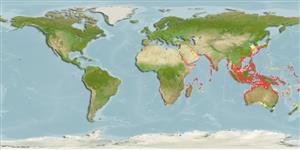
Native range | All suitable habitat | Point map | Year 2050
This map was computer-generated and has not yet been reviewed.
Scomberomorus commerson   AquaMaps   Data sources: GBIF OBIS
Adicionar o seu Fotografias e vídeos
Fotografias | vídeos | Selos, moedas, diversos. | Imagem do Google
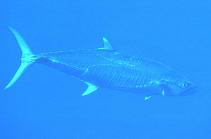
Image of Scomberomorus commerson (Narrow-barred Spanish mackerel)
Scomberomorus commerson
Fotografia de Patzner, R.


Indonesia territory information

Common names: Calong, Macko, Narrow-barred Spanish mackerel
Occurrence: native
Salinity: marine
Abundance: | Ref:
Importance: highly commercial | Ref:
Aquaculture: | Ref:
Regulations: | Ref:
Uses: gamefish: yes;
Comments: From southwest Sumatra to Timor Sea (Ref. 5978, 47567); including Mentawai Islands (Ref. 27157). Also recorded from Raja Ampat Islands, Togean and Banggai Islands; with an Indonesian distribution from Papua to Sumatra (Ref. 47567). Also Ref. 9987, 168.
National Checklist:
Territory Information: https://www.cia.gov/library/publications/resources/the-world-factbook/geos/id.html
National Fisheries Authority:
Occurrences: Occurrences Point map
Main Ref: Kuiter, R.H. and T. Tonozuka, 2001
National Database:

Common names from other countries

Classificação / Nomes Nomes comuns | Sinónimos | Catalog of Fishes(Género, Espécies) | ITIS | CoL | WoRMS | Cloffa

> Scombriformes (Mackerels) > Scombridae (Mackerels, tunas, bonitos) > Scombrinae
Etymology: Scomberomorus: Latin, scomber = mackerel + Greek, moros = silly, stupid (Ref. 45335).
Eponymy: Dr Philibert Commerson (1727–1773) was known as ‘doctor, botanist and naturalist of the King’. [...] (Ref. 128868), visit book page.
More on author: Lacepède.

Ambiente: milieu / zona climática / intervalo de profundidade / gama de distribuição Ecologia

marinhas pelagic-neritic; oceanódromo (Ref. 51243); intervalo de profundidade 10 - 70 m (Ref. 12260). Tropical; 39°N - 41°S, 7°W - 170°W (Ref. 54880)

Distribuição Territórios | Áreas FAO | Ecossistemas | Ocorrências | Mapa dos pontos | Introduções | Faunafri

Southeast Atlantic: St. Helena. Indo-West Pacific: Red Sea and South Africa to Southeast Asia, north to China and Japan and south to southeast Australia, and to Fiji (Ref. 6390). Lessepsian migrant to the Mediterranean Sea.

Comprimento na primeira maturidade / Tamanho / Peso / Idade

Maturidade: Lm 75.2, range 55 - 82 cm
Max length : 240 cm FL macho/indeterminado; (Ref. 5765); common length : 120 cm TL macho/indeterminado; (Ref. 5450); peso máx. Publicado: 70.0 kg (Ref. 5765); Idade máx. registada: 22 anos (Ref. 50580)

Descrição breve Chaves de identificação | Morfologia | Morfometria

Espinhos dorsais (total) : 15 - 18; Raios dorsais moles (total) : 15 - 20; Espinhos anais: 0; Raios anais moles: 16 - 21; Vértebras: 42 - 46. This species is distinguished by the following characters: body elongate (depth 4.8-5.6 in SL), moderately strongly compressed; upper jaw reaching to posterior margin of eye or slightly beyond; teeth in jaws strong and compressed; gill rakers of first gill arch 0-2 on upper limb and 1-8 on lower limb, total 1-8; 2 dorsal fins, D1 XV-XVIII and D2 15-20, followed by 8-11 finlets; anal fin originating below midpoint of second dorsal fin, with 16-21 soft rays, followed by 7-12 finlets; lateral line abruptly bent downward below end of second dorsal fin. Colour of back iridescent blue-grey, sides silver with bluish reflections, marked with numerous thin, wavy vertical bands; number of bars increases from as few as 20 in a 40 cm specimen to as many as 65 at 150 cm; juveniles frequently spotted (Ref. 9684, 90102).


Body shape (shape guide): fusiform / normal; Cross section: oval.

Biologia     Glossário (ex. epibenthic)

A pelagic fish, inhabiting near edge of continental shelf to shallow coastal waters, often of low salinity and high turbidity (Ref. 30199, 48637); also found in drop-offs, and shallow or gently sloping reef and lagoon waters (Ref. 1602, 48637). Feed primarily on small fishes like anchovies, clupeids, carangids, also squids and penaeoid shrimps. Usually hunts solitary and often swim in shallow water along coastal slopes (Ref. 48637). Eggs and larvae are pelagic (Ref. 6769). Caught mainly with drift gill nets, bamboo stake traps, midwater trawls, and by trolling. Marketed mainly fresh; also dried-salted; commonly made into fish balls (Ref. 9684), frozen, smoked, and canned (Ref. 9987). A lipid-soluble toxin, similar to ciguatoxin has been found in the flesh of specimens caught on the east coast of Queensland, Australia. Known to undertake lengthy long-shore migrations, but permanent resident populations also seem to exist.

Ciclo de vida e comportamento de acasalamento Maturidade | Reprodução | Desova | Ovos | Fecundidade | Larvas

Depending on temperature regime, the spawning season may be more or less extended. In Australian waters, each female spawns several times over the season, about 2 to 6 days apart (Ref. 30196), depending on the locality. Spanish mackerel spawn off the reef slopes and edges, and they form spawning aggregations in specific areas (Ref. 6390).

Referência principal Carregar as suas referências | Referências | Coordenador : Collette, Bruce B. | Colaboradores

Collette, B.B. and C.E. Nauen, 1983. FAO Species Catalogue. Vol. 2. Scombrids of the world. An annotated and illustrated catalogue of tunas, mackerels, bonitos and related species known to date. Rome: FAO. FAO Fish. Synop. 125(2):137 p. (Ref. 168)

Categoria na Lista Vermelha da IUCN (Ref. 130435: Version 2025-2 (Global))

  Quase ameaçada (NT) (A2bd); Date assessed: 10 November 2022

CITES

Not Evaluated

CMS (Ref. 116361)

Not Evaluated

Ameaça para o homem

  Reports of ciguatera poisoning (Ref. 168)


Utilização humana

Pescarias: altamente comercial; peixe desportivo: sim
FAO - pescarias: desembarques, perfil da espécie; Publication: search | FishSource | Sea Around Us

Mais informação

Ciclo de vida
Reprodução
Maturidade
Maturidade/Rel. das guelras
Fecundidade
Desova
Agregações de desova
Ovos
Desenvolvimento dos ovos
Larvas
Dinâmica larvar
Anatomia
Área branquial
Cérebro
Otólitos
Fisiologia
Composição corporal
Nutrientes
Consumo de oxigénio
Tipo de natação
Velocidade de natação
Pigmentos visuais
Som de peixe
Doenças e Parasitas
Toxicidade (LC50s)
Genética
genoma
Genética
Heterozigotia
Hereditariedade
Relacionado com o ser humano
Sistemas de aquacultura
Perfis para aquacultura
Estirpes
Casos de Ciguatera
Selos, moedas, diversos.
Divulgação
Colaboradores
Referências
Referências

Ferramentas

Relatórios especiais

Descarregue XML

Fontes da internet

Estimativas baseadas em modelos

Temperatura preferida (Ref. 123201): 22.8 - 29, mean 28 °C (based on 1324 cells).
Índice de diversidade filogenética (Ref. 82804):  PD50 = 0.5000   [Uniqueness, from 0.5 = low to 2.0 = high].
Bayesian length-weight: a=0.00661 (0.00584 - 0.00748), b=3.01 (2.98 - 3.04), in cm total length, based on LWR estimates for this species (Ref. 93245).
Nível Trófico (Ref. 69278):  4.5   ±0.4 se; based on diet studies.
Generation time: 3.6 (2.2 - 5.2) years. Estimated as median ln(3)/K based on 32 growth studies.
Resiliência (Ref. 120179):  Médio, tempo mínimo de duplicação da população 1,4 - 4,4 anos (K=0.12-0.21; tm=2-3; tmax=14; Fec=590,000).
Prior r = 0.98, 95% CL = 0.65 - 1.47, Based on 1 full stock assessment.
Vulnerabilidade da pesca (Ref. 59153):  Moderate to high vulnerability (52 of 100). 🛈
Vulnerabilidade climática (Ref. 125649):  High to very high vulnerability (75 of 100). 🛈
Categoria de preço (Ref. 80766):   Very high.
Nutrientes (Ref. 124155):  Calcium = 19.6 [8.5, 74.3] mg/100g; Iron = 0.719 [0.310, 1.705] mg/100g; Protein = 20.9 [19.6, 22.1] %; Omega3 = 0.222 [0.131, 0.380] g/100g; Selenium = 72.5 [25.5, 222.5] μg/100g; VitaminA = 13.6 [3.2, 60.0] μg/100g; Zinc = 0.508 [0.338, 0.818] mg/100g (wet weight); based on nutrient studies.