Opisthonema oglinum, Atlantic thread herring : fisheries, bait

You can sponsor this page

Opisthonema oglinum (Lesueur, 1818)

Atlantic thread herring
Ajouter votre observation dans Fish Watcher
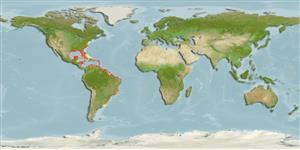
Native range | All suitable habitat | Point map | Year 2050
This map was computer-generated and has not yet been reviewed.
Opisthonema oglinum   AquaMaps   Data sources: GBIF OBIS
Envoyez vos Photos et vidéos
Images | Sons | Images Google
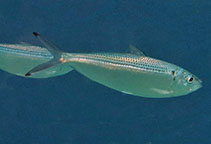
Image of Opisthonema oglinum (Atlantic thread herring)
Opisthonema oglinum
Photo de Charteris, M.


Grenada country information

Common names: Thread herring
Occurrence: native
Salinity: marine
Abundance: | Ref:
Importance: | Ref:
Aquaculture: | Ref:
Regulations: | Ref:
Uses: no uses
Comments:
National Checklist:
Country Information: https://www.cia.gov/library/publications/resources/the-world-factbook/geos/gj.html
National Fisheries Authority: http://www.caricom-fisheries.com/grenada-fisheries
Occurrences: Occurrences Point map
Main Ref: Whitehead, P.J.P., 1985
National Database:

Common names from other countries

Classification / Names Noms communs | Synonymes | Catalog of Fishes(Genre, Espèce) | ITIS | CoL | WoRMS | Cloffa

> Clupeiformes (Herrings) > Dorosomatidae (Gizzard shads and sardinellas)
Etymology: Opisthonema: Greek, opisthe = behind + Greek,nema = filament (Ref. 45335).
More on author: Lesueur.

Environment: milieu / climate zone / profondeur / distribution range Écologie

marin récifal; profondeur 1 - 50 m (Ref. 93252), usually 5 - ? m (Ref. 9710). Tropical; 41°N - 37°S, 98°W - 33°W (Ref. 188)

Distribution Pays | Zones FAO | Écosystèmes | Occurrences | Carte par point | Introductions | Faunafri

Western Atlantic: Gulf of Maine (USA), Bermuda, throughout the Gulf of Mexico, Caribbean and West Indies southward to Santa Catarina, Brazil. Also found in Uruguay (Ref. 54736) and Argentina (Ref. 2806).

Length at first maturity / Taille / Poids / Âge

Maturité: Lm 11.5, range 11 - ? cm
Max length : 38.0 cm TL mâle / non sexé; (Ref. 5217); common length : 20.0 cm SL mâle / non sexé; (Ref. 188); poids max. publié: 375.00 g (Ref. 5217)

Description synthétique Clés d'identification | Morphologie | Morphométrie

Épines dorsales (Total) : 0; Rayons mous dorsaux (Total) : 19 - 21; Épines anales: 0; Rayons mous anaux: 23 - 24. The filamentous last dorsal fin ray distinguishes this species from all other western Atlantic clupeoids except Dorosoma, which has an inferior mouth (Ref. 188). Otherwise, superficially resembles species of Sardinella (but i 8 pelvic fin rays in western Atlantic species, cf. i 7 in Opisthonema) and Harengula (but small toothed hypomaxilla in upper jaw) (Ref. 188). Lower gill rakers stable at 28 to 46 after 8 cm (Ref. 188). Silvery, with a bluish or greenish back, 6-7 lengthwise dark streaks on side. Dark spot above opercle, larger dark spot behind opercle, usually with a row of dark spots behind it. Lower profile deeply curved. Head pointed (Ref. 7251).
Body shape (shape guide): fusiform / normal; Cross section: compressed.

Biologie     Glossaire (ex. epibenthic)

Inhabit harbors and shallow coastal areas (Ref. 9710). Pelagic (Ref. 27549). Form schools (but solitary individuals reported), probably not entering water of low salinity. Feed by filtering plankton (copepods), but also take small fishes, crabs and shrimps. Marketed fresh, frozen and salted; also used in the fishmeal industry. Occur in freshwater in St. Johns River, Florida (Ref. 26938).

Life cycle and mating behavior Maturité | Reproduction | Frai | Œufs | Fécondité | Larves

Possibly breeds in March-July off Venezuela.

Référence principale Upload your references | Références | Coordinateur | Collaborateurs

Whitehead, P.J.P., 1985. FAO Species Catalogue. Vol. 7. Clupeoid fishes of the world (suborder Clupeoidei). An annotated and illustrated catalogue of the herrings, sardines, pilchards, sprats, shads, anchovies and wolf-herrings. FAO Fish. Synop. 125(7/1):1-303. Rome: FAO. (Ref. 188)

Statut dans la liste rouge de l'IUCN (Ref. 130435: Version 2025-1)

  Préoccupation mineure (LC) ; Date assessed: 23 August 2012

CITES

Not Evaluated

CMS (Ref. 116361)

Not Evaluated

Menace pour l'homme

  Reports of ciguatera poisoning (Ref. 30911)


Utilisations par l'homme

Pêcheries: commercial; appât: usually
FAO - pêcheries: landings; Publication: search | FishSource | Sea Around Us

Plus d'informations

Life cycle
Reproduction
Maturité
Maturity/Gills rel.
Fécondité
Frai
Spawning aggregations
Œufs
Développement de l'œuf
Larves
Dynamique des populations larvaires
Distribution
Pays
Zones FAO
Écosystèmes
Occurrences
Introductions
BRUVS - Videos
Anatomy
Surface branchiale
Brain
Otolith
Physiology
Body composition
Nutrients
Consommation d'oxygène
Type de nage
Vitesse de nage
Visual pigments
Fish sound
Diseases & Parasites
Toxicity (LC50s)
Génétique
génôme
Génétique
Heterozygosity
Héritabilité
Human related
Aquaculture systems
Profils d'aquaculture
Souches
Ciguatera cases
Stamps, coins, misc.
Outreach
Collaborateurs
Références
Références

Outils

Articles particuliers

Télécharger en XML

Sources Internet

Estimates based on models

Preferred temperature (Réf. 123201): 22.7 - 28, mean 25.5 °C (based on 480 cells).
Phylogenetic diversity index (Réf. 82804):  PD50 = 0.5312   [Uniqueness, from 0.5 = low to 2.0 = high].
Bayesian length-weight: a=0.00871 (0.00776 - 0.00977), b=3.06 (3.03 - 3.09), in cm total length, based on LWR estimates for this species (Ref. 93245).
Niveau trophique (Réf. 69278):  4.5   ±0.0 se; based on diet studies.
Résilience (Réf. 120179):  Milieu, temps minimum de doublement de population : 1,4 à 4,4 années (tm=1-3; tmax=8).
Prior r = 1.18, 95% CL = 0.78 - 1.77, Based on 4 data-limited stock assessments.
Fishing Vulnerability (Ref. 59153):  Low vulnerability (24 of 100). 🛈
Climate Vulnerability (Ref. 125649):  Moderate to high vulnerability (54 of 100). 🛈
Catégorie de prix (Ref. 80766):   Low.
Nutrients (Ref. 124155):  Calcium = 59.1 [28.2, 107.6] mg/100g; Iron = 0.805 [0.394, 1.446] mg/100g; Protein = 19.9 [18.5, 21.2] %; Omega3 = 0.242 [0.132, 0.455] g/100g; Selenium = 34.8 [18.7, 79.4] μg/100g; VitaminA = 95.7 [28.7, 303.9] μg/100g; Zinc = 0.856 [0.565, 1.280] mg/100g (wet weight);