Scophthalmus maximus, Turbot : fisheries, aquaculture, gamefish, aquarium

You can sponsor this page

Scophthalmus maximus (Linnaeus, 1758)

Turbot
Ajouter votre observation dans Fish Watcher
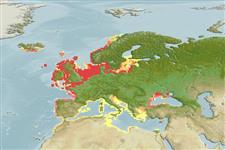
Native range | All suitable habitat | Point map | Year 2050
This map was computer-generated and has not yet been reviewed.
Scophthalmus maximus   AquaMaps   Data sources: GBIF OBIS
Envoyez vos Photos et vidéos
Images | vidéos | Timbres, pièces de monnaie, divers | Images Google
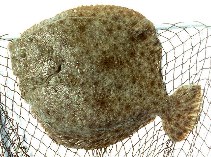
Image of Scophthalmus maximus (Turbot)
Scophthalmus maximus
Photo de Quantz, G.


Germany territory information

Common names: Haandreiß, Steinbutt, Steinbutte
Occurrence: native
Salinity: marine
Abundance: common (usually seen) | Ref: Winkler, H.M., K. Skora, R. Repecka, M. Ploks, A. Neelov, L. Urho, A. Gushin and H. Jespersen, 2000
Importance: | Ref:
Aquaculture: commercial | Ref: FAO Fishery Information, Data and Statistics Service, 1993
Regulations: | Ref:
Uses: no uses
Comments: Found in the Elbe estuary (Ref. 51031).
National Checklist:
Territory Information: https://www.cia.gov/library/publications/resources/the-world-factbook/geos/gm.html
National Fisheries Authority: http://www.ble.de/index.cfm?8C712107D9244972B3C193AC1917DCE7#Handelsbezeichnungen
Occurrences: Occurrences Point map
Main Ref: Muus, B. and P. Dahlström, 1978
National Database: AGRDEU

Common names from other countries

Classification / Noms Noms communs | Synonymes | Catalog of Fishes(Genre, Espèce) | ITIS | CoL | WoRMS | Cloffa

> Pleuronectiformes (Flatfishes) > Scophthalmidae (Turbots)
Etymology: Scophthalmus: Greek, skopelos = a lantern fish + Greek, ophthalmos = eyes (Ref. 45335).
More on author: Linnaeus.

Environnement : milieu / zone climatique / profondeur / gamme de distribution Écologie

marin; saumâtre démersal; océanodrome (Ref. 51243); profondeur 20 - 70 m (Ref. 6302). Temperate; 70°N - 30°N, 25°W - 42°E

Distribution Territoires | Zones FAO | Écosystèmes | Occurrences | Carte par point | Introductions | Faunafri

Northeast Atlantic: throughout the Mediterranean and along the European coasts to Arctic Circle; also found in most of the Baltic Sea. Subspecies Psetta maxima maeotica in the Black Sea.

Longueur à la première maturité / Taille / Poids / Âge

Maturité: Lm 40.8, range 41 - 54 cm
Max length : 100.0 cm SL mâle / non sexé; (Ref. 4703); common length : 50.0 cm TL mâle / non sexé; (Ref. 35388); common length :70 cm TL (female); poids max. publié: 25.0 kg (Ref. 9988); âge max. reporté: 25 années (Ref. 32766)

Description synthétique Clés d'identification | Morphologie | Morphométrie

Body almost circular. Eye side without scales but with large bony tubercles (Ref. 35388).
Body shape (shape guide): short and / or deep; Cross section: flattened.

Biologie     Glossaire (ex. epibenthic)

Adults live on sandy, rocky or mixed bottoms; rather common in brackish waters. Feed mainly on other bottom-living fishes (sand-eels, gobies, etc.), and also, to a lesser extent, on larger crustaceans and bivalves. Batch spawner (Ref. 51846). Spawning season is between April and August; pelagic eggs. May reach 25 kg (Ref. 9988). Highly esteemed food fish. Utilized fresh or frozen; eaten steamed, pan-fried, broiled, boiled, microwaved and baked (Ref. 9988).

Cycle de vie et comportement reproducteur Maturité | Reproduction | Frai | Œufs | Fécondité | Larves

Spawning usually happens between the months of February and April in the Mediterranean and from May to July in the Atlantic. Sequenced spawning every 2-4 days. Eggs have a single fat drop. Larvae are initially symmetric but, at the end of the metamorphosis (day 40-50, 25 mm), the right eye moves to the left side, losing its initial bilateral symmetry. Egg size 0.9 - 1.2 mm, larval length at hatching 2.7-3.1 mm.

Référence principale Téléchargez vos références | Références | Coordinateur | Collaborateurs

Bauchot, M.-L., 1987. Poissons osseux. p. 891-1421. In W. Fischer, M.L. Bauchot and M. Schneider (eds.) Fiches FAO d'identification pour les besoins de la pêche. (rev. 1). Méditerranée et mer Noire. Zone de pêche 37. Vol. II. Commission des Communautés Européennes and FAO, Rome. (Ref. 3397)

Statut dans la liste rouge de l'IUCN (Ref. 130435: Version 2025-2 (Global))

  Préoccupation mineure (LC) ; Date assessed: 07 December 2020

CITES

Not Evaluated

CMS (Ref. 116361)

Not Evaluated

Menace pour l'homme

  Harmless


Utilisations par l'homme

Pêcheries: commercial; Aquaculture: commercial; pêche sportive: oui; Aquarium: Aquariums publics
FAO - Systèmes d'aquaculture: production, Résumé espèce; pêcheries: débarquements; Publication: search | FIRMS - Stock assessments | FishSource | Sea Around Us

Plus d'informations

Écologie trophique
Aliments (proies)
Composition du régime alimentaire
Consommation alimentaire
Rations alimentaires
Prédateurs
Écologie
Écologie
Home ranges
Anatomie
Surface branchiale
Cerveau
Otolithe
Génétique
génôme
Génétique
Hétérozygotie
Héritabilité
Liées à l'homme
Systèmes d'aquaculture
Profils d'aquaculture
Souches
Cas de ciguatera
Timbres, pièces de monnaie, divers
Sensibilisation
Collaborateurs
Références
Références

Outils

Articles particuliers

Télécharger en XML

Sources Internet

AFORO (otoliths) | Alien/Invasive Species database | Aquatic Commons | BHL | Cloffa | Websites from users | FishWatcher | CISTI | Catalog of Fishes: Genre, Espèce | DiscoverLife | DORIS | ECOTOX | FAO - Systèmes d'aquaculture: production, Résumé espèce; pêcheries: débarquements; Publication: search | Faunafri | Fishipedia | Fishtrace | GloBI | Google Books | Google Scholar | Google | IGFA World Record | Bases de données nationales | OneZoom | Open Tree of Life | Otolith Atlas of Taiwan Fishes | Aquariums publics | PubMed | Reef Life Survey | Socotra Atlas | TreeBase | Arbre de Vie | Wikipedia: aller à, chercher | World Records Freshwater Fishing | Zoological Record

Estimations basées sur des modèles

Température préférée (Réf. 123201): 5.9 - 11.9, mean 9.4 °C (based on 239 cells).
Indice de diversité phylogénétique (Réf. 82804):  PD50 = 0.5645   [Uniqueness, from 0.5 = low to 2.0 = high].
Bayesian length-weight: a=0.01122 (0.00917 - 0.01373), b=3.06 (3.00 - 3.12), in cm total length, based on LWR estimates for this species (Ref. 93245).
Niveau trophique (Réf. 69278):  4.4   ±0.0 se; based on diet studies.
Generation time: 4.8 (3.8 - 5.8) years. Estimated as median ln(3)/K based on 24 growth studies.
Résilience (Réf. 120179):  Milieu, temps minimum de doublement de population : 1,4 à 4,4 années (K=0.15-0.28; tm=3-5; tmax=26; Fec=5 million).
Prior r = 0.50, 95% CL = 0.33 - 0.75, Based on 9 full stock assessments.
Vulnérabilité de la pêche (Ref. 59153):  High vulnerability (60 of 100). 🛈
Vulnérabilité climatique (Ref. 125649):  High vulnerability (65 of 100). 🛈
Catégorie de prix (Ref. 80766):   Very high.
Nutriments (Ref. 124155):  Calcium = 28.5 [12.1, 48.8] mg/100g; Iron = 0.144 [0.058, 0.649] mg/100g; Protein = 19.5 [18.0, 21.0] %; Omega3 = 0.275 [0.153, 0.500] g/100g; Selenium = 14.1 [6.4, 33.9] μg/100g; VitaminA = 8.19 [2.10, 35.13] μg/100g; Zinc = 0.156 [0.092, 0.524] mg/100g (wet weight); based on nutrient studies.