Raja clavata, Thornback ray : fisheries, gamefish

You can sponsor this page

Raja clavata Linnaeus, 1758

Thornback ray
Adicionar as suas observações no Fish Watcher
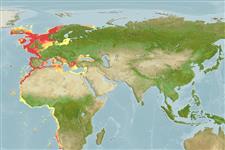
Native range | All suitable habitat | Point map | Year 2050
This map was computer-generated and has not yet been reviewed.
Raja clavata   AquaMaps   Data sources: GBIF OBIS
Adicionar o seu Fotografias e vídeos
Fotografias | vídeos | Imagem do Google
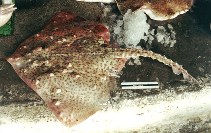
Image of Raja clavata (Thornback ray)
Raja clavata
Fotografia de Stergiou, K.I.


France territory information

Common names: Clavelade, Raie bouclée clovée, Raiton
Occurrence: native
Salinity: marine
Abundance: | Ref:
Importance: commercial | Ref:
Aquaculture: | Ref:
Regulations: | Ref:
Uses: live export: yes;
Comments: Known from the Gironde estuary (Ref. 51442). Recorded from the east coast of Corsica Island (Ref. 95770). Also Ref. 9987.
National Checklist:
Territory Information: https://www.cia.gov/library/publications/resources/the-world-factbook/geos/fr.html
National Fisheries Authority:
Occurrences: Occurrences Point map
Main Ref: Béarez, P., P. Pruvost, É. Feunteun, S. Iglésias, P. Francour, R. Causse, J. De Mazières, S. Tercerie and N. Bailly, 2017
National Database:

Common names from other countries

Classificação / Nomes Nomes comuns | Sinónimos | Catalog of Fishes(Género, Espécies) | ITIS | CoL | WoRMS | Cloffa

Elasmobranchii (tubarões e raias) (sharks and rays) > Rajiformes (Skates and rays) > Rajidae (Skates)
Etymology: Raja: Latin, raja, -ae = a sting ray (Raja sp.) (Ref. 45335).
More on author: Linnaeus.

Ambiente: milieu / zona climática / intervalo de profundidade / gama de distribuição Ecologia

marinhas demersal; intervalo de profundidade 5 - 1020 m (Ref. 114953). Subtropical; 70°N - 38°S, 25°W - 50°E

Distribuição Territórios | Áreas FAO | Ecossistemas | Ocorrências | Mapa dos pontos | Introduções | Faunafri

Eastern Atlantic and Southwest Indian Ocean: Iceland to Madagascar, including the Mediterranean Sea.

Comprimento na primeira maturidade / Tamanho / Peso / Idade

Maturidade: Lm 76.6, range 47 - 87.5 cm
Max length : 105 cm TL macho/indeterminado; (Ref. 53748); 139.0 cm TL (female); common length : 85.0 cm TL macho/indeterminado; (Ref. 9987); peso máx. Publicado: 18.0 kg (Ref. 35388); Idade máx. registada: 15 anos (Ref. 41305)

Descrição breve Chaves de identificação | Morfologia | Morfometria

Espinhos dorsais (total) : 0; Espinhos anais: 0. Sub-rhomboid in shape with pointed wing-tips; disc-width 1,25 to 1,36 times in its length, its length 1,70 to 1,83 times in total length. Short rostrum, rounded at his extremity; pectoral fins with clear angles on lateral side; triangular pelvic fins (Ref. 39246). Dorsally prickly; large females also prickly throughout their ventral surface; juveniles and large males prickly along the margins of their discs and the underside of their snout. 30-50 thorns form a median row from the nape to the first dorsal fin; additional large 'buckler' thorns with swollen bases scattered on upper surface of disc in adults (Ref. 3167). Coloration is highly variable, with the dorsal surface having all shades of brown with dark and light spots and blotches; ventral surface white (Ref. 3167, 58137).
Body shape (shape guide): other; Cross section: flattened.

Biologia     Glossário (ex. epibenthic)

Inhabits shelf and upper slope waters. Reported depth ranges varies, from 10-300 m (Ref. 4426, 82319, 88187), and from 300-577 m in the eastern Ionian Sea (Ref. 56504); most common in coastal waters between 10-60 m depth (Ref. 58137). Tolerates low salinities (Ref. 88171). Found on mud, sand and gravel bottoms, rarely on rougher bottoms (Ref. 6808, 58137). Nocturnal species. Feeds on all kinds of bottom animals, preferably crustaceans (Ref. 3167) and fishes (Ref. 114953). Undertakes migrations with mean distances of 54-117 km per month; shows a clear annual migration cycle (Ref. 89017, 89018), moves from deeper offshore waters (10-30 m) in autumn and winter to shallower areas (<10 m) in spring (Ref. 82319). Young are non-migratory, inhabiting inshore nursery grounds (Ref. 89019, 89020, 89022); in the Bay of Douarnenez (France) they are found to remain in shallow waters for at least 2 years (Ref. 89023). Maturity age 7-8 years (Ref. 114953). Oviparous. Young may tend to follow large objects, such as their mother (Ref. 205). Detects weak electric fields generated by other organisms (prey detection and predator avoidance) but may also generate its own weak electric fields (Ref. 10311, 88171). Utilized fresh and frozen (Ref. 9987).

Ciclo de vida e comportamento de acasalamento Maturidade | Reprodução | Desova | Ovos | Fecundidade | Larvas

Oviparous. Distinct pairing with embrace. Polyandrous species (Ref. 89024). Paired eggs are laid and deposited on shallow sand, mud, pebble or gravel bottoms (Ref. 205, 89025). Up to 170 egg cases can be laid by a single female in a year (Ref. 3167), but average fecundity is much lower (around 48-74 eggs) (Ref. 3603, 31302). In northwestern Europe, egg cases are laid during spring (Ref. 3167) and in the Mediterranean during winter and spring (Ref. 3167). Egg cases are oblong capsules with stiff pointed horns at the corners, each containing one embryo (Ref. 205). Capsules are 5.0-9.0 cm long without the horns (Ref. 41250, 88187) and 3.4-6.8 cm wide (Ref. 41250). Egg cases are anchored with an adhesive film (Ref. 82399). Embryos feed solely on yolk (Ref. 50449). Egg cases hatch after about 4-5 months and pups are about 11-13 cm TL (Ref. 88864). Mating season from February to September, peaking in June (Ref. 74501). Adults observed to form same-sex aggregations during the mating season with females moving to shallower inshore waters approximately a month before the males (Ref 3603, 58137, 74501). Mating does not occur in the Baltic Sea (Ref. 82311).

Referência principal Carregar as suas referências | Referências | Coordenador : McEachran, John | Colaboradores

McEachran, J.D. and K.A. Dunn, 1998. Phylogenetic analysis of skates, a morphologically conservative clade of elasmobranchs (Chondrichthyes: Rajidae). Copeia 1998(2):271-290. (Ref. 27314)

Categoria na Lista Vermelha da IUCN (Ref. 130435: Version 2025-2 (Global))

  Quase ameaçada (NT) (A2bd); Date assessed: 15 April 2023

CITES

Not Evaluated

CMS (Ref. 116361)

Not Evaluated

Ameaça para o homem

  Harmless


Utilização humana

Pescarias: espécies comerciais; peixe desportivo: sim
FAO - pescarias: desembarques; Publication: search | FishSource | Sea Around Us

Mais informação

Ecologia Trófica
Produtos alimentares (presas)
Composição da dieta
Consumo alimentar
Rações alimentares
Predadores
Ecologia
Ecologia
Home ranges
Ciclo de vida
Reprodução
Maturidade
Maturidade/Rel. das guelras
Fecundidade
Desova
Agregações de desova
Ovos
Desenvolvimento dos ovos
Larvas
Dinâmica larvar
Distribuição
Territórios
Áreas FAO
Ecossistemas
Ocorrências
Introduções
BRUVS - Vídeos
Anatomia
Área branquial
Cérebro
Otólitos
Fisiologia
Composição corporal
Nutrientes
Consumo de oxigénio
Tipo de natação
Velocidade de natação
Pigmentos visuais
Som de peixe
Doenças e Parasitas
Toxicidade (LC50s)
Genética
genoma
Genética
Heterozigotia
Hereditariedade
Relacionado com o ser humano
Sistemas de aquacultura
Perfis para aquacultura
Estirpes
Casos de Ciguatera
Selos, moedas, diversos.
Divulgação
Colaboradores
Referências
Referências

Ferramentas

Relatórios especiais

Descarregue XML

Fontes da internet

AFORO (otoliths) | Aquatic Commons | BHL | Cloffa | Websites from users | Consultar FishWatcher | CISTI | Catalog of Fishes: Género, Espécies | DiscoverLife | DORIS | ECOTOX | FAO - pescarias: desembarques; Publication: search | Faunafri | Fishipedia | Fishtrace | GloBI | Google Books | Google Scholar | Google | IGFA World Record | Bases de dados nacionais | OneZoom | Open Tree of Life | Otolith Atlas of Taiwan Fishes | Aquários públicos | PubMed | Reef Life Survey | Socotra Atlas | TreeBase | Árvore da vida | Wikipedia: ir para, procurar | World Records Freshwater Fishing | Zoobank | Registo zoológico

Estimativas baseadas em modelos

Temperatura preferida (Ref. 123201): 7.1 - 15.8, mean 10.7 °C (based on 474 cells).
Índice de diversidade filogenética (Ref. 82804):  PD50 = 0.5000   [Uniqueness, from 0.5 = low to 2.0 = high].
Bayesian length-weight: a=0.00204 (0.00179 - 0.00233), b=3.26 (3.23 - 3.29), in cm total length, based on LWR estimates for this species (Ref. 93245).
Nível Trófico (Ref. 69278):  3.8   ±0.2 se; based on diet studies.
Generation time: 7.8 (5.4 - 10.4) years. Estimated as median ln(3)/K based on 16 growth studies.
Resiliência (Ref. 120179):  Baixo, tempo mínimo de duplicação da população 4,5 - 14 anos (K=0.09-0.14; tm=10; tmax=23; Fec=150).
Prior r = 0.18, 95% CL = 0.12 - 0.26, Based on 4 full stock assessments.
Vulnerabilidade da pesca (Ref. 59153):  High vulnerability (60 of 100). 🛈
Vulnerabilidade climática (Ref. 125649):  High vulnerability (60 of 100). 🛈
Categoria de preço (Ref. 80766):   Medium.
Nutrientes (Ref. 124155):  Calcium = 9.22 [1.18, 176.74] mg/100g; Iron = 0.628 [0.060, 7.651] mg/100g; Protein = 17.2 [14.4, 19.5] %; Omega3 = 0.571 [0.265, 1.295] g/100g; Selenium = 39.7 [7.5, 183.1] μg/100g; VitaminA = 5.22 [0.40, 59.91] μg/100g; Zinc = 0.47 [0.03, 5.30] mg/100g (wet weight); based on nutrient studies.