



Adicionar as suas observações no Fish Watcher
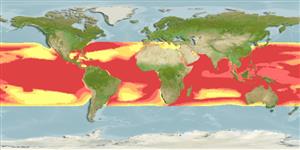
| Native range | All suitable habitat | Point map | Year 2050 |
|
| This map was computer-generated and has not yet been reviewed. |
| Sphyrna mokarran AquaMaps Data sources: GBIF OBIS |
Adicionar o seu Fotografias e vídeos
Fotografias | vídeos | Selos, moedas, diversos. | Imagem do Google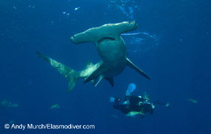 Sphyrna mokarran
Fotografia de Murch, A.
Fotografias | vídeos | Selos, moedas, diversos. | Imagem do Google
Fotografia de Murch, A.
Classificação / Nomes Nomes comuns | Sinónimos | Catalog of Fishes(Género, Espécies) | ITIS | CoL | WoRMS | Cloffa
Elasmobranchii (tubarões e raias) (sharks and rays) > Carcharhiniformes (Ground sharks) > Sphyrnidae (Hammerhead, bonnethead, or scoophead sharks)
Etymology: Sphyrna: Probable misspelling of sphyra (Gr.), hammer, referring to their hammer-shaped heads (See ETYFish); mokarran: Arabic vernacular for this shark, described from the Red Sea, possibly from mogharn, horned, referring to the shape of its head (See ETYFish).
More on author: Rüppell.
Etymology: Sphyrna: Probable misspelling of sphyra (Gr.), hammer, referring to their hammer-shaped heads (See ETYFish); mokarran: Arabic vernacular for this shark, described from the Red Sea, possibly from mogharn, horned, referring to the shape of its head (See ETYFish).
More on author: Rüppell.
Ambiente: milieu / zona climática / intervalo de profundidade / gama de distribuição Ecologia
marinhas; estuarina pelagic-oceanic; oceanódromo (Ref. 87829); intervalo de profundidade 1 - 300 m (Ref. 37816), usually 1 - 100 m (Ref. 89972). Subtropical; 40°N - 37°S, 180°W - 180°E
Distribuição Territórios | Áreas FAO | Ecossistemas | Ocorrências | Mapa dos pontos | Introduções | Faunafri
Circumglobal in coastal warm temperate and tropical seas (Ref. 13562). Western Atlantic: North Carolina, USA to Uruguay, including the Gulf of Mexico and Caribbean. Eastern Atlantic: Mediterranean and Morocco to Senegal. Indo-Pacific: throughout the Indian Ocean; Ryukyu Islands to New Caledonia and French Polynesia. Eastern Pacific: southern Baja California, Mexico to Peru. Highly migratory species.
Comprimento na primeira maturidade / Tamanho / Peso / Idade
Maturidade: Lm 249.5, range 210 - 300 cm
Max length : 610 cm TL macho/indeterminado; (Ref. 244); common length : 370 cm TL macho/indeterminado; (Ref. 13562); peso máx. Publicado: 449.5 kg (Ref. 40637); Idade máx. registada: 30 anos (Ref. 116211)
Max length : 610 cm TL macho/indeterminado; (Ref. 244); common length : 370 cm TL macho/indeterminado; (Ref. 13562); peso máx. Publicado: 449.5 kg (Ref. 40637); Idade máx. registada: 30 anos (Ref. 116211)
Descrição breve Chaves de identificação | Morfologia | Morfometria
Espinhos dorsais (total) : 0; Espinhos anais: 0. A very large hammerhead also with a notch at the center of the head (Ref. 5578). Front margin of head gently curved in juveniles, becoming nearly straight in adults, with slight median notch (Ref. 26938). 1st dorsal fin very high and curved; 2nd dorsal and pelvic fins high and with deeply concave rear margins. Light grey or grey-brown above, white below; fins without conspicuous markings (Ref. 5578).
Body shape (shape guide): elongated.
Body shape (shape guide): elongated.
A coastal-pelagic, semi-oceanic shark, found close inshore and well offshore, over the continental shelves, island terraces, and in passes and lagoons (Ref. 244, 58302). Often bottom and reef associated at 1-80 m (Ref. 58302). Prefers to feed on stingrays and other batoids, groupers and sea catfishes, but also preys on other small bony fishes, crabs, squid, other sharks, rays, and lobsters (Ref. 244, 13562, 1602). A viviparous species, with 13-42 of about 56 to 70 cm young in a litter (Ref. 26938, 1602). Potentially dangerous to people (Ref. 13562) but only few, if any, of the attacks on people can be definitely attributed to it because of the apparent difficulty of distinguishing large hammerhead species involved in attacks (Ref. 244). Caught occasionally by target shark longline, demersal tangle net and tuna gillnet fisheries (Ref.58048). Meat utilized for human consumption (fresh, fresh-frozen, dried-salted, and smoked), liver oil for vitamins, fins for soup, hides for leather, and carcasses for fishmeal (Ref. 244). Its large fins, including the tail, sail-like first dorsal fin, are prized in the Oriental sharkfin trade (Ref. 47737).
Ciclo de vida e comportamento de acasalamento Maturidade | Reprodução | Desova | Ovos | Fecundidade | Larvas
Viviparous with a yolk sac placenta and 13-42 young in a litter (Ref. 244); 6-42 pups after gestation period of ~11 months (Ref.58048). Size at birth between 50 to 70 cm TL (Ref.58048, Ref. 13562).
Referência principal
Carregar as suas referências | Referências | Coordenador : Compagno, Leonard J.V. | Colaboradores
Compagno, L.J.V., 1984. FAO Species Catalogue. Vol. 4. Sharks of the world. An annotated and illustrated catalogue of shark species known to date. Part 2 - Carcharhiniformes. FAO Fish. Synop. 125(4/2):251-655. Rome: FAO. (Ref. 244)
Categoria na Lista Vermelha da IUCN (Ref. 130435: Version 2025-2 (Global))
Criticamente ameaçada (CR) (A2bd); Date assessed: 09 November 2018
Ameaça para o homem
Other (Ref. 244)
Utilização humana
Pescarias: espécies comerciais; peixe desportivo: sim
FAO - Publication: search | FishSource | Sea Around Us
Mais informação
Ecologia Trófica
Produtos alimentares (presas)
Composição da dieta
Consumo alimentar
Rações alimentares
Predadores
Produtos alimentares (presas)
Composição da dieta
Consumo alimentar
Rações alimentares
Predadores
Dinâmica das populações
Parâmetros de crescimento
Idades / tamanhos máximos
Comprimento-peso rel.
Comprimento-comprimento rel.
Frequência de comprimento
Conversão de massa
Recrutamento
Abundância
Parâmetros de crescimento
Idades / tamanhos máximos
Comprimento-peso rel.
Comprimento-comprimento rel.
Frequência de comprimento
Conversão de massa
Recrutamento
Abundância
Ciclo de vida
Reprodução
Maturidade
Maturidade/Rel. das guelras
Fecundidade
Desova
Agregações de desova
Ovos
Desenvolvimento dos ovos
Larvas
Dinâmica larvar
Reprodução
Maturidade
Maturidade/Rel. das guelras
Fecundidade
Desova
Agregações de desova
Ovos
Desenvolvimento dos ovos
Larvas
Dinâmica larvar
Fisiologia
Composição corporal
Nutrientes
Consumo de oxigénio
Tipo de natação
Velocidade de natação
Pigmentos visuais
Som de peixe
Doenças e Parasitas
Toxicidade (LC50s)
Composição corporal
Nutrientes
Consumo de oxigénio
Tipo de natação
Velocidade de natação
Pigmentos visuais
Som de peixe
Doenças e Parasitas
Toxicidade (LC50s)
Relacionado com o ser humano
Sistemas de aquacultura
Perfis para aquacultura
Estirpes
Casos de Ciguatera
Selos, moedas, diversos.
Sistemas de aquacultura
Perfis para aquacultura
Estirpes
Casos de Ciguatera
Selos, moedas, diversos.
Ferramentas
E-book | Guia de campo | Chaves de identificação | Ferramenta auxiliar de frequências de comprimento | Ferramenta sobre a história de vida | Mapa dos pontos |
Captura-MSY |
Relatórios especiais
Descarregue XML
Fontes da internet
AFORO (otoliths) | Alien/Invasive Species database | Aquatic Commons | BHL | Cloffa | Websites from users | Consultar FishWatcher | CISTI | Catalog of Fishes: Género, Espécies | DiscoverLife | ECOTOX | FAO - Publication: search | Faunafri | Fishipedia | Fishtrace | GloBI | GoMexSI (interaction data) | Google Books | Google Scholar | Google | IGFA World Record | Bases de dados nacionais | OneZoom | Open Tree of Life | Otolith Atlas of Taiwan Fishes | PubMed | Reef Life Survey | Socotra Atlas | TreeBase | Árvore da vida | Wikipedia: ir para, procurar | World Records Freshwater Fishing | Registo zoológico
Estimativas baseadas em modelos
Temperatura preferida (Ref. 123201): 21.3 - 28.9, mean 27.2 °C (based on 4410 cells).
Índice de diversidade filogenética (Ref. 82804): PD50 = 0.5006 [Uniqueness, from 0.5 = low to 2.0 = high].
Bayesian length-weight: a=0.00229 (0.00131 - 0.00399), b=3.10 (2.94 - 3.26), in cm total length, based on LWR estimates for this species & (Sub)family-body (Ref. 93245).
Nível Trófico (Ref. 69278): 4.3 ±0.5 se; based on diet studies.
Resiliência (Ref. 120179): Baixo, tempo mínimo de duplicação da população 4,5 - 14 anos (tmax=30; tm=8.2; Fec=13).
Nutrientes (Ref. 124155): Calcium = 6.09 [1.31, 34.08] mg/100g; Iron = 0.597 [0.148, 1.835] mg/100g; Protein = 20.7 [18.6, 22.9] %; Omega3 = 0.168 [0.066, 0.417] g/100g; Selenium = 33.5 [10.8, 93.8] μg/100g; VitaminA = 4.93 [1.58, 16.43] μg/100g; Zinc = 0.393 [0.195, 0.737] mg/100g (wet weight);