



Potamotrygon motoro (Müller & Henle, 1841)
South American freshwater stingrayFotos | Imagem do Google
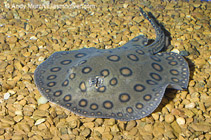
Foto de Murch, A.
Classificação / Nomes Nomes comuns | Sinônimos | Catalog of Fishes(Gênero, Espécies) | ITIS | CoL | WoRMS | Cloffa
Etymology: Potamotrygon: Greek, potamos = river + Greek, trygon = a sting ray (Ref. 45335).
More on authors: Müller & Henle.
Taxonomic Remarks
Authorship of species is credited to Müller & Henle (1841) and not Naterrer (who collected the type specimen) as in Rosa (1985a). A widespread species that may require further subdivision after more study. Studies of its reproductive biology indicate that females attain sexual maturity between 24 and 32 cm DW (males between 20 and 30 cm DW), and may produce from three to 21 embryos per gestation (Achenbach & Achencbach, 1976) or only six or seven (Thorson et al., 1983b; these differences may be populational). Larger specimens may weigh 10 kg. This species has been captively bred in aquaria, but is still the most comercially imported species by the aquarium industry. Additional references: Bertin (1939), Castex & Castello (1970b), Achenbach & Achenbach (1976), Thorson et al. (1983b), Sérét & McEachran (1986), Ortega & Vari (1986), Paepke & Schmidt (1988), Barriga (1991), Compagno & Cook (1995), Lasso et al. (1997a), Ferreira et al. (1998), Britski et al. (1999).
Meio ambiente: milieu / Zona climática / intervalo de profundidade / faixa de distribuição Ecologia
Distribuição Territórios | Áreas da FAO | Ecossistemas | Ocorrências | Mapa de pontos | Introduções | Faunafri
Tamanho / Peso / Idade
Max length : 50.0 cm WD macho/indeterminado; (Ref. 36687); peso máx. publicado: 34.2 kg (Ref. 85107)
Ciclo de vida ou comportamento de acasalamento Maturidade | Reprodução | Desova | Ovos | Fecundidade | Larvas
Referência principal
Carregar suas referências | Referências | Coordenador : Carvalho, Marcelo | Colaboradores
Status na Lista Vermelha da UICN (Ref. 130435: Version 2025-2 (Global))
Ameaça para os humanos
Uso pelos humanos
Mais informação
Itens alimentares (presas)
Composição da dieta
Consumo alimentar
Rações alimentares
Predadores
Ecologia
Parâmetros de crescimento
Idade máxima / tamanhos
Relação comprimento-peso.
Relação comprimento-comprimento.
Frequências de comprimento
Conversão de massa
Recrutamento
Abundância
Reprodução
Maturidade
Maturidade/Rel. das guelras
Fecundidade
Desova
Agregações de desova
Ovos
Desenvolvimento dos ovos
Larvas
Dinâmica larval
Composição corporal
Nutrientes
Consumo de oxigênio
Tipo de natação
Velocidade de natação
Pigmentos visuais
Som de peixe
Doenças e Parasitas
Toxicidade (LC50s)
genoma
Genética
Heterozigosidade
Hereditariedade
Diversidade genética
Sistemas de aquicultura
Perfis para aquacultura
Estirpes
Casos de Ciguatera
Selos, moedas, diversos.
Ferramentas
Relatórios especiais
Baixar XML
Fontes da internet