>
Acanthuriformes (Surgeonfishes) >
Chaetodontidae (Butterflyfishes)
Etymology: Forcipiger: Latin, forceps = instrument of the pincers kind used for seizing and holding objects, esp. In surgical and obstetric operations + latin, gero = to carry; 1634 (Ref. 45335).
More on authors: Jordan & McGregor.
Issue
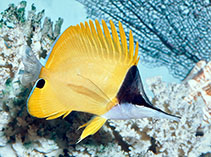
FishBase common name changed from Longnose butterfly[ ]fish FAO/ASFIS: Ref. 131312 ) to Forcepsfish (AFS: Ref. 130874) because it is used forForcipiger longirostris (and longirostris = long nose).
Environment: milieu / climate zone / Tiefenbereich / distribution range
Ökologie
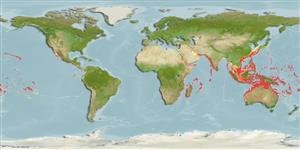
seewasser riff-verbunden; standorttreu; tiefenbereich 0 - 145 m (Ref. 89467). Tropical; 36°N - 32°S, 30°E - 79°W
Indo-Pacific: East Africa and Red Sea (Ref. 12484) to the Hawaiian and Easter islands, north to southern Japan, south to Lord Howe Island; throughout Micronesia. Eastern Pacific: southern Baja California, Mexico and from the Revillagigedo and Galapagos Islands (Ref. 5227, 11482).
Size / Gewicht / Alter
Geschlechtsreife: Lm ? range ? - ? cm
Max length : 22.0 cm TL Männchen/unbestimmt; (Ref. 9710); max. veröff. Alter: 18 Jahre (Ref. 72479)
Rückenflossenstacheln (insgesamt) : 12 - 13; Rückenflossenweichstrahlen (insgesamt) : 19 - 25; Afterflossenstacheln: 3; Afterflossenweichstrahlen: 17 - 19.
Body shape (shape guide): short and / or deep; Cross section: compressed.
Common in exposed seaward reefs but also found in lagoon reefs (Ref. 9286). Benthopelagic (Ref. 58302). Solitary or in small groups of up to 5 individuals (Ref. 9286). Adults usually in pairs (Ref. 48636). Feed on a wide variety of animal prey including hydroids, fish eggs, small crustaceans but prefers tube feet of echinoderms, pedicilaria of sea urchins, and polychaete tentacles (Ref. 1602). Oviparous (Ref. 205), monogamous (Ref. 52884). Form pairs during breeding (Ref. 205). Second most important export in Hawaii (Ref. 37816). Minimum depth reported taken from Ref. 128797.
Life cycle and mating behavior
Geschlechtsreife | Fortpflanzung | Ablaichen | Eier | Fecundity | Larven
Distinct pairing (Ref. 205). Monogamous mating is observed as both obligate and social (Ref. 52884).
Myers, R.F., 1991. Micronesian reef fishes. Second Ed. Coral Graphics, Barrigada, Guam. 298 p. (Ref. 1602)
IUCN Rote Liste Status (Ref. 130435: Version 2025-1)
Bedrohung für Menschen
Harmless
Nutzung durch Menschen
Fischereien: nicht kommerziell; Aquarium: Kommerziell
Tools
Zusatzinformationen
Download XML
Internet Quellen
Estimates based on models
Preferred temperature (Ref.
123201): 24.3 - 28.8, mean 27.5 °C (based on 710 cells).
Phylogenetic diversity index (Ref.
82804): PD
50 = 0.6250 [Uniqueness, from 0.5 = low to 2.0 = high].
Bayesian length-weight: a=0.01995 (0.00906 - 0.04395), b=3.01 (2.83 - 3.19), in cm total length, based on all LWR estimates for this body shape (Ref.
93245).
Trophic level (Ref.
69278): 3.1 ±0.2 se; based on diet studies.
Widerstandsfähigkeit (Ref.
120179): hoch, Verdopplung der Population dauert weniger als 15 Monate. (Preliminary K or Fecundity.).
Fishing Vulnerability (Ref.
59153): Low vulnerability (12 of 100).
🛈
Nutrients (Ref.
124155): Calcium = 77.3 [40.2, 116.8] mg/100g; Iron = 0.735 [0.446, 1.180] mg/100g; Protein = 18.5 [17.4, 19.7] %; Omega3 = 0.129 [0.079, 0.208] g/100g; Selenium = 44.4 [24.8, 80.8] μg/100g; VitaminA = 44.4 [12.5, 154.3] μg/100g; Zinc = 1.25 [0.86, 1.79] mg/100g (wet weight);