Environment: milieu / climate zone / depth range / distribution range
Ecology
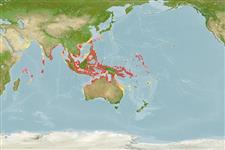
Marine; reef-associated; depth range 3 - 20 m (Ref. 1602). Tropical; 31°N - 30°S, 52°E - 179°W
Indo-West Pacific: East Indies and the Philippines, through Papua New Guinea and the Great Barrier Reef to the Solomon Island, Palau, and north to China; extends into the Indian Ocean at least to the Maldives, India and Sri Lanka.
Size / Weight / Age
Maturity: Lm ? range ? - ? cm
Max length : 12.0 cm TL male/unsexed; (Ref. 9710)
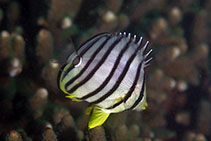
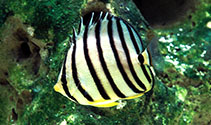
Dorsal spines (total): 10 - 12; Dorsal soft rays (total): 17 - 19; Anal spines: 3 - 4; Anal soft rays: 14 - 17. White to yellowish below with 7 black stripes over head and sides, one centrally on snout and another as a strong black margin on end of dorsal and anal fins. Third line extends onto ventral fin (Ref. 48636). Snout length 3.0-4.1 in HL. Body depth 1.4-1.6 in SL (Ref. 90102).
Body shape (shape guide): short and / or deep; Cross section: compressed.
Swim in pairs in coral rich areas of sheltered lagoon and inshore reefs; juveniles seen in groups among Acropora corals. Feed exclusively on coral polyps. Oviparous (Ref. 205). Form pairs during breeding (Ref. 205).
Life cycle and mating behavior
Maturity | Reproduction | Spawning | Eggs | Fecundity | Larvae
Distinct pairing (Ref. 205). Monogamous mating is observed as both obligate and social (Ref. 52884).
Myers, R.F., 1991. Micronesian reef fishes. Second Ed. Coral Graphics, Barrigada, Guam. 298 p. (Ref. 1602)
IUCN Red List Status (Ref. 130435: Version 2025-2)
Threat to humans
Harmless
Human uses
Fisheries: commercial; aquarium: commercial
Tools
Special reports
Download XML
Internet sources