Elasmobranquios (tiburones y rayas) (sharks and rays) >
Myliobatiformes (Stingrays) >
Myliobatidae (Eagle and manta rays)
Etymology: Aetomylaeus: Greek, aetos = eagle + Greek, mylio = mill, grinder (Ref. 45335).
Environment: milieu / climate zone / rango de profundidad / distribution range
Ecología
marino; salobre bentopelágico; rango de profundidad 10 - 150 m (Ref. 6808). Subtropical; 44°N - 35°S, 19°W - 36°E
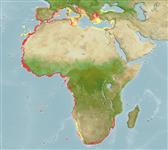
Eastern Atlantic: Portugal and Morocco to Angola, including the Mediterranean, Madeira and the Canary Islands; then from Saldanha Bay to Natal (South Africa) and southern Mozambique (Ref. 5578).
Length at first maturity / Tamaño / Peso / Age
Madurez: Lm 90.0, range 35 - 148 cm
Max length : 222.0 cm WD (female); common length : 150 cm WD macho / no sexado; (Ref. 57025); peso máximo publicado: 116.0 kg (Ref. 85836)
Short description
Claves de identificación | Morfología | Morfometría
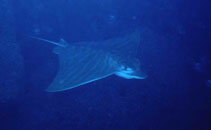
Long, flat, rounded snout like a duck's bill; head thick and pectoral disc with sharply curved, angular corners; upper or lower jaw; usually with 7 rows of flat teeth (Ref. 5578). Light brown with several pale blue-grey stripes (may be absent) dorsally, white ventrally (Ref. 5578).
Body shape (shape guide): other.
Found in coastal tropical and warm temperate waters, occasionally offshore. Sometimes found in small groups (Ref. 5578). Feed on bottom-living crustaceans and mollusks. Ovoviviparous (Ref. 50449), aplacental (Ref. 57025). Prized angling fish, often released (Ref. 5578). Flesh highly esteemed (Ref. 3965).
Exhibit ovoviparity (aplacental viviparity), with embryos feeding initially on yolk, then receiving additional nourishment from the mother by indirect absorption of uterine fluid enriched with mucus, fat or protein through specialised structures (Ref. 50449). Gestation about 6 months; 3-7 young produced (Ref. 5578). Size at birth 45 cm WD (Ref. 6677).
White, W.T., 2014. A revised generic arrangement for the eagle ray family Myliobatidae, with definitions for the valid genera. Zootaxa 3860(2):149-166. (Ref. 97392)
IUCN Red List Status (Ref. 130435: Version 2025-1)
Threat to humans
Harmless
Human uses
Pesquerías: comercial; pesca deportiva: si
Herramientas
Special reports
Download XML
Fuentes de Internet
Estimates based on models
Preferred temperature (Referencia
123201): 13.7 - 24.5, mean 17.2 °C (based on 196 cells).
Phylogenetic diversity index (Referencia
82804): PD
50 = 0.5039 [Uniqueness, from 0.5 = low to 2.0 = high].
Bayesian length-weight: a=0.00389 (0.00119 - 0.01269), b=3.08 (2.83 - 3.33), in cm total length, based on LWR estimates for this (Sub)family-body shape (Ref.
93245).
Nivel trófico (Referencia
69278): 3.8 ±0.57 se; based on food items.
Resiliencia (Referencia
120179): Muy bajo, población duplicada en un tiempo mínimo superior a 14 años (Fec=3).
Fishing Vulnerability (Ref.
59153): Very high vulnerability (83 of 100).
🛈
Nutrients (Ref.
124155): Calcium = 6.08 [0.77, 110.95] mg/100g; Iron = 0.496 [0.044, 5.834] mg/100g; Protein = 20.6 [15.3, 25.8] %; Omega3 = 0.146 [0.059, 0.340] g/100g; Selenium = 32.5 [6.1, 179.7] μg/100g; VitaminA = 3.64 [0.33, 39.75] μg/100g; Zinc = 0.455 [0.027, 5.132] mg/100g (wet weight); based on
nutrient studies.