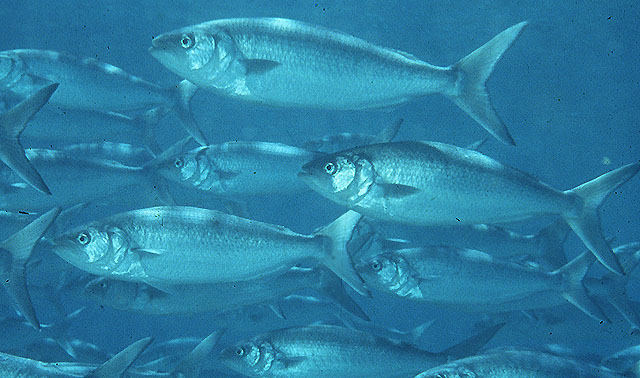
| Arripidae (Australian salmon) |
| 89 cm TL (male/unsexed); max.weight: 9,400.0 g; max. reported age: 26 years |
|
pelagic-neritic; brackish; marine; depth range 30 - 39 m, anadromous |
| Southwest Pacific: southern Australia (including Tasmania, Lord Howe Island and Norfolk Island), usually Brisbane to Western Victoria, rarely to Western Australia; and New Zealand (including Chatham and Kermadec Islands). |
|
Dorsal spines (total): 9-9; Dorsal soft rays (total): 15-17; Anal spines: 3-3; Anal soft rays: 9-10; Vertebrae: 25-25. Adults are dark blue-green above and silvery below, with irregularly defined spots arranged laterally in indistinct rows (Ref. 33616). Length of upper lobe of caudal fin < 29.9% SL, more or less equal to, or less than, the length fo the head (Ref. 9701). |
| Inhabit continental shelf waters including estuaries, bays and inlets (Ref. 6390). Found between depths of 30 m (Ref. 33616) and 39 m (Ref. 58489). They enter rivers (Ref. 9002). Juveniles form school in shallow coastal bays and estuaries; adults move in large schools along shores (Ref. 9002), and can move over reefs in depths just sufficient to cover their bodies (Ref. 6390). They form large surface aggregations in deep water (Ref. 6390). Feed mainly on fishes but also on pelagic crustaceans, especially krill (Nyctiphanes australis). Take also food from the seabed. Fish smaller than 10 cm feed predominantly on copepods (Ref. 9072). Utilized fresh, canned and frozen; can be steamed, fried, broiled, boiled, microwaved and baked (Ref. 9988). |
|
Not Evaluated (N.E.) Ref. (130435)
|
| harmless |
|
Eastern Australian salmon inhabit waters off the eastern and southern coasts of Australia from Brisbane to Tasmania and through Bass Strait to Cape Otway in Victoria. Occasionally, individuals are found as far west as Western Australia (Ref. 27960, 2657, 27961, 27296).
Stock structure: Australian salmon were originally considered to be 1 species, Arripis trutta. However, studies in the early 1980s revealed genetic evidence of reproductive isolation between eastern and western populations (Ref. 27969). Genetic studies have indicated that eastern Australian salmon in New Zealand waters form a further discrete breeding population, although they are not sufficiently different for them to be considered more than a subspecies of A. trutta (Ref. 27969). The stock structure of the eastern Australian salmon populations at Lord Howe, Norfolk and the Kermadec islands (north of New Zealand) require further investigation.
Commercial fishery: Eastern Australian salmon are caught in the waters off southern New South Wales, central and eastern Victoria, east of Port Sorrell on the north and the east coasts of Tasmania, and Bass Strait islands.
Eastern Australian salmon are harvested primarily by beach seining or bottom set gillnetting. Large fish are also taken on trolling gear and there is some beach seining and gillnetting of juveniles.
The major fisheries are in or near spawning areas, and they target fish undergoing pre-spawning or post-spawning migrations. These fisheries are seasonal: January to April in New South Wales. Catches of juvenile Australian salmon are made throughout the year in Victoria and Tasmania.
Aircraft and land-based spotters are, or have been, used to locate schools of Australian salmon. Beach seine fishers rely on cliff-top spotters to locate schools of fish. Australian salmon are sold as whole, fresh fish, or canned for human consumption or pet food, or used for rock lobster (Jasus species) bait. The highest demand for Australian salmon is for use as rock lobster bait. Prices for Australian salmon vary Australia wide depending on the end use. Fish for local fresh fish markets fetched the highest prices.
Recreational fishery: Eastern Australian salmon are taken by recreational anglers throughout its range. They are especially popular with beach and rock anglers (Ref. 27996) and smaller fish are sometimes netted. In Victoria, Australian salmon are targeted by shoreline fishers and by boat-based trolling. The most common method is the use of pilchard bait on linked hooks although metal casting lures are also used.
Resource status: As of 1993, the Australian salmon fishery in New South Wales was believed to be fully exploited.
Also Ref. 2156, 9563, 9988. |
Source and more info: www.fishbase.org. For personal, classroom, and other internal use only. Not for publication.