
|
Verilus atlanticus (Mochizuki & Sano, 1984) |
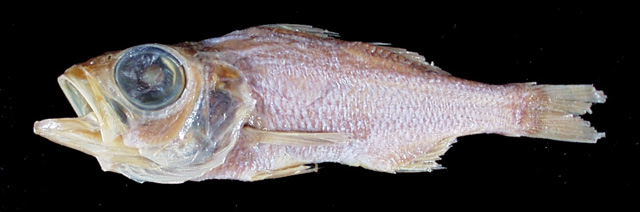
|
|
photo by
Yamanoue, Y. |
| Family: | Malakichthyidae (Temperate ocean-basses) | |||
| Max. size: | 24.5 cm TL (male/unsexed); max.weight: 181.4 g | |||
| Environment: | pelagic-oceanic; marine; depth range 180 - 300 m | |||
| Distribution: | Western Atlantic: Caribbean Sea and Straits of Florida, | |||
| Diagnosis: | Dorsal spines (total): 10-10; Dorsal soft rays (total): 10-10; Anal spines: 3-3; Anal soft rays: 7-7. This species is distinguished from its congeners by the following set of characters: lower jaw with only villiform teeth posterior to a canine tooth near symphysis; absence of basioccipital fossa; proximal-middle radial of first anal-fin pterygiophore with angular concavity on anterior surface; pectoral-fin rays 16 (rarely 15); first gill arch with gill rakers on lower arm 14-18; lateral-line scales 45-49; scales cycloid and very weakly ctenoid (Ref. 123567). | |||
| Biology: | ||||
| IUCN Red List Status: | Not Evaluated (N.E.) Ref. (130435) | |||
| Threat to humans: | harmless | |||