
|
Trimma irinae Winterbottom, 2014 Irina's pygmygoby |
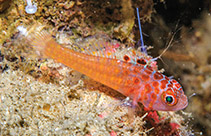
|
|
photo by
Erdmann, M.V. |
| Family: | Gobiidae (Gobies), subfamily: Gobiinae | |||
| Max. size: | 1.97 cm SL (female) | |||
| Environment: | reef-associated; marine; depth range 50 - 65 m | |||
| Distribution: | Western Pacific: Papua New Guinea. | |||
| Diagnosis: | Dorsal spines (total): 7-7; Dorsal soft rays (total): 9-9; Anal spines: 1-1; Anal soft rays: 8-8. This species is distinguished by the following characters: predorsal midline with 8-9 scales; usually cycloid scales along the upper border of the opercle in up to 3 horizontal rows; without cheek scales; second dorsal spine very elongated, reaching posteriorly to the end of the second dorsal fin or beyond this (in specimens >18 mm SL); pectoral fin with branched middle rays; fifth pelvic fin ray branches once dichotomously and is 52-64% the length of the fourth ray; basal membrane connecting the inner margins of the fifth pelvic fins rays is less than 15% the length of the fifth ray (Ref. 95906). | |||
| Biology: | Most Trimma species are found between 10-30 m, with relatively few occurring in depths shallower than this. In this case of Trimma irinae, this species occur at depths below about 50 m (Ref. 95906). | |||
| IUCN Red List Status: | Data deficient (DD); Date assessed: 07 September 2021 Ref. (130435) | |||
| Threat to humans: | harmless | |||