
|
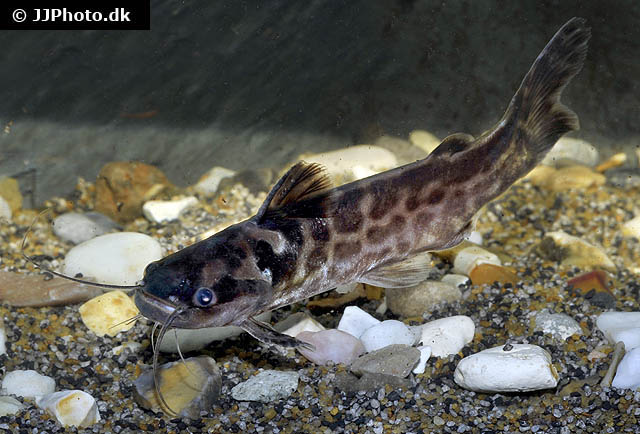
Tatia dunni (Fowler, 1945) |
|
|
photo by
JJPhoto |
| Family: | Auchenipteridae (Driftwood catfishes), subfamily: Centromochlinae | |||
| Max. size: | 12 cm SL (male/unsexed) | |||
| Environment: | demersal; freshwater | |||
| Distribution: | South America: Upper Amazon in Ecuador and Colombia; central Amazon in Brazil; Caquetá River drainage in Colombia. | |||
| Diagnosis: | Dorsal spines (total): 1-1; Dorsal soft rays (total): 4-5; Anal soft rays: 9-10; Vertebrae: 35-35. Can be diagnosed by the unique combination of characters: nasal ossified with narrow medial flanges partially sutured to lateral margin of mesethmoid; anal fin rays iii, 6-7; modified anal fin with short tip in mature males; first unbranched anal-fin ray with segments fused, last branched ray normally developed, not reduced; ribs 10; and vertebrae 35. Differs further by the following coloration details: contour of mouth dark, same color as head; posterior border of nuchal shield usually dark; pectoral-fin spine usually dark brown; body with irregular blotches or stripes; presence of faint stripes or blotches in large specimens ; and caudal fin dark with whitish blotches. Distinguished from Tatia intermedia by having preanal length 70.0-75.0% SL, vs. 65.0-69.4% SL and interorbital distance 54.1-59.4% HL, vs. 60.1-63.6 HL (Ref. 79512). Description: A iii,6-7; V i5. Post-Weberian vertebrae (Ref. 79512). | |||
| Biology: | ||||
| IUCN Red List Status: | Least Concern (LC); Date assessed: 19 August 2020 Ref. (130435) | |||
| Threat to humans: | harmless | |||