
|
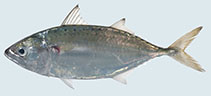
Rastrelliger brachysoma (Bleeker, 1851) Short mackerel |
|
|
photo by
Williams, J.T. |
| Family: | Scombridae (Mackerels, tunas, bonitos), subfamily: Scombrinae | |||
| Max. size: | 34.5 cm FL (male/unsexed); max. reported age: 2 years | |||
| Environment: | pelagic-neritic; brackish; marine; depth range 15 - 200 m, oceanodromous | |||
| Distribution: | Pacific Ocean: Andaman Sea to Thailand, Indonesia, Papua New Guinea, Philippines, Solomon Islands and Fiji. | |||
| Diagnosis: | Dorsal spines (total): 8-11; Dorsal soft rays (total): 12-12; Anal spines: 0-0; Anal soft rays: 12-12; Vertebrae: 31-31. This species is distinguished by the following characters: body very deep, its depth at posterior margin of opercle 3.7-4.3 times in fork length; head equal to or less than body depth; maxilla covered by lacrimal bone but extending nearly to end of lacrimal; gill rakers very long, visible when mouth is opened, 30-48 on lower limb of first gill arch; numerous bristles on longest gill raker, about 150 on one side in specimens of 12.7 cm, 210 in specimens of 16 cm, and 240 at 19 cm fork length; intestine very long, 3.2-3.6 times fork length; snout pointed; swim bladder present; vertebrae 13 + 18 = 31; interpelvic process small and single; anal spine rudimentary. Colour of spinous dorsal fin yellowish with a black edge, pectoral and pelvic fins dusky, other fins yellowish (Ref. 168, 9684). | |||
| Biology: | An epipelagic, neritic species that tolerates slightly reduced salinities in estuarine habitats and in areas where surface temperature range between 20° and 30°C. It forms schools of equally sized individuals. Batch spawning is believed to extend from March through September. Feeds chiefly on microzooplankton with a high phytoplankton component. Marketed fresh, frozen, canned, dried salted and smoked (Ref. 168, 9684). | |||
| IUCN Red List Status: | Vulnerable (VU); Date assessed: 01 March 2022 (A2bd) Ref. (130435) | |||
| Threat to humans: | harmless | |||